Interactions Correctly?


Single Customer View Myths Debunked – Here’s Why It’s Still the Gold Standard


10 Key Use Cases of Customer Data Platform
How well do you really know your customers?
For most businesses, the answer is: not well enough. In fact, 72% of organizations admit they struggle to create a complete picture of their customers because their data is scattered across multiple platforms.
Only 1 in 5 businesses can confidently say they truly understand their customers.
Why? Because most companies lack a Single Customer View (SCV)—a unified, 360-degree customer profile that connects every interaction across web, mobile, in-store, and support channels.
In today’s data-driven marketing landscape, some believe that SCV is outdated or no longer effective.
But that couldn’t be further from the truth.
A Single Customer View remains the gold standard for brands aiming to deliver hyper-personalized experiences, build long-term loyalty, and make smarter, data-driven business decisions.
At first glance, an SCV might seem like just another customer database.
But it’s far more powerful.
It’s the engine behind true customer understanding, enabling businesses to unify fragmented data, predict intent, and create meaningful interactions that resonate deeply with customers.
What Is a Single Customer View (SCV)?
A Single Customer View (SCV) is a unified summary of all the data you have about a customer or prospect. Often referred to as a 360-degree view or unified customer view (UCV), it combines data from multiple channels such as website visits, mobile app activity, purchases, and support interactions into a single, comprehensive profile.
An SCV brings together fragmented customer data from different sources to create one complete, continuously updated profile.
With this, businesses gain full visibility into the customer journey. Instead of managing scattered touchpoints, you get a connected timeline of interactions that enables you to:
- Improve decision-making with accurate, real-time insights
- Personalize communication based on customer behavior and preferences
- Deliver seamless customer experiences across every channel
In short, an SCV transforms disconnected data into actionable intelligence, helping businesses truly understand their customers.
Why Most Companies Fail to See the Potential of Single Customer View?
Companies track clicks, purchases, and engagement rates.
But does that mean they truly understand their customers?
Not exactly.
Many businesses focus on surface-level metrics like clicks or page views, which only tell part of the story.

The Single Customer View digs deeper, providing a unified perspective of each customer’s journey across all touchpoints.
They fail to uncover the motivations behind customer actions.
They optimize for short-term gains.
Without building a deep, long-term relationship with their audience.
For example, a company might notice that customers abandon their shopping carts at a high rate.
The immediate response?
Offer a discount.
But without understanding why customers are abandoning their carts—confusing checkout processes, unexpected shipping fees, or security concerns—the problem remains unsolved.
And that’s the challenge.
Companies collect data. Lots of it.
But without context, that data is just noise.
Top Platforms to Build a Single Customer View (SCV)
Building a single customer view isn’t just about strategy; it’s about choosing the right technology. From identity resolution to real-time activation, the right platform acts as the foundation for unified customer insights.
Here are five leading SCV platforms to consider:
1. Segment
Segment is a widely adopted customer data infrastructure platform that simplifies data collection and routing across multiple sources—apps, websites, servers, and more. It supports identity resolution, making it easier to build a consistent and accurate single customer view.
| Pros | Cons |
|---|---|
| 300+ tool integrations | Can get expensive at scale |
| Strong support for real-time data | Requires additional tools for analytics |
| Developer-friendly and highly customizable | Initial setup can be complex |
2. Tealium AudienceStream
Tealium’s CDP specializes in identity stitching, real-time segmentation, and event-based personalization. It's ideal for companies looking to enrich their SCV marketing with compliance-ready capabilities.
| Pros | Cons |
|---|---|
| Advanced identity stitching | May require technical expertise |
| Strong privacy and consent tools | Implementation complexity for non-tech teams |
| Real-time customer profile updates | Higher learning curve for beginners |
3. Adobe Real-Time CDP
Adobe’s Real-Time CDP connects data across known and anonymous identities to form unified, AI-enriched customer profiles. It enables real-time decision-making and seamless personalization across digital channels.
| Pros | Cons |
|---|---|
| Offers a 360-degree customer view | Cost-prohibitive for small businesses |
| AI-driven personalization & activation | High onboarding complexity |
| Real-time profile enrichment | Requires alignment with Adobe ecosystem |
4. Salesforce Data Cloud (CDP)
Salesforce’s Data Cloud consolidates data from Sales, Marketing, and Service Clouds to build a single customer view across the entire Salesforce stack. It’s suited for brands already in the Salesforce ecosystem.
| Pros | Cons |
|---|---|
| Strong B2B and B2C flexibility | Limited integration outside Salesforce |
| Real-time data unification | Customization requires deep Salesforce knowledge |
| Seamless automation and segmentation | High dependency on full Salesforce stack |
5. mParticle
mParticle is a mobile-first SCV platform built for fast-moving, privacy-conscious brands. It unifies first-party data and ensures real-time data delivery across tools and teams.
| Pros | Cons |
|---|---|
| Mobile and app-friendly data unification | Less focus on advanced analytics |
| Robust consent management features | Can require developer involvement |
| Fast integration with 300+ tools | Limited reporting without add-ons |
Real-World SCV Use Cases in Marketing
Modern marketers aren’t starving for data—they’re overwhelmed by it.
Every customer swipe, scroll, and session is logged somewhere. But when that data sits in silos, you get fragments, not insights. That’s where the Single Customer View (SCV) comes in—connecting the dots, so brands can serve up marketing that actually matters.
Here’s how brands are turning SCV into a competitive advantage—not in theory, but in practice:
1. Nike — VIP Sneaker Drops Fueled by Data, Not Hype
Nike’s audience is massive. But they don’t talk to everyone the same way.
Using SCV, Nike identifies its most loyal sneakerheads—people who obsess over launches, engage with the app frequently, and have a track record of early purchases. These high-intent users don’t just get another campaign email. They get priority access, sneak peeks, and first dibs on limited releases.
What feels like VIP treatment is actually the result of unified customer intelligence.
The result: more conversions, less drop-day chaos, and a brand experience that feels personal, not mass-produced.
2. IKEA — Cart Recovery That Understands Context
We’ve all abandoned a cart. IKEA doesn’t treat that as the end of the journey.
Thanks to SCV, they know where you browsed, what you added, and even which store you’ve visited. So instead of a bland “Did you forget something?” email, you’ll get a reminder tailored to your location, with inventory status, and maybe even assembly options—all relevant to how you previously engaged.
Why it works: the follow-up feels helpful, not pushy. Like a salesperson who remembers your last visit and your taste in furniture.
3. ASOS — Style-Savvy Promotions with Substance
ASOS doesn’t just guess what their users want—they know.
By tracking behavior across web and app, they build real-time SCVs that reflect not just past purchases, but browsing patterns, time of day, preferred categories, and even device types. If someone keeps scrolling through men’s streetwear but never checks out, ASOS knows when to nudge and what to nudge with.
The outcome: personalized offers that align with actual interest. Not noise, not guesswork—just well-timed relevance.
4. Citi — Smarter Cross-Selling, Driven by Customer Intent
Financial services are rarely “one size fits all.” Citi uses SCV to make sure they don’t treat them that way.
They merge card usage data, mobile banking behavior, service call logs, and even financial content engagement into a unified profile. That lets them pinpoint where a customer is in their financial journey—whether they’re saving, spending, or investing.
So instead of pushing generic offers, Citi can suggest a travel loan to a jet-setting cardholder or a mutual fund to someone browsing retirement content.
That’s SCV in action: from blanket promotions to informed, meaningful cross-sells.
5. Decathlon — From Browsing to In-Store Buying
Decathlon’s not just an eCommerce brand; they bridge digital and physical seamlessly.
When a customer browses hiking gear online and later walks past a Decathlon outlet, their SCV powers a location-aware push notification:
“Outdoor Weekend Sale — happening now at your nearest store!”
That’s not a coincidence. It’s the product of real-time SCV enriched with geo-data.
Result: a quick scroll becomes a store visit. And a browse becomes a buy.
Why These Use Cases Matter
These brands aren’t chasing data for the sake of it. They’re using SCV to:
- Personalize at scale—without losing the human touch
- Align sales, marketing, and support around the same customer truth
- Replace spray-and-pray tactics with precision and empathy
- Build trust and loyalty—not just transactions
Because when your teams see the whole customer picture, your customers start to feel seen.
And that’s when marketing stops being marketing and starts being remembered.
AI-Powered SCV: The Next Step in Customer Understanding
A Single Customer View (SCV) has always been about knowing your customers better. But today, that’s no longer enough. Businesses need to predict customer intent and act on it instantly—and that’s where AI-powered SCVs step in.
By combining AI and machine learning with SCV, businesses can turn unified customer data into real-time intelligence:
- Predict intent — identify when a customer is about to buy, churn, or engage.
- Deliver hyper-personalization — trigger the right offers at the right moment.
- Discover growth patterns — uncover micro-segments and hidden opportunities.
- Enable smarter decisions — equip marketing, sales, and support with predictive insights.
This isn’t about replacing SCV’s foundation—it’s about elevating it. SCV evolves from being a static data repository into an intelligence engine that keeps brands one step ahead of customer expectations.
Privacy-First Personalization: SCV’s Role in 2025
Customers today demand personalization but are also increasingly concerned about how their data is used. With regulations like GDPR, CCPA, and stricter APAC privacy laws reshaping marketing, brands can no longer depend on third-party tracking or opaque targeting.
This is where SCV becomes indispensable. By consolidating first-party, consented data into a secure, unified profile, businesses can:
- Deliver personalized experiences without breaching privacy boundaries.
- Manage customer consent preferences seamlessly across channels.
- Build trust through transparent, responsible data practices.
- Stay compliant while still offering relevant, meaningful interactions.
In a privacy-first marketing era, SCV bridges the gap between data protection and personalization, helping brands remain credible, competitive, and customer-focused.
The Disconnect Between Data Collection and Real Customer Understanding
Why data silos are the biggest barrier to a unified customer view
Most companies already have the data they need to understand their customers.
The problem?
That data is scattered across different teams, tools, and systems.

Marketing tracks website visits and email engagement.
Sales logs calls and deal progress in a CRM.
Customer support records complaints and issue resolutions.
But these data sources rarely “talk” to each other.
For example, a customer might browse a product online, engage with an ad, and later call support with a question.
Without a unified system, the marketing team sees ad engagement.
Sales sees a potential lead. Support sees a routine inquiry.
No one sees the full picture of that customer’s journey.
That’s why data silos are such a massive obstacle.
They prevent businesses from getting a single, comprehensive view of their customers—leading to inconsistent messaging, missed opportunities, and a disconnected customer experience.
Why Data Silos Are the Biggest Barrier to a Unified Customer View
How a Single Customer View solves fragmentation and improves decision-making
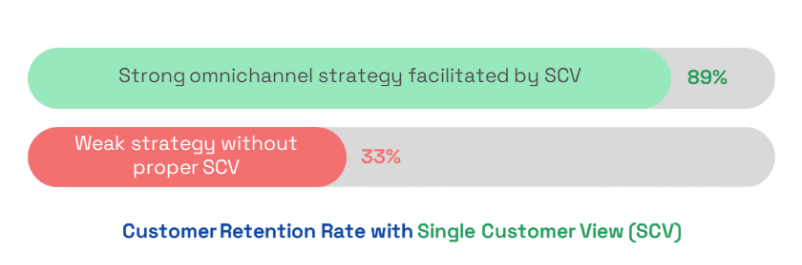
A Single Customer View (SCV) brings everything together.
Instead of fragmented data spread across different systems, an SCV consolidates customer interactions into one unified profile.
This means marketing, sales, and support teams all see the same up-to-date information.
For example, if a customer engages with a marketing email, visits the website, and later contacts support, all those interactions are linked to a single profile.
No more guessing. No more disjointed customer experiences.
With an SCV, businesses can:
- Personalize marketing based on real customer behaviour
- Equip sales teams with deeper insights into potential buyers
- Provide customer support with full context to resolve issues faster
And most importantly, an SCV helps companies move beyond surface-level metrics to truly understand what drives their customers.
Breaking Down the Myths About Single Customer View
It’s Not Just a Customer Database
The Single Customer View (SCV) is more important than ever. But many businesses misunderstand it.
Some think SCV is just another customer database. Others see it as a simple data integration tool.
But SCV is more than that. It unifies scattered data. It creates a real-time, complete picture of each customer.
These misconceptions hold companies back. They stop businesses from using SCV to its full potential.
Comparison Table: SCV vs CRM vs CDP vs DMP
| Feature / System | SCV (Single Customer View) | CRM (Customer Relationship Management) | CDP (Customer Data Platform) | DMP (Data Management Platform) |
|---|---|---|---|---|
| Purpose | Unified customer profile across all channels | Manage customer interactions (mostly sales/service) | Consolidate and activate first-party data for marketing | Aggregate anonymous data for ad targeting |
| Data Types | First-party, behavioral, transactional, service | First-party (mainly contact and interaction data) | First-party, behavioral, transactional | Third-party and anonymous audience data |
| Identity Resolution | High (links known and unknown users) | Medium (based on user-provided contact info) | High (uses identity stitching) | Low (cookie-based, no persistent identity) |
| Real-Time Updates | Yes (with right tech stack) | Often delayed/manual | Yes | No |
| Use Cases | Personalization, lifecycle marketing, support | Sales tracking, customer service | Targeted campaigns, audience segmentation | Retargeting, lookalike modeling |
| Department Usage | Cross-functional: marketing, sales, support, product | Mostly sales and support | Primarily marketing | Media buying and advertising teams |
| Data Ownership | Centralized within the business | Internal (owned by sales/service teams) | Internal (marketing-focused) | Often external (data broker-controlled) |
| Privacy Compliance | High (built on consented, owned data) | High | High | Often lower (cookie-based, restricted by regulations) |
How a Single Customer View Differs from a CDP, CRM, and DMP
Many companies mistake a Single Customer View (SCV) for other data tools. They confuse it with CRMs, DMPs, and CDPs.
But these systems do different things.
- CRMs manage customer interactions like sales and support. But they miss marketing and online behaviour.
- DMPs handle anonymous audience data for ads. They don’t build detailed customer profiles.
- CDPs unify data from multiple channels. But they may not give a real-time, single view across all business functions.
An SCV does what these systems don’t. It pulls everything together into one updated profile. Every team—marketing, sales, and support—gets a complete, actionable customer view.
Why Technology Alone Won’t Give You a Complete Customer View
Technology is important for building a Single Customer View (SCV).
But it’s not a magic fix.
Many companies invest in advanced platforms.
They assume software alone will give them a full picture of their customers.
But technology is only as good as the strategy behind it.
A strong SCV needs more than data integration.
It requires teamwork across departments, solid data governance, and a customer-first approach.
Without clear data management and team alignment, even the best tools can create fragmented or misleading insights.
The Data Puzzle – What You Need for a True Single Customer View
Building a Single Customer View (SCV) is like solving a complex puzzle.
Businesses gather data from many touchpoints.
But without the right approach, it stays fragmented.
To create a unified profile, companies need to integrate key data sources.
They must accurately identify customers across channels. And they must ensure privacy compliance.
The Essential Data Sources Every Business Needs to Connect
A Single Customer View (SCV) depends on multiple data sources.
Each source offers unique insights into customer behaviour.
Without connecting them, businesses make decisions based on an incomplete picture.
Key data sources include:
- Transactional data from purchases, invoices, and order history, which reveal buying patterns and preferences.
- Behavioral data from websites, mobile apps, and social media interactions, which show how customers engage with digital content.
- Customer service interactions from call centers, chatbots, and support tickets, which highlight common issues and satisfaction levels.
- Marketing engagement data from email campaigns, advertisements, and loyalty programs, which track how customers respond to promotional efforts.
Combining these data points turns scattered insights into a complete customer view.
But connecting data sources isn’t enough.
The real challenge is identifying and linking customer identities across different channels.
Why Identity Resolution Is the Missing Piece in Customer Tracking
Collecting data from multiple sources isn’t enough.
To build a true Single Customer View (SCV), businesses must link data to the right individuals.

Customers use different devices, emails, and shop both online and in-store.
Without a way to connect these interactions, businesses get duplicate or fragmented records.
Identity resolution solves this with email matching, device tracking, and first-party data integration.
It ensures every data point belongs to the same person.
This reduces redundancy and provides a clearer view of customer behaviour.
But merging online and offline identities must be done carefully. It needs to respect privacy and follow data protection rules.
The Right Tech and Strategies for a Single Customer View That Actually Works
Building a Single Customer View (SCV) takes more than just technology.
Many businesses struggle because their systems don’t communicate. Others invest in advanced tools without a clear plan.
To make SCV work, companies need platforms that unify data. They need AI-driven insights to understand customer behavior.
And they need a clear strategy for choosing the right tools.
The first step? Understanding the key platforms that bring customer data together.
The Tools and Platforms That Help Bring Customer Data Together
Creating a Single Customer View (SCV) requires technology that integrates data from different sources.
Several platforms help with this:
- Customer Data Platforms (CDPs): They centralize customer data from multiple touchpoints. This creates a persistent, unified profile for all teams.
- Customer Relationship Management (CRM) systems: They store customer interactions, purchase history, and support records. This helps track relationships over time.
- Data Management Platforms (DMPs): They collect and organize third-party data. Businesses use them mainly for advertising and audience segmentation.
- Data Lakes and Warehouses: They store large amounts of structured and unstructured data. This supports advanced analytics and reporting.
Success isn’t about using these tools individually. They need to work together.
But technology alone isn’t enough.
Businesses also need smart insights to turn raw data into real customer understanding.
Why AI and Machine Learning Are Game Changers for Customer Insights
Collecting and unifying customer data is just the first step.
Making sense of that data is just as important.
This is where AI and machine learning change the game.
AI-powered analytics uncover patterns humans might miss.
Machine learning predicts future actions, recommends content, and spots at-risk customers before they leave.
Some key ways AI improves the Single Customer View (SCV):
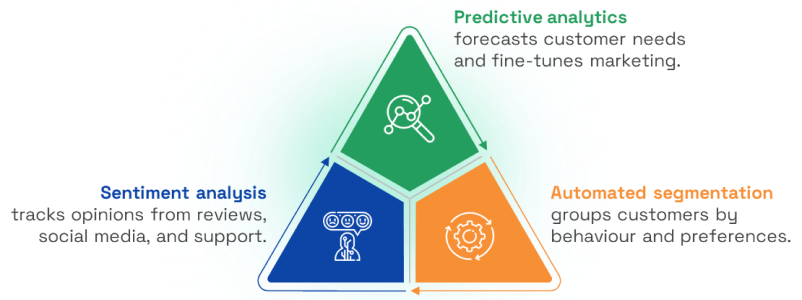
With AI, businesses move beyond static data. They get real-time, actionable insights.
But choosing the right AI solution takes careful planning.
It must fit business needs and capabilities.
What to Look for When Choosing a Solution for Your Business
Choosing the right technology for a Single Customer View (SCV) depends on many factors.
Business size, existing systems, and data strategy all play a role.
The wrong choice wastes resources and delivers poor insights.
Key factors to consider:
- Integration Capabilities – The platform must connect with CRM, CDP, analytics, and marketing tools.
- Real-time Data Processing – Customer profiles should update continuously for accurate decisions.
- Scalability – The system must handle growing data without slowing down.
- Privacy and Compliance – GDPR, CCPA, and consent management should be built-in.
- AI and Analytics – The platform should provide insights, not just store data.
Evaluating these factors helps businesses choose a solution that centralizes data, improves decisions, and enhances customer experiences.
Turning a Single Customer View Into a Competitive Advantage
A Single Customer View (SCV) is more than just a data tool.
It’s a powerful driver of business growth.
Companies that unify customer data understand their audience better. This helps them personalize experiences, boost retention, and optimize marketing.
But having an SCV isn’t enough.
Businesses must use the data strategically to make an impact.
The first step?
Leveraging unified data to personalize interactions and drive growth.
How Businesses Use Unified Data to Personalize and Drive Growth
Businesses that use a Single Customer View (SCV) effectively create highly personalized experiences.

This boosts engagement and drives revenue.
By understanding preferences, behaviors, and past interactions, companies can tailor marketing, sales, and support.
Key ways businesses use unified data:
- Personalized Marketing: Deliver relevant content, product recommendations, and offers.
- Dynamic Pricing and Promotions: Adjust based on behavior, loyalty, and purchase history.
- Proactive Customer Support: Anticipate issues and provide solutions before customers ask.
- Omnichannel Consistency: Ensure seamless experiences across digital and physical touchpoints.
Using data to enhance experiences increases conversions and improves retention.
But to measure success, businesses must track the right performance metrics.
The Key Metrics to Measure the Impact of Your Customer Data Strategy
To measure the impact of a Single Customer View (SCV), businesses need to track key performance metrics.
These metrics show how SCV affects engagement, retention, and revenue.
Key indicators to monitor:
- Customer Lifetime Value (CLV) — the total revenue a customer brings over time. SCV helps boost CLV by enabling personalized engagement.
- Retention and Churn Rates — tracks loyal customers versus those who leave. A unified view helps identify at-risk customers and reduce churn.
- Marketing ROI — measures campaign effectiveness by analyzing conversions, engagement, and revenue from personalized marketing.
- Customer Satisfaction (CSAT) & Net Promoter Score (NPS) — reflects how well businesses meet customer needs and drive loyalty.
Tracking these metrics helps businesses refine their data strategy.
The most successful brands go further. They use insights in unique and innovative ways.
What Top-Performing Brands Do Differently With Their Customer Insights
Top brands don’t just collect customer data.
They use it to gain a competitive edge.
They move beyond basic personalization. They leverage real-time insights to create seamless, predictive, and relevant experiences.
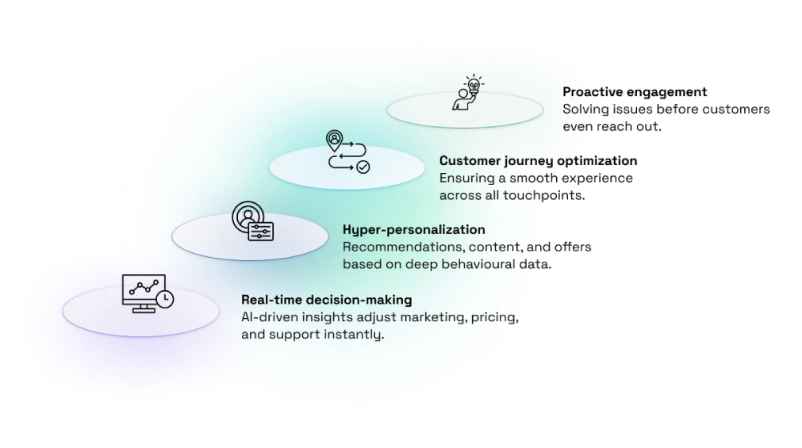
By treating customer insights as a strategic asset, top brands build loyalty, increase revenue, and stay ahead of the competition.
Suggested FAQs
1. What is a Single Customer View (SCV)?
A Single Customer View (SCV) is a unified profile of all the data your business collects about a customer—from website visits to purchases and support interactions—consolidated in one place. It helps teams personalize experiences, reduce redundancy, and make informed decisions based on complete customer insight.
2. How do I build a single customer view?
To build a Single Customer View:
- Integrate data sources (CRM, web analytics, support tickets, etc.).
- Use identity resolution to unify profiles.
- Clean and standardize your data.
- Store the unified data in a centralized platform like a CDP.
- Ensure real-time updates and access across departments.
3. Is SCV different from a CDP (Customer Data Platform)?
Yes. A CDP is a technology that helps create and manage SCVs. An SCV is the output—the unified profile. CDPs are the tools that ingest, unify, and activate data across channels to create those views.
4. Why is a single customer view important for marketing?
SCVs help marketers:
- Personalize messages based on real-time behavior.
- Run targeted campaigns using accurate customer profiles.
- Avoid fragmented messaging caused by data silos.
- Improve ROI by focusing on what each customer actually needs.
5. Which platforms help build a single customer view?
Tools like Segment, Adobe Real-Time CDP, Salesforce Data Cloud, Tealium, and mParticle offer built-in features to collect, unify, and activate data for SCVs.
6. How does Xerago help implement a Single Customer View (SCV)?
Xerago helps brands unify fragmented customer data across channels—from email, website, CRM, and service desks—into one actionable profile. Using a blend of MarTech tools, data strategy, and implementation expertise, Xerago creates SCV ecosystems that improve personalization, campaign efficiency, and customer lifecycle visibility.
7. Is SCV part of Xerago’s Campaign Management services?
Yes. SCV is a foundational element in Xerago’s Campaign Management offering. A unified customer view ensures that marketing campaigns are triggered based on real-time behavior and accurate data, enabling precise segmentation, relevant messaging, and measurable ROI across the customer journey.
8. Can Xerago integrate SCV with existing systems like CRMs or CDPs?
Absolutely. Xerago specializes in building SCV pipelines that work with your current tech stack—including CRMs like Salesforce, CDPs like Adobe Real-Time CDP or Segment, and other tools. This integration ensures seamless data flow, governance, and activation without needing to rip and replace existing infrastructure.
Vignesh Gunaseelan
Technical Content Writer
Xtelligence Inbox.
Your weekly dose of marketing smarts!
Related Posts