Interactions Correctly?


8 CDP Trends for 2026: AI, Hybrid Architecture and Real-Time Activation


Get the Free Checklist to Evaluate Your CDP Modernization
In 2026, the customer data platform conversation is moving beyond unified profiles toward AI-ready customer context, warehouse-connected architectures and measurable activation. The practical question is how to turn trusted customer data into timely, relevant experiences across your existing systems.
That’s why enterprises are investing heavily in Customer Data Platforms (CDPs). These platforms go beyond being simple data repositories — they act as intelligent engines that unify customer data, power hyper-personalized journeys, and enable real-time activation.
Adobe’s State of the CDP Report 2026 identifies real-time performance, interoperability with data warehouses and AI integration as the top three buying criteria in its research. The Adobe-sponsored study surveyed 150 CDP users between March 18 and April 8, 2026; its findings describe that sample, rather than the entire CDP market
This guide explains eight customer data platform trends for 2026, compares traditional, composable and hybrid approaches, and shows how to evaluate CDPs for real-time segmentation and AI-driven personalization.
Get the [ Free Checklist ] to Modernize Your CDP Effectively
1. AI-Powered and Agentic Customer Data Platforms
AI-powered Customer Data Platforms are revolutionizing how businesses manage and utilize customer information. These platforms go beyond basic data storage and unification by applying artificial intelligence to generate insights, predict customer behavior, and automate decision-making. They also provide the flexibility to integrate CDPs with marketing automation for more targeted campaigns.
Here’s a closer look at how they work and some tools leading the charge.
How AI-Powered CDP Platforms Work
An AI-enabled CDP combines customer profiles with models that support tasks such as propensity scoring, audience discovery and next-best-action decisions. Some tasks use historical data; others use streaming events. The required data freshness depends on the decision you need to make.
- Data Unification: Identity resolution uses configured matching rules and, in some products, machine learning to connect records. Validate match quality and false merges before using a unified profile for personalization.
- Predictive Analytics: The platform leverages historical data to forecast customer behavior, such as when they’re most likely to make a purchase or churn. This helps businesses take proactive steps to retain or convert customers.
- Dynamic Segmentation: Rules and predictive scores can work together to identify eligible audiences. Check how often scores and audience memberships refresh; AI features do not make every segment real time.
- Automation: Approved audiences and decisions can be passed to connected execution tools. Consent, suppression rules, frequency limits and human approval should control what reaches customers.
These functionalities allow businesses to move from reactive to proactive customer engagement, improving efficiency and driving better outcomes.
2026 Developments to Evaluate
Agentic CDPs extend AI beyond scoring into assistance with investigation, audience creation and marketing workflows. Treat this as an emerging product direction and validate access, controls and availability with each vendor.
- Hightouch: Its June 15, 2026 Agentic CDP announcement describes agents that investigate marketing opportunities using customer data and business context. Evaluate its proposed actions against your campaign rules before approving activation.
- Adobe Real-Time CDP: Adobe’s April 20, 2026 update describes Audience Agent enhancements and natural-language field discovery. Its expanded profile support for unstructured data is introduced first for Brand Concierge customers; the announcement describes broader channel availability as forthcoming.
- Salesforce Data 360: Its zero-copy connectivity supports access to external warehouse data. This can provide customer context for connected Salesforce applications, but connector scope, optional caching and implementation requirements still matter.
When evaluating AI-driven personalization, ask which data informs the model, how decisions are explained, where human approval is required and how incremental results will be measured.
Connect your CDP to the tools that act on it
Xerago designs integrations between CDPs, CRM, marketing automation and personalization platforms, with clear ownership of decisioning, consent and measurement.
2. Real-Time Segmentation and Data Activation
Real-time CDP activation is useful when the customer’s current behavior changes to the next action. A checkout event might suppress an abandoned-cart message, while an app interaction might update an audience for an in-session offer. Not every campaign needs the same response time.
Customers expect businesses to respond to their needs immediately, whether it’s through dynamic website content, personalized offers, or timely support. Customer Data Platforms are evolving to meet these demands, enabling brands to shift from passive data collection to active, on-the-spot engagement.
From Data Storage to Immediate Action
Traditional approaches to customer data focused heavily on collection and storage, with insights often applied long after the fact. Real-time activation flips this model on its head. CDPs now prioritize delivering actionable insights as customer behaviors unfold.
Here’s how it works:
- Event Processing: Collect and validate relevant web, app and transaction events. Track the delay between the original event and its availability for audience evaluation.
- Trigger-Based Actions: A qualifying event or audience change can trigger a connected journey or decision engine. Delivery depends on identity matching, consent checks, orchestration and the destination’s capabilities.
- Streaming and Batch Together: Use streaming or edge evaluation for time-sensitive experiences and scheduled processing for workloads such as daily reporting or planned campaigns.
Use Cases Powering Real-Time Engagement
Real-time CDPs open up a world of possibilities for marketers to deliver impactful experiences:
- Dynamic Website Personalization: Websites can adapt to individual users by highlighting relevant products, content, or promotions based on their browsing history or current behavior.
- Live Campaign Adjustments: Marketers can tweak ad campaigns on the fly based on how audiences respond, optimizing ROI as campaigns run.
- Customer Support Enhancements: Chatbots and support teams equipped with real-time insights can provide faster, more relevant responses, improving customer satisfaction.
Illustrative workflow: A returning shopper views a product, qualifies for an eligible audience and receives a relevant on-site experience. If the shopper purchases, a suppression rule should stop the corresponding recovery campaign. Measure the complete event-to-action delay, rather than only ingestion speed.
Example Tools for Real-Time Data Activation
Examples to shortlist for testing, not a ranked list of the best CDP platforms:
- Tealium AudienceStream: Its documentation describes unified profiles, custom audiences and real-time personalization, with vendor API connectors and webhooks for activation. Validate each destination’s delivery behavior.
- Adobe Real-Time CDP: Streaming segmentation evaluates eligible audiences in near real time as data arrives. Not every segment definition qualifies; the documented rules and implementation settings matter. Connect the audience to an appropriate execution tool for message delivery.
Real-time activation isn’t just about speed—it’s about creating meaningful, timely interactions that make customers feel seen and valued. Businesses that embrace this approach are better positioned to meet the expectations of today’s on-demand consumers.
3. CDP Integration with CRM, Personalization and Activation Tools
Every business today relies on a mix of tools to manage marketing campaigns, track sales, analyze customer behavior, and handle support. But when these tools don’t talk to each other, customer data becomes fragmented, workflows slow down, and opportunities to connect with customers are missed. That’s why seamless integrations between Customer Data Platforms (CDPs) and other systems are quickly becoming a top priority.
Think of a CDP as the brain of your customer engagement efforts. But a brain is only effective if it can send signals to the rest of the body. Without strong connections to your existing tools—like your email platform, CRM, or analytics dashboard—a CDP is just another data silo.
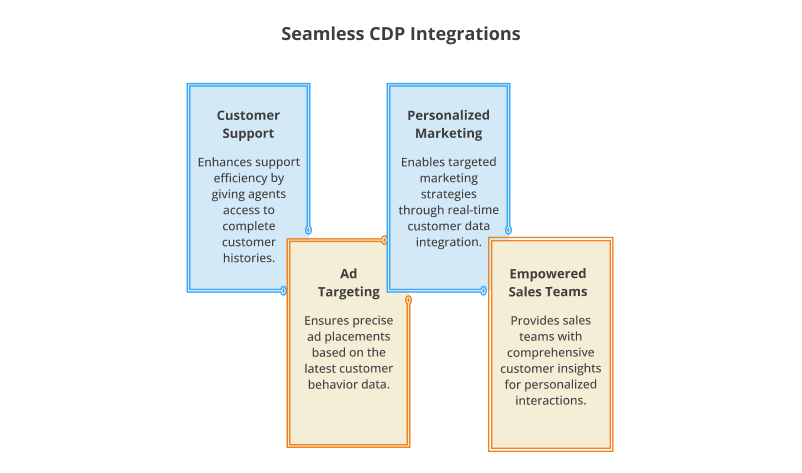
Integrations make it possible for your CDP to power every part of your business:
How Do Personalization Platforms Complement CDPs?
The CDP prepares customer profiles, audience membership and relevant signals. A personalization platform chooses and delivers the content, offer or experience. Connecting them creates a feedback loop: data informs the experience, and interaction results return for analysis. Define ownership of decisioning, consent, delivery and measurement before integrating the two.
- Personalized Marketing: A CDP can identify an eligible audience and share it with a marketing automation platform. The execution tool applies campaign logic, consent and timing rules before sending a message or displaying an offer.
- Sales Context: Share the relevant profile attributes and interaction history with a CRM. Define which fields sales teams can access and how often they refresh; avoid assuming every interaction is available immediately.
- Paid-Media Activation: Send permitted audience updates or suppression lists through supported connectors. Match rates, minimum audience sizes, platform processing and consent restrictions affect whether and when those updates become usable.
- Service Context: Make relevant purchase and support history available to service teams through approved integrations. Access controls and consistent identity matching help teams use the appropriate context.
4. First-Party Data, Consent and Governed Collaboration
First-party data remains important, but the case for a CDP should not rely on a blanket claim that third-party cookies are disappearing. In April 2025, Google said it would maintain Chrome’s existing approach to third-party cookie choice. Build your customer data strategy around permission, data quality and durable customer relationships. [7]
A CDP’s security and data location depend on its deployment model. Define collection permissions, allowed purposes, access controls, retention and deletion processes across the CDP and its destinations. A connector or reverse ETL pipeline does not automatically establish compliance.
A transparent approach should make data use understandable and give customers appropriate control:
- Clear Communication: Explain what data is collected, why it is needed and how it benefits the customer.
- Customer-Controlled Preferences: Allowing users to manage their preferences, opt-out options, and data-sharing settings easily.
- Ethical Practices: Using data responsibly to enhance experiences, not exploit them.
Governed data collaboration is also developing. Adobe announced Real-Time CDP Collaboration Starter as available in April 2026. Evaluate partner permissions, permitted purposes and measurement needs before sharing or activating audience data. Collaboration controls do not replace your own governance obligations. [2]
Businesses that adopt these practices build stronger, trust-based relationships that are more likely to result in customer loyalty. For enterprises, this means adopting platforms that not only enhance data security but also integrate with MarTech platforms for seamless marketing to avoid silos.
5. Industry-Specific Customer Data Models and Use Cases
Sector-specific CDP evaluation should start with the customer data model and activation requirements. Retail needs product, order and loyalty context; financial services may need account and household relationships; healthcare teams need carefully scoped engagement workflows and sensitive-data controls. A packaged industry solution and a configurable general-purpose platform can both be candidates.
Why Industry-Specific CDPs Are Gaining Popularity
Compare the work required to support your sector’s relationships, workflows and data restrictions. A vendor’s industry positioning does not establish that its product meets every requirement in your deployment.
- Governance Fit: Review the vendor’s documented controls, contractual commitments, permitted data types and responsibilities for the proposed deployment. Sector templates do not make compliance automatic
- Optimized Workflows: These platforms are designed around the industry’s standard processes, reducing the need for extensive customization and making them easier to adopt.
- Targeted Insights: Industry-specific CDPs include analytics and reporting capabilities that align with the key performance indicators most relevant to the sector.
CDP Use Cases by Industry
Use these illustrative scenarios to define requirements before selecting a platform:
- Healthcare: Connect permitted appointment and service interactions to improve reminder relevance. Keep sensitive clinical information out of marketing activation unless the proposed use is appropriately authorized and governed.
- Retail: Combine purchase, browsing and loyalty signals to test replenishment or repeat-purchase journeys. Track conversion and contribution margin alongside engagement.
- Financial Services: Connect approved account and digital journey signals to identify onboarding friction. Track completion and service outcomes, with access controls appropriate to the data.
Evaluating Industry Fit
Choose between an industry package and a configurable platform based on data coverage, integration effort, controls and time to a useful first deployment. Validate each shortlisted option against the same scenario and acceptance criteria.
A small proof of concept should test the actual data relationships and destination you need. Evaluate profile quality and delivery behavior before extending the use case to a wider audience.
6. Hybrid CDPs and Warehouse-Connected Activation
Hybrid approaches are a practical option when an enterprise needs both warehouse history and operational activation. They are not the best choice for every team: the right architecture depends on data maturity, latency requirements, governance and who will operate it. Compare all three approaches against one priority use case before deciding.
A hybrid CDP combines capabilities across environments—for example, operational profiles or streaming events alongside data in Snowflake, BigQuery or Databricks. Warehouse-connected activation can reduce some duplication, but hybrid, composable and zero-copy describe different aspects of the architecture. They are not interchangeable labels.
How Hybrid CDPs Are Redefining Activation
- Warehouse-Native OperationsWarehouse-connected systems can reuse governed data for audience creation. Check whether each workload uses live queries, cached data, replicated attributes or outbound synchronization; activation is not automatically instantaneous.
- Real-Time + Historical ContextBy combining live event streams with rich historical data, brands can trigger personalized experiences without compromising on scale.
- Better Compliance and SecurityUsing existing governance can simplify some controls, but assess copies, caches, permissions and destination exports across the complete workflow. No architecture alone guarantees compliance.
Salesforce’s documentation explicitly describes optional cached acceleration within its zero-copy approach. This illustrates why buyers should inspect data movement and performance at the workload level rather than assume that zero-copy means no copies anywhere. [4]
7. Composable CDPs and Architecture Choice
Composable CDPs separate capabilities such as collection, identity resolution, modeling, audience building and activation. In 2026, evaluate how these components fit your existing warehouse and operating team, rather than relying on an outdated vendor count or a historical investment forecast.
This signals a shift toward composability, prioritizing a modular architecture in CDPs. Composable Customer Data Platforms are gaining traction as they allow companies to build modular, customizable systems tailored to their unique needs. This trend aligns with the broader push for flexibility, scalability, and efficiency in how businesses manage their customer data and engagement strategies.
Traditional vs Composable vs Hybrid CDPs
| Approach | Typical design | Choose when / watch for |
|---|---|---|
| Traditional / packaged | Vendor-managed profiles, audiences and activation capabilities. | Useful for a consolidated operating model. Review ingestion, export and suite dependence. |
| Composable | Selected collection, modeling, identity and activation components, often using a warehouse. | Useful for teams with a mature data foundation. Budget for integration and operations. |
| Hybrid | Operational CDP capabilities combined with warehouse-connected data access. | Useful when history and timely action both matter. Validate latency, caches and data ownership. |
These categories can overlap. Evaluate the implemented architecture, rather than treating each vendor label as a fixed technical standard.
A composable CDP combines selected components for data collection, identity resolution, modeling, segmentation and activation. APIs and data pipelines connect them. This gives teams more architectural choice, alongside responsibility for integration, monitoring and ongoing maintenance.
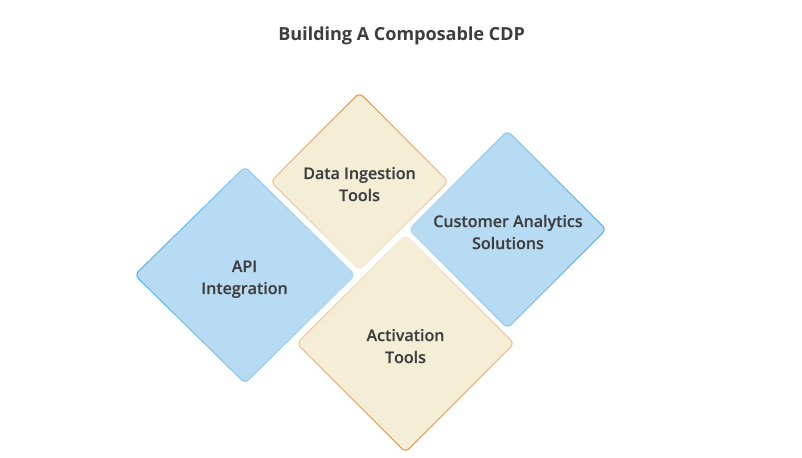
Key Features of Composable CDPs
- API-Based Integration: Use documented APIs and connectors, with defined data contracts, monitoring and error handling.
- Modular Architecture: Components can be added or replaced, but changes may require migration, remapping and validation.
- Vendor Choice: Reduce dependence on a single suite where practical, while accounting for each component’s licensing, proprietary features and switching costs.
- Data Portability: Define export formats, identity mappings and deletion propagation before moving data between systems.
Real-World Applications of Composable CDPs
- eCommerce: Combine a collection pipeline, warehouse data models, an audience builder and a campaign platform. Assign an owner to profile definitions and measurement so each component supports the same journey.
- Media and Entertainment: Connect subscription and engagement data to approved retention audiences, then evaluate the effect of the resulting campaign against a comparison group.
- Retail: Combine relevant store and online signals with an activation tool. Validate identity matching and data freshness before using those signals to personalize an experience.
Composable architectures require planning and ongoing ownership. Compare total cost—including warehouse computation, integration work and operations, with a packaged approach. A modular stack is useful when the team can operate it reliably.
8. AI-Assisted Analytics and Governed Self-Service
In 2026, AI-assisted and visual interfaces can help marketers investigate data and build audiences. The useful question is how much routine work teams can do safely within approved definitions and permissions, while technical teams retain ownership of the underlying data foundation.
How This Changes the Game
- Natural Language InsightsNatural-language interfaces can help users explore data or construct an audience. Review the interpreted filters, time window and metric definition before treating a generated answer as a decision.
- Drag-and-Drop Journey BuildingVisual journey builders can reduce routine coding in supported workflows. Engineering support is still needed for collection, integration, identity design and troubleshooting.
- Predictive Decision-MakingPredictive models can help identify likely conversion or churn. Validate performance on relevant data and monitor drift before using a score to determine customer treatment.
Do not evaluate self-service by the presence of a chat interface alone. Check whether users can inspect definitions, preview audience counts, identify sensitive fields and approve changes. Monitor failed activations and the business outcomes of approved campaigns.
Conclusion
In the ecosystem of MarTech, Customer Data Platforms are no longer just about managing customer information—they are at the forefront of transforming how businesses understand, engage, and build loyalty with their audiences. The trends shaping the future of CDPs—AI-powered insights, real-time data activation, seamless integrations, privacy-first practices, industry-specific solutions, and composable architectures—highlight the rapid evolution of these platforms.
A useful 2026 CDP strategy connects data quality, identity resolution, consent and activation to a specific business outcome. Choose the architecture that meets that requirement and fits the team responsible for operating it.
Start with one measurable use case, such as onboarding completion, repeat purchase or suppression of irrelevant messages. Agree on a baseline and comparison method before expanding your investment.
Your next step: assess the data and destination needed for that use case, test the complete workflow and measure whether it improves the customer outcome. That evidence is more useful than selecting a CDP on its feature list alone.
Start with one journey, the data it needs and the systems that deliver it.
Talk to Xerago about your CDP architecture, integration gaps and measurement priorities.
Frequently Asked Questions
1. What are the main customer data platform trends in 2026?
The eight trends covered here are AI and agentic workflows, timely segmentation and activation, integration with execution tools, consent and governed collaboration, sector-specific data models, hybrid architectures, composability and AI-assisted self-service. Assess each against your data readiness and business use case.
2. Is hybrid the future of customer data platforms?
Hybrid CDPs are one option for connecting warehouse history with operational profiles and activation. They are useful when both are needed, but a packaged or composable approach may fit better depending on the team, latency requirements and operating cost.
3. What is the difference between hybrid and composable CDPs?
Composable describes how selected capabilities are assembled. Hybrid describes combining capabilities or data access across environments. A solution can be both: for example, modular audience and activation tools connected to a warehouse and a streaming profile layer.
4. Which CDPs support real-time segmentation for AI-personalized messages?
Adobe Real-Time CDP and Tealium AudienceStream are examples to evaluate for timely segmentation. Verify the specific rules, event processing and destination behavior. The CDP supplies audience or profile context; a connected decisioning or journey tool typically selects and delivers the message. [5][6]
5. How should enterprises choose a CDP for AI-driven personalization?
Test a shortlist against your actual behavioral signals, identity requirements, model controls and delivery destination. Include consent enforcement, human review, latency, integration effort and total operating cost. There is no universal best CDP for every enterprise.
6. How do personalization platforms complement CDPs?
A CDP unifies usable customer context and builds audiences. A personalization platform selects and delivers the experience. Connect the two with clear responsibilities for decisioning, consent and measurement, then return interaction results for analysis.
7. What is an agentic CDP?
An agentic CDP adds AI agents that can help investigate data, propose audiences or support marketing workflows. The scope differs by vendor. It still requires reliable profiles, permissions and review of customer-facing actions; a product announcement is not evidence that every capability is available in every deployment.
8. How can Xerago help with CDP modernization?
Xerago’s consulting and advisory services cover data, AI, experience and MarTech architecture. Bring a priority customer journey and your current stack to discuss the integration and activation gaps that matter for that use case.
Ram Prabhakar
Head of Solutions and Content
Xtelligence Inbox.
Your weekly dose of marketing smarts!
Related Posts