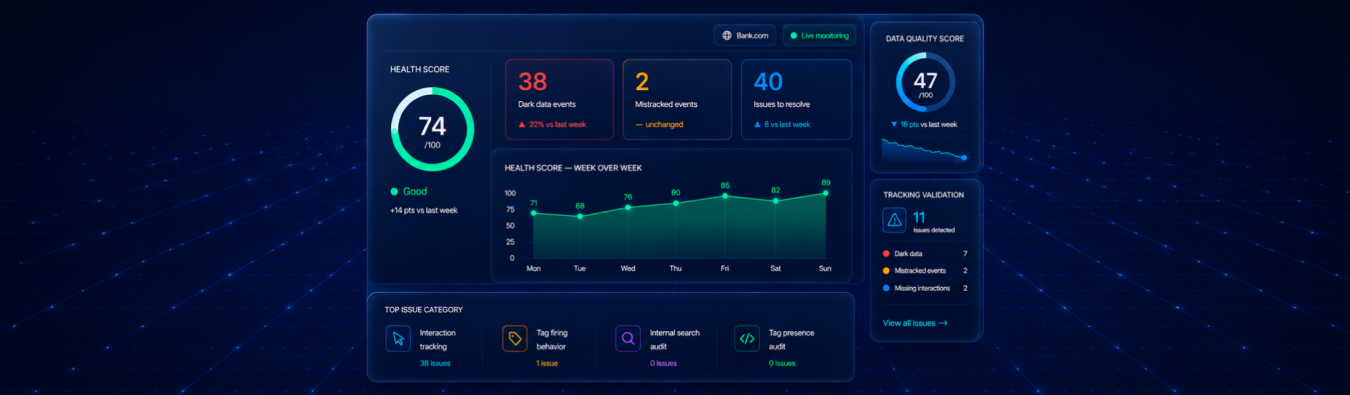
Interactions Correctly?


Why Do Analytics & CRM Numbers Never Match? Here’s What to Check


Validate & Fix Tracking Gaps with Xerago TrueMeasure
Your CRM says 1,000 leads, while GA4 reports 820 conversions. Naturally, the first question is: which number is right?
That usually starts a familiar chain of checks across marketing, analytics, engineering, and reporting teams, often ending with the conclusion that analytics and CRM simply never match.
And to some extent, that is true.
These systems are built for different purposes, observe different stages of the customer journey, and apply different rules to the same customer activity.
So some variance is expected. The problem begins when that explanation becomes a reason to accept every discrepancy without understanding what caused it.
Because sometimes the gap is not created by system logic at all. It starts much earlier, when an event is missed, fired twice, mapped incorrectly, or changed after a release. In those cases, comparing analytics with CRM only tells you that the numbers are different. It does not tell you where the difference actually started.
That is why the more useful question is whether the gap comes from legitimate system variance, or from measurement that is losing, duplicating, or misclassifying customer activity.
Key Takeaways
- Accept the gap when it's explainable by a documented rule as a conversion definition, a consent restriction, an offline channel, and stays roughly the same size month to month.
- Escalate the gap when it grows, shifts suddenly after a release or migration, or has no owner who can explain it.
- Diagnose by tracing one record, not by reconciling totals, follow a single conversion through action → event → analytics → backend → CRM until you find the step where it breaks.
- Watch for silent failures even when tracking looks healthy, a tag firing on schedule doesn't confirm the event still matches the customer action it's supposed to represent.
- Prioritize by business value, not by gap size and audit the tracking behind your highest-value conversion first, since it typically surfaces the same issues affecting the rest.
Why Do Analytics and CRM Numbers Not Match?
Analytics and CRM numbers usually differ because the systems collect, process, and define customer activity differently. Analytics platforms measure digital interactions, while CRM systems record business outcomes such as leads, customers, opportunities, and revenue.
A certain level of discrepancy is therefore normal. However, a large, sudden, or growing gap can indicate a measurement problem, such as missing events, duplicate tracking, incorrect conversion definitions, broken parameters, identity loss, or implementation drift.
The key is to separate expected system variance from measurement variance.
System variance happens when both systems are working correctly but use different rules. Measurement variance happens when analytics no longer accurately represent what the customer actually did.
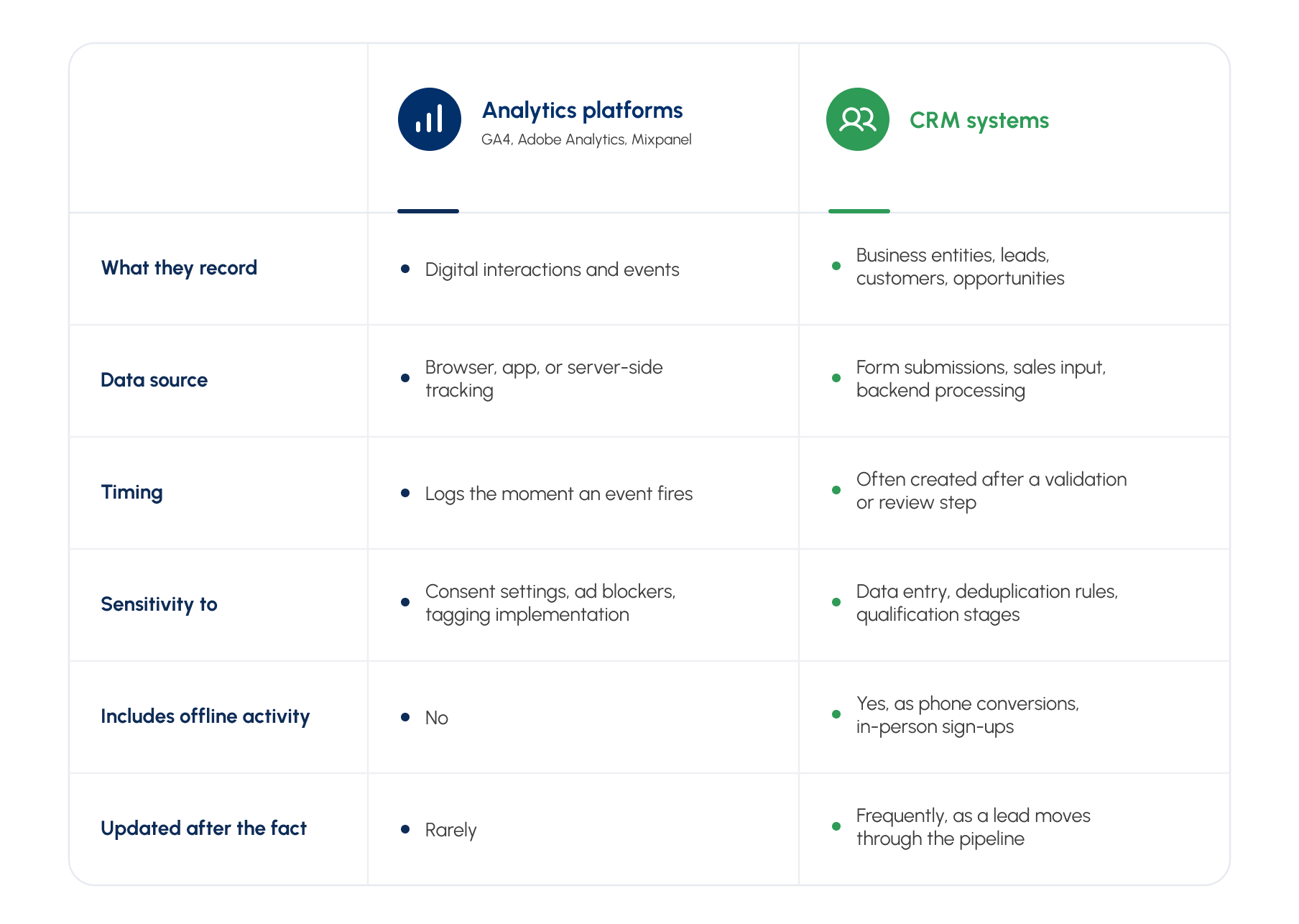
7 Key Reasons Why Analytics and CRM Numbers Diverge Normally
1. Different systems answer different questions
Analytics platforms such as GA4, Adobe Analytics, and Mixpanel primarily measure digital behaviour such as visits, clicks, form submissions, product interactions, and purchases.
CRM systems manage business records such as leads, contacts, opportunities, qualified prospects, customers, and revenue.
A single website conversion therefore does not always translate into a new CRM lead.
For example, a CRM may identify the submission as a duplicate, update an existing contact, reject an invalid enquiry, or route it outside the sales pipeline.
2. Conversion definitions may be different
Analytics might count every successful form submission as a conversion, while the CRM counts only leads that meet predefined business rules.
If 1,000 forms are submitted but only 900 qualify as valid leads, both systems can be correct while reporting different totals.
3. Attribution works differently
Analytics platforms may assign a conversion to paid search, organic search, email, direct traffic, or another channel according to their attribution rules.
A CRM may store the source captured when the lead was created, use a different attribution convention, or associate the eventual revenue with a sales record rather than the original marketing interaction.
The conversion can therefore exist in both systems while the reported source differs.
4. Timing can create temporary differences
Analytics generally records digital events close to when they happen.
CRM records may appear later because the submission needs to pass through backend processing, validation, integrations, payment confirmation, or lead-routing logic.
Comparing the platforms before those processes are complete can create temporary discrepancies.
5. Privacy and consent reduce analytics visibility
Some users decline analytics consent, block tracking scripts, or use browser settings that restrict measurement.
Their form submission can still reach the backend and CRM even though the analytics platform never receives the corresponding event.
That creates a legitimate difference in what each system can observe.
6. CRM Systems Deduplicate and Validate Records
A customer may submit the same form twice, use an existing email address, or already exist in the CRM.
Analytics can record each digital action separately, while the CRM may merge, reject, update, or deduplicate those submissions before creating a business record.
7. Identity Is Handled Differently Across Systems
Analytics may identify a person through cookies, device IDs, sessions, or user IDs, while the CRM identifies them through known information such as an email address or customer record.
One person can therefore appear as multiple users or sessions in analytics while being represented as a single customer in the CRM.
These differences are examples of system variance. They do not automatically indicate that anything is broken.
The real concern begins when the gap cannot be explained by these differences or starts changing unexpectedly.
See which of these seven issues may be affecting your own numbers. A Xerago TrueMeasure audit scans your tracking implementation and tells you exactly where events are missing, duplicated, or misclassified.
When Should You Actually Worry About the Difference?
The starting assumption should not be that analytics and CRM are supposed to match. A more useful way to evaluate a gap is to check it against three questions:
- Is it explainable? Can the team point to a specific, documented reason, a definitional difference, a consent restriction, an offline channel that accounts for the gap?
- Is it consistent? A steady 5% gap month over month suggests a structural, understood difference between the two systems. A gap that moves from 5% to 30% suggests something in the measurement chain has changed, and that change has not been investigated.
- Is it measurable at the individual level? Can a specific lead or conversion be traced through the chain from the original interaction to its appearance or absence, in each system? If the gap can only be discussed in aggregate, it usually means nobody has actually traced a single record through the process.
If the difference is explainable and stable, it may be normal. If it is large, growing, unpredictable, or cannot be traced, investigate the measurement.
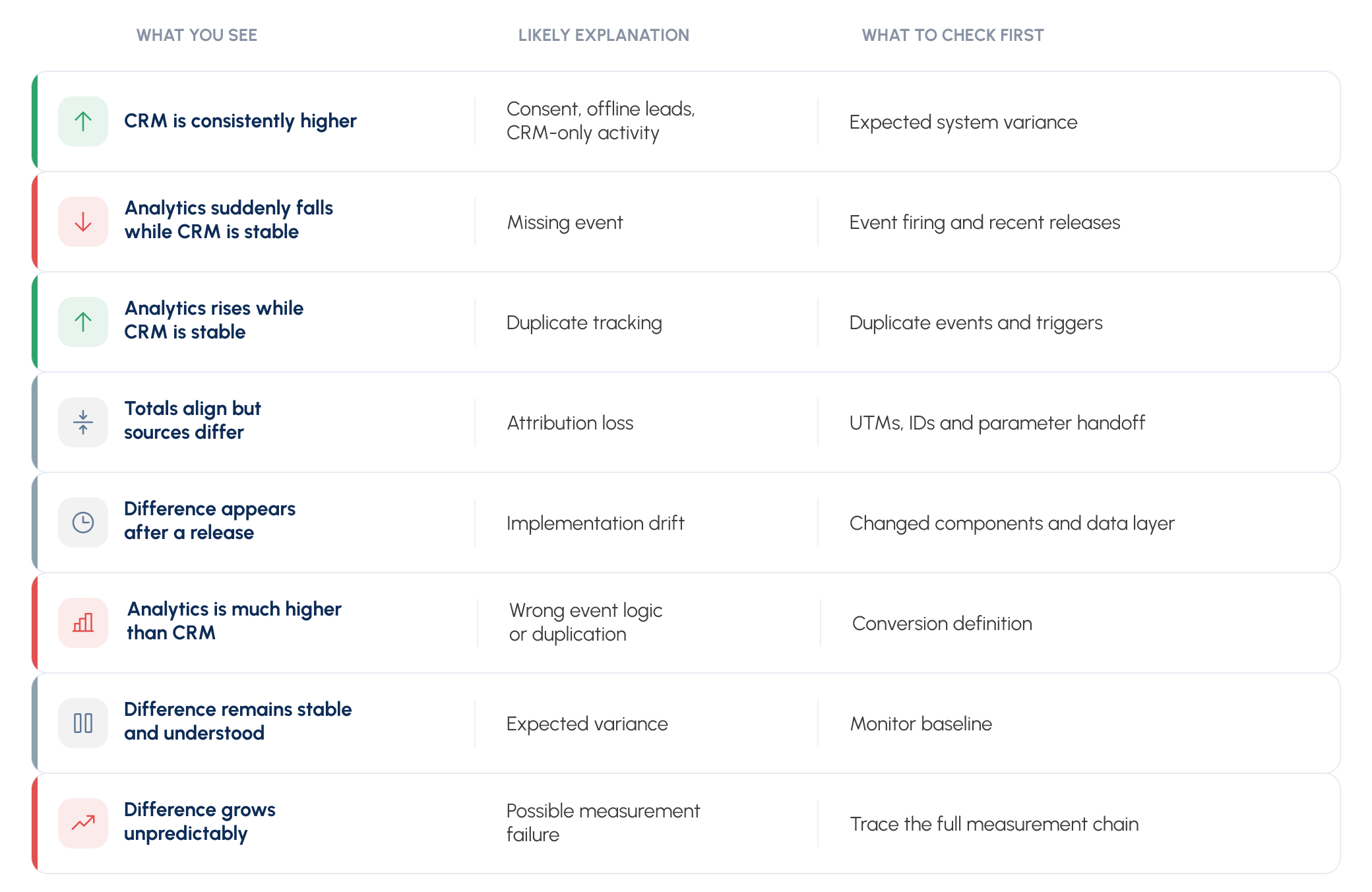
When Is an Analytics and CRM Difference Actually a Tracking Problem?
An analytics and CRM difference becomes a tracking problem when analytics does not accurately capture the customer action that actually occurred.
For example, the CRM may receive a valid lead while the analytics conversion event never fires. Or one real submission may generate two analytics events, causing analytics to overcount conversions.
The event itself can also be wrong. A button click may be counted as a completed form submission even though the form failed, or a purchase event may fire with an incorrect value, currency, product, or customer identifier.
Tracking problems can also appear over time. A website release, form update, tag change, consent update, or migration can break measurement that previously worked correctly.
A discrepancy should therefore be investigated when it is unexplained, suddenly increases, keeps growing, changes after a release, or cannot be traced from the customer action through analytics and into the CRM.
Put simply, if both systems use different rules but accurately record what they are designed to record, the difference may be normal.
If analytics is missing, duplicating, misclassifying, or incorrectly describing customer activity, it is a tracking problem
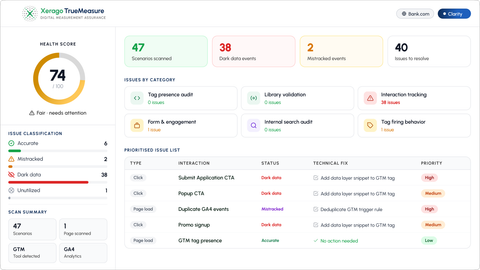
5 Signs Your Analytics–CRM Gap Is a Measurement Problem
1. Before Comparing Analytics With CRM, Check What Was Measured
Comparing analytics and CRM reports helps identify that a discrepancy exists.
It does not necessarily show where the discrepancy originated.
If CRM reports 1,000 leads and analytics reports 820 conversions, work backwards instead of immediately reconciling the final numbers.
Confirm that the customer completed the expected business action, that the corresponding event fired exactly once, and that analytics received the correct parameters.
Then validate whether the backend processed the action and whether the CRM created or updated the expected record.
The first place where the expected behaviour and recorded data separate is where the problem begins.
That changes the investigation from reconciling outputs to validating measurement inputs.
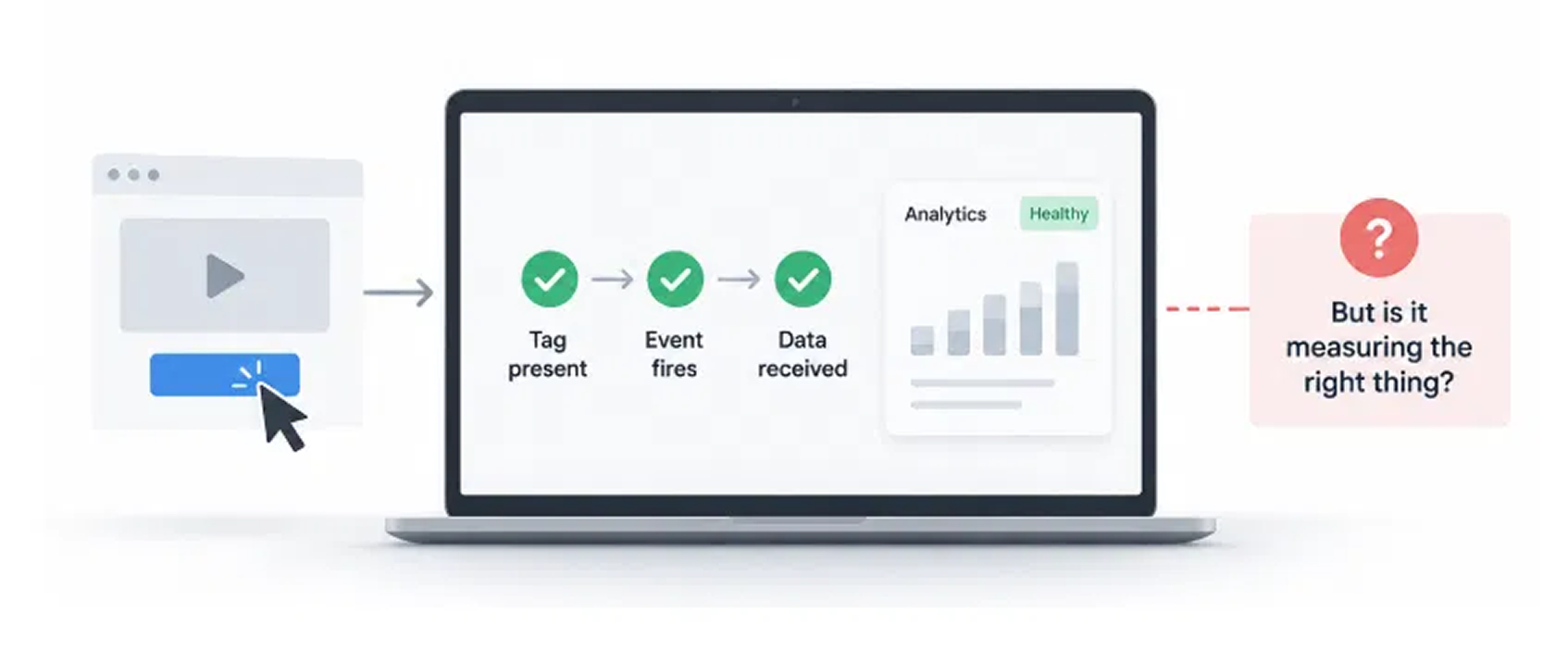
2. Your Tracking Can Be Technically Healthy and Still Be Wrong
A tag can be present, the event can fire, analytics can receive the data, and the dashboard can continue updating normally. None of that proves that the event represents the right customer interaction.
A video play incorrectly mapped as a form submission can fire perfectly.
A button click incorrectly treated as a successful application can fire perfectly.
A purchase event containing the wrong value can fire perfectly.
The implementation is technically functioning, but the measurement is still wrong.
This distinction matters because analytics platforms report the data they receive.
If measurement sends an inaccurate representation of customer behaviour, the resulting analytics can look completely healthy while producing misleading conclusions.
3. One genuine action creates multiple analytics conversions
A single form submission can sometimes trigger the same analytics event more than once.
This may happen because of duplicate tags, repeated callbacks, SPA behaviour, overlapping GTM and hardcoded tracking, or both client-side and server-side implementations recording the same action.
The CRM records one lead while analytics records multiple conversions.
4. The conversion survives but its context does not
Analytics and CRM may agree that a conversion happened while disagreeing about where it came from.
Analytics may report paid search while the CRM records the source as unknown.
That can happen when UTMs, click IDs, session data, campaign parameters, or user identifiers fail to move correctly between the website, backend, and CRM.
The conversion is still there, but the context required for attribution and optimization has been lost.
Not sure whether your gap is normal or a tracking issue? Xerago TrueMeasure helps identify whether the problem is Mistracked, Dark Data, or Unutilized, and prioritizes it by business impact.
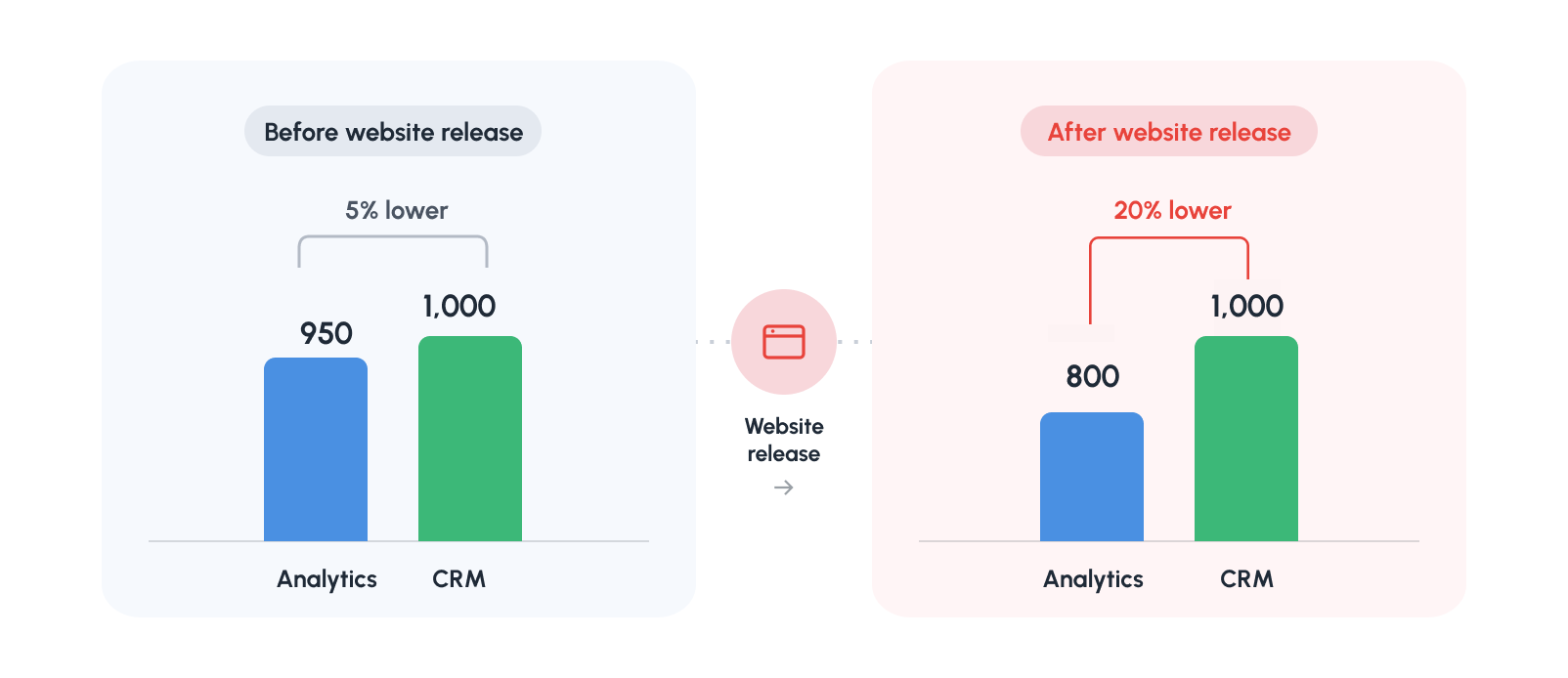
5. A previously stable gap suddenly starts growing
A tracking implementation that worked correctly at launch can change after website releases, form updates, component changes, consent-platform updates, or migrations.
Suppose analytics normally reports around 5% fewer conversions than CRM and that difference has been understood for months.
After a website release, the difference suddenly grows to 20%.
CRM has not changed, and the analytics platform itself may not have changed.
What changed was the measurement implementation between the customer and analytics.
How Xerago TrueMeasure Helps Validate the Gap
When analytics and CRM numbers diverge by an amount nobody can explain, most teams default to reconciling dashboards, comparing totals, adjusting filters, and debating which platform is closer to correct.
This process rarely identifies the actual cause, because the cause typically sits inside the tracking implementation itself, not in how the two reports are being compared. Xerago TrueMeasure addresses that layer directly. It is not built to reconcile CRM and analytics into a single number, and it is not positioned as a replacement for either system, instead, it validates the measurement feeding into analytics reporting, checking whether the events an analytics platform receives actually reflect what customers did on the site.
In practice, that means scanning tracking implementations
to identify the specific issues that tend to sit behind unexplained discrepancies:
- Missing events
- Duplicate events
- Incorrect data mappings
- Broken parameters
- Tracking inconsistencies across pages
- Implementation drift introduced by changes made after launch
Each issue is classified and tied to its likely effect on reporting, rather than left as an unranked list of technical findings. Applied to the credit card campaign scenario described earlier, that would mean checking whether the conversion event on the application form fires exactly once per submission, whether a validation rule is silently blocking a subset of forms before the backend logs them, and whether campaign parameters are passed through correctly to both analytics and CRM, identifying which part of the 150-application gap is a measurement issue rather than leaving the team to guess.
Once the underlying tracking issue is identified and corrected, the team is left with a smaller, better-understood gap between systems one they can attribute to genuine differences like offline conversions or definitional rules, rather than to an unverified assumption. That distinction is what determines whether a discrepancy is safe to leave alone or is actively distorting campaign and reporting decisions.
CRM and analytics platforms do not need to report the same number. They are built to observe different parts of the customer journey, and some divergence between them is expected. What a team should always be able to do is explain why the two systems differ.
When that explanation is not available, the appropriate next step is not another round of dashboard reconciliation. It is validating the measurement chain itself, from the original customer action through to the record that lands in CRM, to find where the discrepancy actually begins.
Frequently Asked Questions
Do analytics and CRM numbers need to match exactly?
No. The two systems record different things, digital interactions versus business entities, so some gap is expected. What matters is whether the gap can be explained.
What typically causes a gap between GA4 or Adobe Analytics and CRM data?
Most often: a conversion event that never fired, one that fired twice, differing definitions of "conversion," broken user identity across devices, consent restrictions, lost attribution, or tracking drift after a site change.
How much of a gap between analytics and CRM is considered normal?
There's no universal number. A gap is more likely normal when it stays consistent month to month and has a documented cause. A gap that grows or fluctuates without one is the one to investigate.
What is tracking drift, and why does it matter?
It's when an implementation that was accurate at launch changes silently after a release, update, or migration. It matters because it builds up gradually without triggering an obvious error.
How does Xerago TrueMeasure help identify the source of an analytics-CRM discrepancy?
It scans the tracking implementation for missing events, duplicates, bad mappings, and drift, then classifies each by its likely reporting impact so a gap traces back to a specific step instead of a guess.
Kaviarasu S
Associate Content Writer
Xtelligence Inbox.
Your weekly dose of marketing smarts!
Related Posts
Xerago TrueMeasure
Google Tag Diagnostics Tool Doesn't Validate Measurement Health. Here's Why