Interactions Correctly?


Your GA4 Audit Should Not Start With Tags. Here's What To Do Instead


Xerago Truemeasure Continuously Checks Whether GA4 Implementation Captures The Right Events And Parameters
Most GA4 audits begin with a familiar question: are the tags firing?
It's a necessary question. But it's not the first one.
Before you check events, conversions, parameters, or data streams, you need to ask what the business is trying to learn, decide, or improve with GA4 data. Otherwise, your audit may confirm that the setup works technically while missing whether it works strategically.
That distinction matters more than most GA4 audit checklists let on. A Digital Analytics solution team can actually use shouldn't open with a list of settings to verify. It should open with a list of decisions the business needs GA4 to support and only then work backward into the events, parameters, and conversions that prove or disprove whether it's supporting them.
This article walks through why that order matters, and gives you a framework plus a downloadable checklist to run a GA4 audit that holds up to more than a technical review.
Most GA4 Audits Start With The Wrong First Question
Open almost any GA4 audit template and you'll find it starts in the same place: property settings, data streams, tag configuration, event names, conversion markers, GTM container versions, consent settings, ecommerce tracking. Every one of these deserves scrutiny. None of them is where the audit should start.
Here's why. Implementation checks answer a narrow question: does the tracking work as configured? They don't answer a more important one: is it configured to capture what the business actually needs to know?
Google’s own support forums show GA4 channel-wise data discrepancies continuing into 2026. Google
A Google Analytics audit that stops at implementation can return a clean bill of health every tag firing, every event registering, every conversion marker in place and still leave the business making decisions on data that doesn't reflect what matters. Tags firing correctly is a baseline. It was never the goal.
This is where most checklist-driven audits quietly fail. They validate that the plumbing works. They don't validate that the plumbing is connected to the right rooms.
Start With The Decisions GA4 Is Supposed To Support
Before you open GTM or click into the GA4 admin panel, answer a different set of questions first:
- Which campaigns deserve more budget, and what does GA4 need to prove to justify that call?
- Which product journeys need optimization, and does the current setup show where they break down?
- Which conversion points actually define real buyer intent, versus which ones just look like progress?
- Which customer actions should trigger remarketing or personalization, and are they being captured at all?
- Which funnel drop-offs should leadership be acting on, and would anyone notice if they weren't showing up?
These aren't abstract questions. They're the business logic your GA4 measurement plan is supposed to encode. If you can't answer them before the audit starts, the audit has nothing to check itself against you're just confirming that data exists, not that the right data exists.
This is the shift a decision-first approach makes: instead of asking "is this tracking correct," you ask "does this tracking answer the question the business is actually asking." Those are frequently two different things, even in properties that look pristine on paper.
Why Event Accuracy Is Not The Same As Measurement Value
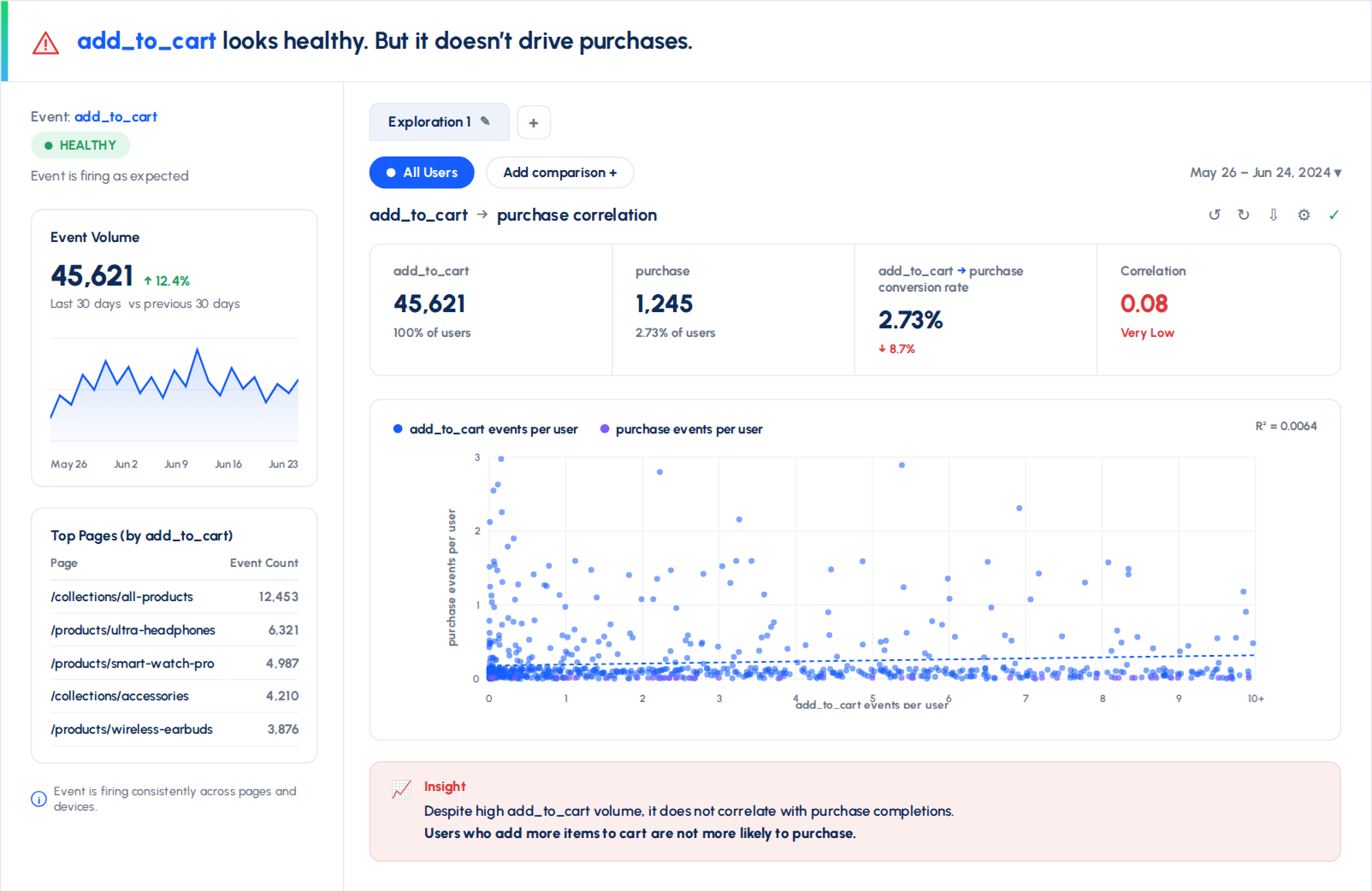
An event shouldn't be considered "right" just because it fires. It should be considered right if it captures a meaningful behavior, maps to a business question, and can support action. Those are three separate bars, and a lot of GA4 implementations only clear the first one.
Consider a few patterns that show up constantly in a GA4 tracking audit, and would pass a purely technical review:
- A conversion event fires reliably, but it doesn't represent true pipeline or purchase intent; it's counting a click, not a commitment.
- Enhanced measurement tracks clicks and scrolls by default, but misses the specific product interaction the team actually cares about.
- Checkout events all exist and populate correctly, but the journey between them can't explain where revenue is leaking.
- Reports are full and dashboards update on schedule, but nobody on the leadership team trusts the numbers enough to build a budget case around them.
Every one of these is a technically correct setup. Every one of these is also, functionally, a measurement failure. This is the core problem with checklist-only audits: a checklist can confirm an event exists. It can't confirm the event means anything to the people making decisions from it. That's a GA4 data quality question, and data quality isn't just about accuracy, it's about relevance to a decision.
The Decision-First GA4 Audit Framework
Reordering the audit changes what it's able to catch. Here's the sequence:
- Define the decisions GA4 must support. Pull these from marketing, product, and leadership, not just from the analytics team's own assumptions.
- Map those decisions to customer journeys. Which paths through the site or app actually produce the behavior each decision depends on?
- Identify the critical events and conversions. Not every event matters equally. Rank them by which decision they inform.
- Validate whether the right data is being captured. This is where the technical audit finally enters these checking tags, parameters, and event triggers against the journeys mapped in step 2.
- Check whether the data is accurate, deduplicated, and usable. Duplicate events, mismatched parameters, and inconsistent naming all erode trust even when the underlying tracking is directionally correct.
- Prioritize fixes by business impact, not by ease of implementation. A checkout tracking gap outranks a cosmetic naming inconsistency, even if the naming fix takes five minutes and the checkout fix takes five days.
- Monitor continuously instead of relying on one-time audits. Sites change weekly. A single GA4 audit is a snapshot; measurement health is a moving target.
Running the audit in this order doesn't just change what gets flagged as it changes what gets fixed first. A technical audit prioritizes what's broken. A decision-first audit prioritizes what's costing the business the ability to decide.
What To Check After Business Intent Is Clear
Once the decisions and journeys are mapped, the implementation review still matters as it's just no longer the starting point. Work through it methodically:
- Tags and GTM containers. Version history, unused tags, duplicate triggers, and firing conditions that no longer match the current site structure.
- Events and parameters. Naming consistency, parameter completeness, and whether custom events actually differentiate meaningfully from GA4's default enhanced measurement.
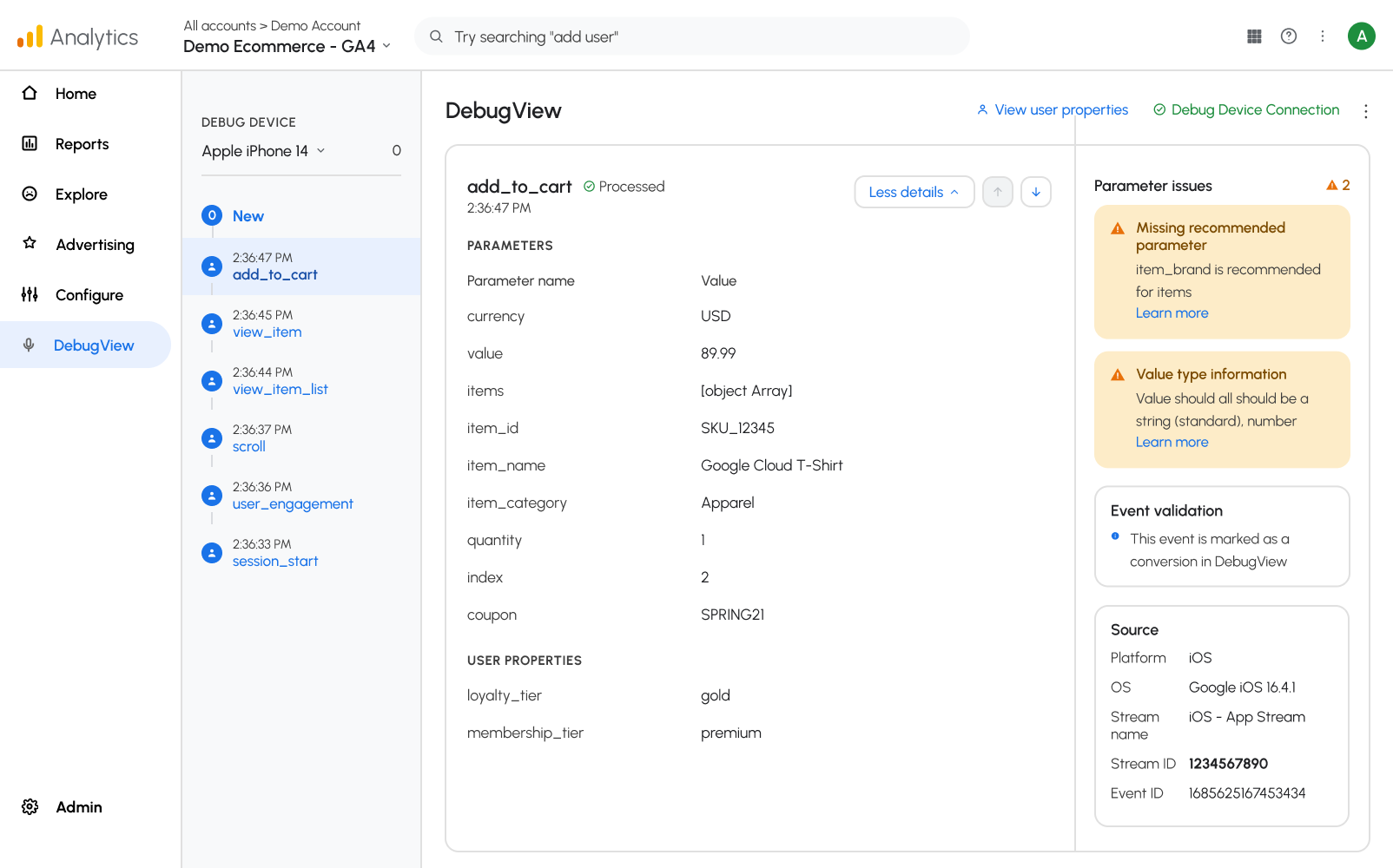
- Conversions. Whether marked conversions represent real intent or just convenient milestones.
- Consent settings. Consent Mode configuration, region-specific behavior, and how much of your traffic is being modeled versus observed.
- Ecommerce tracking. Full funnel coverage from product view through purchase, including refunds and cart abandonment.
- Attribution. Whether channel groupings and attribution settings reflect how the business actually thinks about credit across campaigns.
- Reporting. Whether the reports built on top of this data actually get used, or quietly ignored because nobody trusts them.
- Data usability. Whether data is exportable, joinable with other systems, and structured well enough for BI tools and downstream analysis.
This is the point where most GA4 audit checklist 2026 resources start and stop. Treated as the second half of the process rather than the whole of it, this list becomes far more useful every check now ties back to a decision the business actually needs to make.
See how TrueMeasure helps teams find and fix the measurement gaps that keep GA4 data from supporting real business decisions.
Why GA4 Accuracy Matters More in 2026
GA4 isn't just a reporting layer anymore. It feeds media optimization, audience building, experimentation platforms, personalization engines, and executive decision-making, often without a human checking the handoff at each step. When the underlying data is wrong, the error doesn't stay contained in a dashboard, it propagates into every system downstream of it.
At the same time, the conditions for measurement drift have gotten worse. Privacy requirements keep tightening. Consent Mode is reshaping how much of your traffic is observed versus modeled. Server-side tagging adds a layer of infrastructure that can fail quietly. Customer journeys are more fragmented across devices and sessions than they were even two years ago. Each of these raises the cost of poor measurement and lowers the odds that a one-time technical audit catches the problem before it affects a real decision.
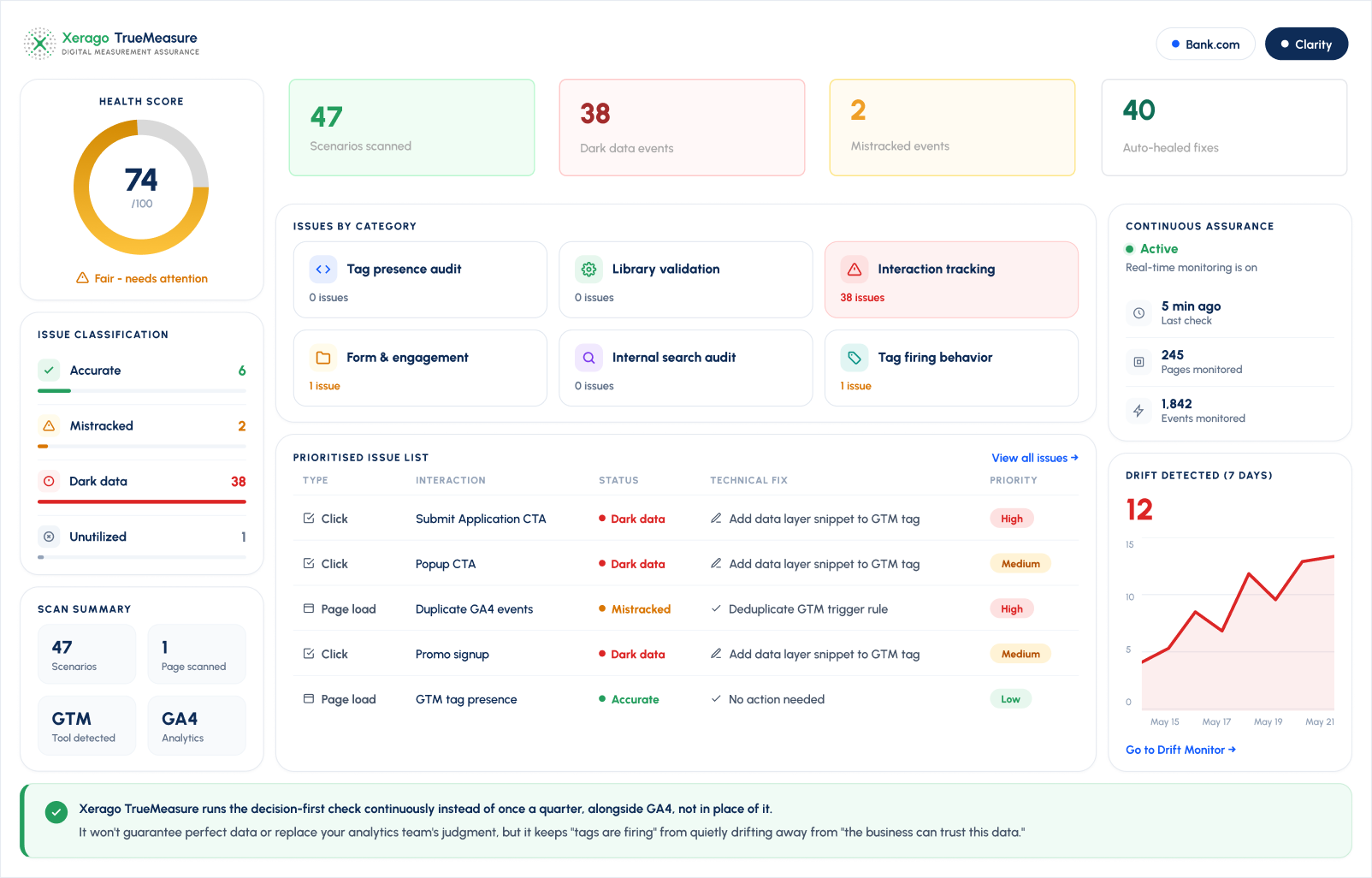
Xerago TrueMeasure is built for exactly this, catching silent failures like these as they happen, instead of waiting for the next scheduled audit to surface.
From GA4 Audit To Continuous Measurement Assurance
A one-time audit, even a decision-first one, is a snapshot. It tells you the state of your measurement on the day you ran it. Sites don't stay still, new pages launch, campaigns spin up, product teams ship changes, and every one of those introduces new tracking risk. A GA4 measurement plan built once and never revisited degrades the same way any unmaintained system does: slowly, then all at once, usually discovered only when someone questions a number in a leadership meeting.
One-Time Audit vs. Continuous Assurance
| Dimension | One-Time Audit | Continuous Assurance |
|---|---|---|
| Catches drift | At the next scheduled review | The week it appears |
| Coverage | A snapshot in time | Every site change, ongoing |
| Who finds the gap first | Someone questioning a report | The system, before the report ships |
Xerago TrueMeasure runs the decision-first check continuously instead of once a quarter, alongside GA4, not in place of it. It won't guarantee perfect data or replace your analytics team's judgment, but it keeps "tags are firing" from quietly drifting away from "the business can trust this data."
What A Decision-First GA4 Audit Looks Like Next
A GA4 audit shouldn't begin with whether data exists. It should begin with whether the data can support the decisions the business actually needs to make. Tags firing is table stakes. Trustworthy, decision-ready data is the actual goal and it's a different, harder bar to clear.
If you want a starting point that follows this framework rather than a generic settings checklist, download Xerago's GA4 audit checklist. It walks through the same decision-first sequence covered here, so you can run your next GA4 audit, GA4 tracking audit, or full Google Analytics audit against business intent from the very first step.
If your measurement questions extend beyond GA4 alone, Xerago's analytics audit checklist and web analytics audit checklist apply the same framework more broadly.

Kaviarasu S
Associate Content Writer
Xtelligence Inbox.
Your weekly dose of marketing smarts!
Related Posts

Xerago TrueMeasure
Google Tag Diagnostics Tool Doesn't Validate Measurement Health. Here's Why