---blog Title---
Why You Need a CDP + Marketing Automation in Your Marketing Tech Stack
---desktop---

---mobile---

In a world where 80% of consumers are more likely to make a purchase when they receive personalized experiences, businesses are realizing that the key to success lies in understanding their customers at a deeper level.
A Customer Data Platform (CDP) is the first step in this process, consolidating data from multiple touchpoints to create a unified customer profile. When paired with Marketing Automation, businesses can deliver tailored messages at scale, increasing engagement, improving conversions, and maximizing ROI. Together, they form a powerful duo for modern marketing success.
But what exactly are CDPs and marketing automation? And why do you need both in your marketing tech stack? This blog will explore the definitions, benefits, and real-world applications of CDP marketing automation, providing a clear understanding of why combining both technologies is essential for success.
What is a CDP (Customer Data Platform)?
A Customer Data Platform (CDP) is a martech platform designed to collect, integrate, and organize data from various customer touchpoints into a single, 360-degree view of each customer. Unlike other systems like CRM or DMPs, a CDP consolidates all types of customer data—including behavioral, transactional, demographic, and interaction data—into a comprehensive database.
---outlined-cta---
A CDP serves as a single source of truth, offering valuable insights about customers that allow businesses to deliver personalized marketing strategies across channels.
Benefits of a CDP:
- Unified Customer Data: One of the primary benefits of a CDP is its ability to create a single customer view by collecting data from multiple touchpoints. This data helps businesses better understand their customers’ behaviors and preferences. As a result, marketing teams can create targeted campaigns based on real-time insights.
- Segmentation and Targeting: CDPs allow businesses to segment their customers based on various attributes such as demographics, purchase history, or engagement. This segmentation helps marketers tailor their campaigns more effectively, increasing the likelihood of engagement and conversions.
- Real-Time Data Processing: With a CDP, businesses can access real-time data, allowing them to act quickly on emerging customer behaviors or trends. For instance, if a customer abandons a cart, a business can immediately trigger a follow-up email or retargeting ad based on the insights from the CDP.
- Enhanced Customer Experiences: By having a deeper understanding of customers, a CDP enables businesses to deliver highly personalized experiences. Personalized messaging leads to higher engagement rates, customer satisfaction, and retention.
What is Marketing Automation?
Marketing Automation refers to the use of software and tools to automate repetitive marketing tasks and workflows, such as email campaigns, social media posts, lead nurturing, and customer segmentation. The goal is to enhance efficiency, reduce manual effort, and deliver timely, personalized messages to customers.
---outlined-cta---
Marketing automation allows businesses to streamline marketing processes, ensuring that customers receive the right messages at the right time, without manual intervention.
Benefits of Marketing Automation:
- Increased Efficiency: Marketing automation streamlines repetitive tasks like sending follow-up emails, managing campaigns, and segmenting leads. By automating these processes, marketing teams can focus on strategic decision-making, creative content, and campaign optimization.
- Personalized Campaigns at Scale: Automation enables businesses to send personalized communications to customers based on their behavior, interests, and interactions. For instance, a customer who has abandoned a cart will receive a personalized email with a discount, making it more likely they will complete their purchase.
- Improved Lead Nurturing: Marketing automation helps nurture leads through automated workflows. Whether it's sending educational content, offering discounts, or delivering product recommendations, automation ensures that customers are engaged at every stage of their journey, increasing the chances of conversion.
- Data-Driven Insights: Marketing automation platforms provide real-time data on campaign performance, customer engagement, and ROI. By continuously analyzing this data, businesses can refine their strategies and optimize future campaigns.
Customer Data Platform vs Marketing Automation: Key Differences
While CDP and marketing automation play crucial roles in modern marketing, they serve different functions. Understanding the distinctions between a CDP and a marketing automation platform helps businesses leverage both for maximum impact.
| Feature | Customer Data Platform (CDP) | Marketing Automation |
|---|---|---|
| Primary Purpose | Collects, integrates, and unifies customer data from multiple sources to provide a 360-degree customer view. | Uses customer behavior insights to execute personalized campaigns and automate customer engagement workflows. |
| Data Handling | Aggregates first-party, second-party, and third-party data from various touchpoints, ensuring unified customer profiles. | Uses CDP automation data to trigger automated marketing campaigns, such as email sequences, social media interactions, and retargeting ads. |
| Customer Insights | Offers deep customer behavior insights, enabling better segmentation, targeting, and audience personalization. | Uses customer journey orchestration to engage users with relevant content, guiding them through the automated customer journey. |
| Personalization | Enables personalized campaigns by leveraging real-time customer insights for targeted outreach. | Executes personalized campaigns by delivering automated, real-time interactions through various marketing channels. |
| Automation Capabilities | Stores and analyzes data but does not automate marketing actions; instead, it informs marketing automation tools for execution. | Automates marketing actions such as lead nurturing, follow-up emails, social media management, and customer engagement. |
| Use Case | Ideal for businesses looking to unify customer data, improve segmentation, and gain actionable customer behavior insights. | Best suited for businesses seeking to automate marketing processes, enhance customer experience, and drive engagement. |
Why You Need a CDP + Marketing Automation Together - A Key Use Cases
[ ]
]
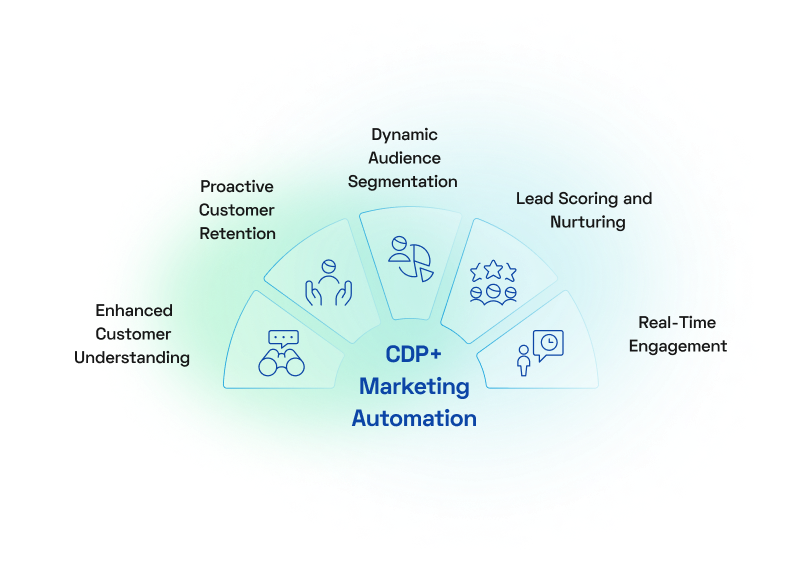
While both CDPs and marketing automation offer significant advantages independently, combining them provides a synergistic effect that helps businesses deliver superior customer experiences and drive marketing success. Here’s why you need both in your marketing tech stack:
1. Enhanced Customer Understanding to Deliver Personalized Engagement
A CDP consolidates customer data from various touchpoints into one centralized platform, providing a 360-degree view of the customer. This allows businesses to understand their customers better and deliver more targeted, relevant marketing messages.
When paired with marketing automation, this data can be leveraged to trigger personalized campaigns at scale. For example, if a customer has interacted with specific products or shown interest in particular content, marketing automation can use this data to send timely, personalized emails or offers.
2. Proactive Customer Retention
Most businesses face challenges in preventing customer churn before it happens. A major roadblock is the failure to leverage customer data to predict churn behavior and automate timely interventions to retain customers.
When a CDP and marketing automation are integrated, businesses can proactively address the factors that lead to disengagement. The CDP consolidates unified customer data from all touchpoints, including app usage, payments, and engagements, capturing both historical and real-time behavioral data. This enables businesses to identify trends that correlate with churn, such as:
- Customers who haven’t logged in for 30 days
- A sharp decline in purchase frequency
- Decreased interaction with marketing emails
By integrating these insights with marketing automation platforms, businesses can send targeted engagement messages, such as personalized emails or push notifications, with relevant offers to prevent churn before it happens.
3. Dynamic Audience Segmentation for Campaigns
Dynamic audience segmentation involves categorizing customers into distinct groups based on their behavior, preferences, and characteristics. Unlike static segmentation, which is based on fixed criteria, dynamic segmentation constantly updates as new data becomes available.
In a CDP, every customer has a unified profile that consolidates:
- Behavioral Patterns: For example, frequent visits on weekends.
- Preferences: Such as preferring blogs over videos.
- Purchase History: Including past transactions.
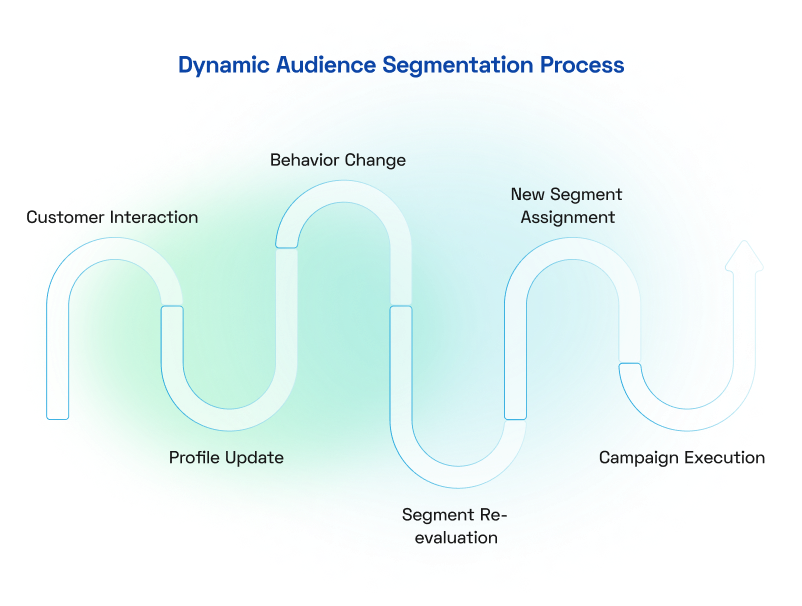
As customers interact with touchpoints, the CDP continuously updates their profiles in real time:
- A new purchase? It's added to their history.
- Watched a video? That preference is recorded.
- Stopped engaging? The CDP flags them as dormant.
Within the CDP, rules and criteria are used to automatically group customers into segments:
- Frequent Buyers: If a customer makes 5 purchases in the past month, they’re added to this segment.
- Lapsed Users: If a customer hasn’t interacted for 90 days, they’re moved to this segment.
- Content Readers: If a customer engages with blog content, they’re tagged under this segment.
[ ]
]
These segments adjust automatically as behaviors change. For example:
A “Content Reader “might start purchasing frequently after engaging with blogs for a while, and the CDP will automatically move them to the "Frequent Buyers" segment.
Marketing automation tools use these dynamic segments to run highly relevant campaigns such as sending exclusive offers to Frequent Buyers or Running win-back emails for Lapsed Users.
4. Lead Scoring and Nurturing
Delivering the right message to the right person at the right time is key to driving meaningful engagement and conversions.
A CDP will have all customer data, including website interactions, email engagement, CRM data, and more. This provides a comprehensive view of each lead's behavior.
Based on these insights, the company creates a scoring model that assigns points to leads for actions such as visiting specific pages, downloading content, or engaging with emails. For example, a lead who spends time on a product page may receive a higher score than someone who only views a blog post.
Using the lead scores, automation tools are set up to trigger specific actions. High-value leads (those with higher scores) are automatically passed to the sales team, while lower-value leads are entered into a nurturing sequence, where they receive targeted content like case studies, whitepapers, or demo invites.
5. Real-Time Engagement and Actionable Insights
When you combine a CDP with marketing automation, you can act on customer behavior insights in real-time. For instance, if a customer abandons a cart, the CDP captures this behavior, and marketing automation can trigger a personalized email with a discount or a reminder to complete the purchase.
Real-time action is crucial for engaging customers at critical points in their journey. By responding promptly and appropriately, businesses can increase conversions and foster long-term customer relationships.
The combination of CDP + marketing automation is essential for modern businesses looking to enhance customer engagement, improve marketing efficiency, and increase ROI. A CDP provides a unified, 360-degree view of customer data, while marketing automation ensures that personalized, relevant messages are delivered to customers at scale.
By leveraging both technologies, businesses can automate the customer journey, nurture leads more effectively, and optimize the customer experience across channels. Having siloed platforms connecting data together to generate actionable insights will be simplified when you integrate a CDP with a marketing automation tool. This integration provides the option to scale operations in real time, backed by data-driven insights.