---blog Title---
Why Your Digital Analytics Tools Don’t Tell You When Analytics Is Wrong
---desktop---

---mobile---
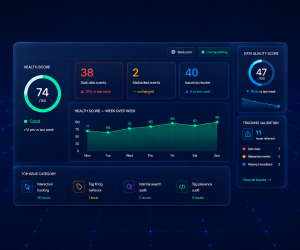
When a conversion rate drops, the first question is usually about the campaign or the product. Rarely does anyone ask: is the tracking correct? That ordering is a problem because tracking errors are common, invisible, and expensive, and they get investigated last.
Most analytics teams trust the data until something looks obviously wrong. But tracking problems rarely look obviously wrong.
- A form submit event that fires on every button click, including failed attempts, produces a conversion rate that looks completely plausible.
- A duplicate purchase event produces metrics that look strong.
- A missing interaction in the middle of a funnel produces a drop-off that looks like a UX problem.
None of these produce an error. All of them produce wrong decisions.
The gap isn't in the reporting. It's in what gets measured.
GA4, Adobe Analytics, and GTM were built to receive data and report it. They were never built to verify whether the data coming in is correct. That verification is not a feature any of them offer and it is the gap where measurement goes quietly wrong.
What Analytics Tools Actually Assume
Every analytics platform your team relies on was built around a single foundational assumption: that the data feeding it is correct.
These platforms are engines of analysis. They are exceptionally good at aggregating, segmenting, and visualizing what they receive. That is precisely what they were designed to do, and they do it well.
But validation is a different discipline entirely. No digital analytics solutions independently confirm that the right interactions are being tracked, that the tags firing are mapped to the right events, or that the data layer values flowing into reports reflect what actually happened in the user session.
They trust the input. They report on it. And when the input is wrong, the reporting looks exactly the same as when it is right. The intelligence lives in the reporting layer. The blind spot lives in the measurement layer beneath it.
Choosing the right analytics platform matters. Verifying what goes into it matters just as much.
---outlined-cta--- Also Read: Steps to Perform a Digital Analytics Audit for Business Growth
What Are the Common Reasons Analytics Data Looks Inflated?
Most analytics implementations were built incrementally with a tag added for a campaign, an event created for a product launch, a trigger set up before a redesign. Nobody stepped back to ask whether the full picture was accurate. They just kept building on top of it.
The result is that most funnels exist in one of several measurement states right now. Only one of them is safe to optimise against.
-
The event fires at the wrong moment
The trigger doesn't match the action it's meant to represent. A value gets logged, but it's tied to the wrong point in the interaction so every metric built on top of that event is reading the wrong signal as the right one. -
An important interaction was never tracked
No event was ever specified for it, so nothing fires, and nothing fails to fire either; there's no missing event to flag, because there was never an event to begin with. The only trace it leaves is an unexplained drop somewhere downstream. -
The same event fires twice
One action triggers two events instead of one. The count goes up, but it stays inside a believable range nothing about the number on its own suggests it's been inflated. -
The event fires correctly but carries the wrong value
The trigger is right. The timing is right. But the parameter attached to it (a channel, a category, a classification) is wrong. The event is accurate. The report built on top of it isn't.
What makes these failures dangerous isn't their size. It's where they sit. None of them appear in the tag itself as they appear in the gap between what was meant to be tracked and what was actually built. A debug view will confirm the event fired. It won't confirm the event meant what the team thinks it means.
This is exactly why these gaps need a dedicated audit, not a sharper read of the dashboard. A standard analytics review checks whether numbers look reasonable. It doesn't check whether the event behind each number is firing the way it was meant to. That's a different question, and it requires comparing the funnel as built against the funnel as specified.
Why Teams Keep Missing These Failures
Tracking is rarely the first suspect when performance drops. It should be. The four failures above don't announce themselves; a debug view confirms the event fired, never whether it still means what the team thinks it means. So when a number drops, teams investigate the product or the campaign first, almost never the measurement underneath it.
The assumption is that the events are accurate and the problem lives somewhere in the funnel. Often the actual cause is exactly where nobody looked: a trigger that stopped matching the event it was built to track, sometime after it was built, without anyone deciding that it should.
That drift tends to show up the same few ways, regardless of the team or the stack:
- When a new payment provider, redesigned form, or rebuilt checkout step goes live, it changes what triggers an event but the tag never gets updated to match.
- An event built for a specific campaign or feature keeps firing long after that campaign ended or that feature was removed
- A trigger built against an old page structure keeps firing against a page that no longer matches it
None of these get flagged when they happen, because nothing in the setup ties a live tag back to whether the spec behind it is still current. So each one keeps running invisibly at the event level, until a number downstream looks wrong for reasons nobody traces back this far. Nobody traces it back because nobody is regularly checking whether what is live still matches what was meant to be built, and that is precisely the check a measurement audit is designed to run.
This is the exact gap between a measurement audit and the tools built to run one continuously exists to close.
Why Analytics Data Quality Matters More in 2026
Measurement integrity has always mattered. In 2026, the cost of getting it wrong is higher.
Traffic is more expensive:
- Cost per site visit rose 9% year-over-year, and 30% over three years
- 59% of sites saw their traffic decline in 2025
Source: Content Square
When every visitor costs more to acquire, optimising against wrong data isn't just an analytics problem. It's a budget problem.
When a key funnel event is tracked incorrectly, it doesn't just affect that one metric it corrupts the attribution signals downstream of it. The whole picture gets worse.
Teams can't easily tell the difference between a real performance drop and a tracking break. When a metric falls, the right question is whether user behaviour changed, the product changed, the campaign changed, or the tracking changed. That question is harder to answer confidently in a fragmented measurement environment, and the consequences of getting it wrong are more expensive than they used to be.
Google's Tag Manager continues to improve server-side conversion tracking and attribution, which reflects where the market is heading towards a better signal infrastructure, not just better reporting. But better infrastructure doesn't automatically produce accurate measurement. Signal quality still depends on whether the right interactions are tracked at all.
What a Proper Digital Analytics Audit Looks Like
A GA4 audit or one run against Adobe Analytics or any other platform doesn't start inside the analytics platform. It starts with the funnel.
The audit begins by looking at the actual funnel of every button, form, page transition, and interaction a real user encounters and building a list of everything that should be tracked. This becomes the expected specification.
Then it compares that specification against what's actually firing: the live tags, the events being sent, the data layer values at each step. The comparison shows what's mistracked, what's missing, what's duplicated, and what exists but is never used.
This same comparison runs whether the tracking already exists or is being specified for the first time. The audit isn't just for funnels that have drifted, it's also how new tracking gets built right from the KPI down, so there's nothing to drift from later.
The findings are then prioritised by business impact. A missing event on a low-traffic page is different from a duplicate event on the main checkout flow. Fixing the highest-impact issues first means the most important decisions get more accurate data sooner.
Finally, fixes are validated after deployment, confirming the corrected tracking is working before the new data enters reporting.
Most analytics audits stop at detection. They tell you what's broken and hand you a list. What happens next is a developer queue, a QA cycle, and weeks before the corrected data enters your reports. TrueMeasure works differently. Once a fix is approved, the auto-healing engine deploys it directly to your tag manager and validates it with no manual intervention, no developer required.
Here's what that looks like in practice:
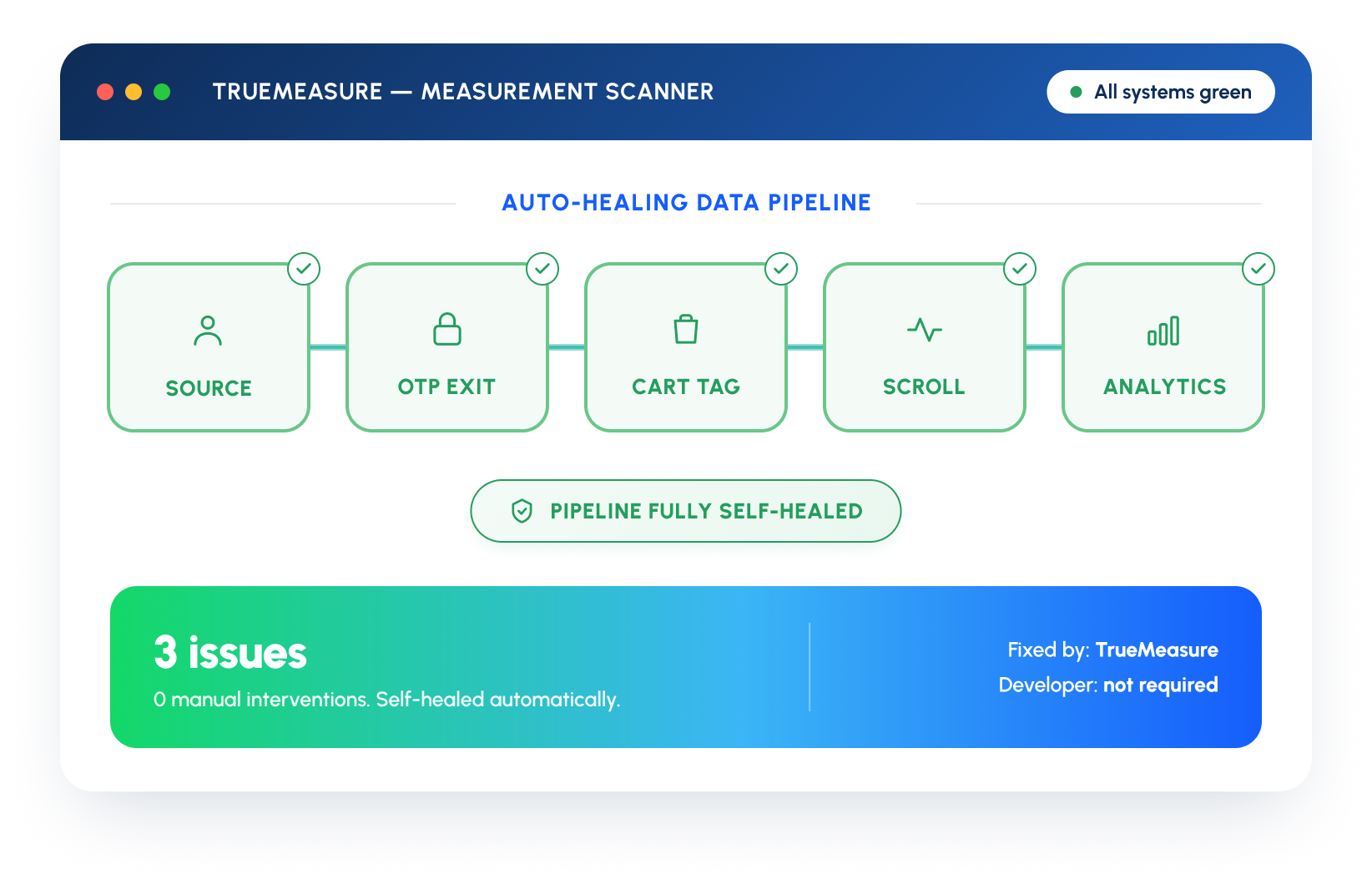
All three were fixed automatically. Zero manual interventions. The pipeline self-healed.
In this example, three tracking issues were identified across the funnel from source through to the analytics layer.
This is what measurement assurance looks like when it runs continuously, not a one-time cleanup, but a system that catches the drift after every redesign, every new payment provider, every campaign launch. The data entering your reports is verified before it gets there, not audited after something looks wrong.
This is where xerago’s TrueMeasure sits in that layer. It works alongside your existing analytics tools and tag managers to audit and fix how your funnels are actually measured across your digital analytics audit stack using DOM discovery, tag extraction, mismatch detection, and approved fixes, TrueMeasure answers the question your analytics platform was never designed to ask: is the data going into these tools accurate?
---cta--- **Is your conversion rate real, or just what your tags happened to send?**Find out how much of your funnel is actually being tracked correctly. Start a Digital Measurement Audit
Where Measurement Assurance Fits in the Stack
TrueMeasure works alongside your existing analytics stack, checking the one layer GA4, Adobe Analytics, and your tag manager were never built to check on their own.
Once the fixes are approved, there's no manual SDR rewrite and no separate QA cycle waiting behind it the corrected spec and the validation run are part of the same pass.
Most teams already have the tools to collect and report data. What's missing is a layer that continuously confirms the data those analytics tools are collecting is the data they were supposed to collect. That's the gap measurement assurance closes not by adding another dashboard, but by validating the one you already trust.
In practice, this runs as a sequence:
- DOM discovery maps every interactive element on a page to buttons, forms, fields, transitions against what a real user actually encounters, not what a spec from two years ago assumed they would.
- Tag extraction pulls every live tag and trigger currently firing across the funnel, so there's a complete record of what's actually being measured right now, not what's documented as being measured.
- Mismatch detection compares the two. This is where a submit event that fires on click instead of confirmation gets caught, where a duplicate add-to-cart tag gets flagged, where a coupon field with no tag at all becomes visible for the first time.
- Approved fixes are reviewed and implemented confirmed against business priority first, so the highest-impact gaps close before the smaller ones.
- Validation runs again after deployment, confirming the fix actually fixed the thing it was meant to fix before that corrected data starts feeding any report.
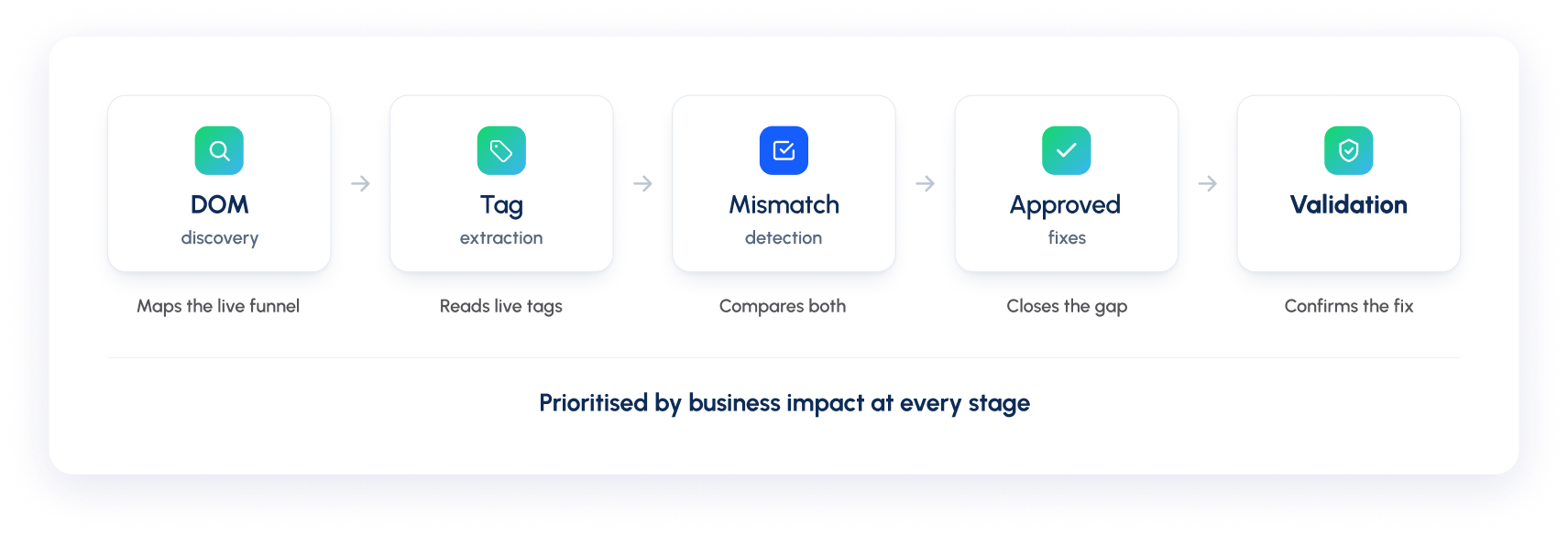
This runs alongside GA4, Adobe Analytics, Mixpanel, or whatever the existing stack already is the same way a structural inspection confirms a building matches its blueprint without replacing the building itself.
This is also where measurement assurance differs from a one-time cleanup project. A single audit tells you the state of your tracking on the day it ran. A continuous layer tells you whether that state holds after the next redesign, the next payment provider switch, the next campaign launch instead of waiting for a number to look wrong before anyone checks.
Before You Optimize the Funnel, Verify the Measurement Layer
The standard response to a performance problem is to change something in the product or the campaign. That's the right response when the data is reliable. When the data is not reliable, optimisation effort goes in the wrong direction no matter how good the next campaign or redesign is.
Tracking problems are quiet. They don't announce themselves. A dashboard with a tracking error looks the same as one without. The difference shows up in the decisions, and by the time those decisions have been made and acted on, the cost of the error has already compounded.
This is what analytics data quality actually means in practice tracking accuracy you can verify, not just a dashboard that looks clean. A measurement audit compares what the funnel should be measuring against what the analytics actually captures. That gap is where optimisation decisions go wrong. Closing it doesn't require replacing the analytics stack. It requires verifying that the data entering it is accurate.
---outlined-cta--- Start with a Digital Measurement Audit