---blog Title---
Customer Journey Analytics: The Ultimate Guide (Tools & Examples)
---desktop---

---mobile---

The customer journey is a story, and every interaction is a chapter.
Each decision a customer makes, each step they take, and every touchpoint they encounter is a part of a larger narrative that leads them toward or away from your brand.
But how well do you truly understand this journey? Do you know the exact moments that propel them forward or the ones that cause them to lose interest and fall off?
Customers engage with brands through multiple channels, each interaction offering a glimpse into their thoughts, preferences, and behaviors. Yet, too often, businesses focus on isolated touch points rather than understanding the journey as a whole.
Customer journey analytics bridges that gap by giving you the full picture—an integrated view of how customers interact with your brand from start to finish. By mapping out every step of the customer’s experience, you can pinpoint where they are most engaged, where they face obstacles, and what ultimately motivates them to take action. Understanding these moments helps you refine your approach, deliver more personalized experiences, and ensure you’re meeting your customers’ needs at every turn.
---cta--- Want to know what's next in CX? Grab the 2025 Trends & Strategy Guide now Download Now
So, how can you transform these insights into actions that drive meaningful engagement? Let’s explore how customer journey analytics can help you do just that.
What Is Customer Journey Analytics?
Customer journey analytics is a method of collecting, tracking, and analyzing data to understand the entire experience a customer has with a brand across multiple touchpoints. It goes beyond just looking at isolated interactions, such as website visits or social media engagements, and instead connects these interactions to form a comprehensive picture of the customer’s entire journey from awareness to consideration, purchase, and even post-purchase. It differs from customer journey analysis, which focuses on evaluating behavioral trends and patterns to improve engagement strategies.
This analysis includes both qualitative and quantitative data, such as website behavior, mobile app usage, email responses, call center interactions, and social media activity. By gathering all this data, businesses can identify patterns, behaviors, and pain points throughout the customer’s journey.
For example, if customer journey analytics tools reveal that customers frequently abandon their carts at the checkout stage, businesses can use this data to address the friction points causing drop-offs—whether it’s a complicated checkout process or unexpected shipping costs—and take steps to improve the overall experience.
The customer journey is a story, and every interaction is a chapter.
Each decision a customer makes, each step they take, and every touchpoint they encounter is a part of a larger narrative that leads them toward or away from your brand.
But how well do you truly understand this journey? Do you know the exact moments that propel them forward or the ones that cause them to lose interest and fall off?
Customers engage with brands through multiple channels, each interaction offering a glimpse into their thoughts, preferences, and behaviors. Yet, too often, businesses focus on isolated touch points rather than understanding the journey as a whole.
Customer journey analytics bridges that gap by giving you the full picture—an integrated view of how customers interact with your brand from start to finish. By mapping out every step of the customer’s experience, you can pinpoint where they are most engaged, where they face obstacles, and what ultimately motivates them to take action. Understanding these moments helps you refine your approach, deliver more personalized experiences, and ensure you’re meeting your customers’ needs at every turn.
Want to know what’s next in CX? Grab the 2025 Trends & Strategy Guide now
Download Now So, how can you transform these insights into actions that drive meaningful engagement? Let’s explore how customer journey analytics can help you do just that.
What Is Customer Journey Analytics? Customer journey analytics is a method of collecting, tracking, and analyzing data to understand the entire experience a customer has with a brand across multiple touchpoints. It goes beyond just looking at isolated interactions, such as website visits or social media engagements, and instead connects these interactions to form a comprehensive picture of the customer’s entire journey from awareness to consideration, purchase, and even post-purchase. It differs from customer journey analysis, which focuses on evaluating behavioral trends and patterns to improve engagement strategies."
This analysis includes both qualitative and quantitative data, such as website behavior, mobile app usage, email responses, call center interactions, and social media activity. By gathering all this data, businesses can identify patterns, behaviors, and pain points throughout the customer’s journey.
For example, if customer journey analytics tools reveal that customers frequently abandon their carts at the checkout stage, businesses can use this data to address the friction points causing drop-offs—whether it’s a complicated checkout process or unexpected shipping costs—and take steps to improve the overall experience.
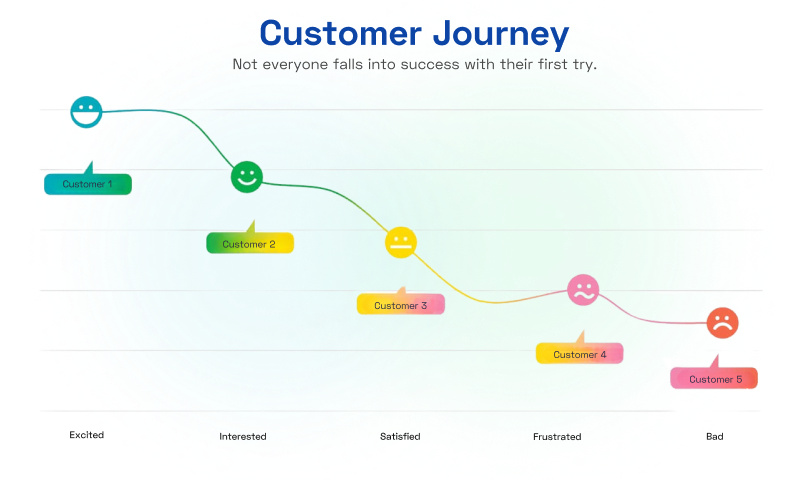
In simple customer journey analytics helps businesses make data-driven decisions to boost engagement, increase conversions, and improve retention by creating seamless, relevant experiences at every stage.
---outlined-cta---
A Guide to Implement Customer Journey Analytics- Download Now
Why Should You Care About Customer Journey Analytics?
Customers are more informed and have higher expectations than ever, making it essential to understand how they interact with your brand across all customer journey touchpoints. If you're not leveraging customer journey analytics, you're essentially flying blind when it comes to understanding their needs and pain points. By tracking customer journeys, businesses can gain detailed insights into customer behaviors and preferences, allowing them to tailor messaging, offers, and content for more relevant, personalized experiences.
Here are more reasons why you should care about CJA.
- Without CJA, you miss the ability to identify key moments in the customer journey, leaving you uncertain about which touchpoints truly drive customer decisions.
- CJA helps uncover pain points where customers are facing challenges or friction, providing clarity on areas needing improvement.
- With CJA, you gain detailed insights into customer preferences and behaviors, allowing you to tailor messaging, offers, and content to each customer and create more relevant, personalized experiences.
- By tracking a customer’s interactions across multiple channels, CJA enables you to connect the dots between online and offline behaviors, helping you truly understand their needs, motivations, and pain points.
- CJA also helps track customer sentiment across the journey. Understanding how customers feel at each touchpoint whether satisfied, frustrated, or confused—enables you to adapt your approach and create more positive, engaging interactions.
- With CJA, you're no longer working with fragmented or siloed data. You can break down data barriers, integrate insights from multiple departments, and create a unified strategy that works across marketing, sales, and customer service.
- Moreover, CJA helps improve resource allocation by identifying the most effective touchpoints and channels. By focusing on the areas that matter most, businesses can maximize ROI and optimize their marketing spend.
Customer Journey Analytics Vs Customer journey mapping
Customer Journey Mapping (CJM) is a visual representation that outlines the steps a customer takes when interacting with your brand. It helps businesses design and improve the customer experience by identifying key touchpoints and emotions, but it's a static tool that may become outdated as customer behavior changes.
Customer Journey Analytics mapping (CJA), on the other hand, uses real-time data to track and analyze actual customer behavior across various touchpoints. It provides actionable insights by identifying pain points, optimizing interactions, and personalizing the experience, all based on actual data rather than just perceptions.
In short, CJM helps design the customer experience, while CJA helps measure and optimize it based on real-time customer behavior. Together, they allow businesses to both visualize and refine the customer journey continuously.
| Feature | Customer Journey Mapping | Customer Journey Analytics mapping |
| Definition | A static visualization of the ideal customer journey. | A dynamic, data-driven analysis of real customer behavior. |
| Focus | Hypothetical paths customers take. | Actual, real-time interactions and trends. |
| Data-Driven? | Not necessarily—often based on assumptions. | Yes—relies on actual data from multiple sources. |
| Use Case | Used for planning and designing experiences. | Used for optimizing and improving experiences in real time. |
| Key Insights | Customer needs, pain points, and general expectations. | Behavioral trends, predictive insights, and impact assessment. |
| Purpose | Helps design a structured customer experience. | Helps measure, analyze, and improve the experience dynamically. |
Together, customer journey tracking, analytics, and mapping allow businesses to both visualize and refine the customer journey continuously.
How to Get Started with Customer Journey Analytics
Implementing Customer Journey Analytics doesn’t have to be overwhelming. By following a structured approach, you can systematically analyze and optimize the customer journey, leading to better engagement, higher conversions, and increased retention.
Here’s a step-by-step guide to getting started with customer journey analytics tools:
Step 1: Map the Customer Journey
Before you analyze customer journey data, you need a clear customer journey map that outlines:
What to include in your map:
- Stages: Awareness → Consideration → Purchase → Post-Purchase → Loyalty
- Touchpoints: Website, social media, emails, ads, customer support, in-store visits
- Customer expectations: What are they hoping to achieve at each stage?
- Potential drop-off points: Where do customers tend to disengage?
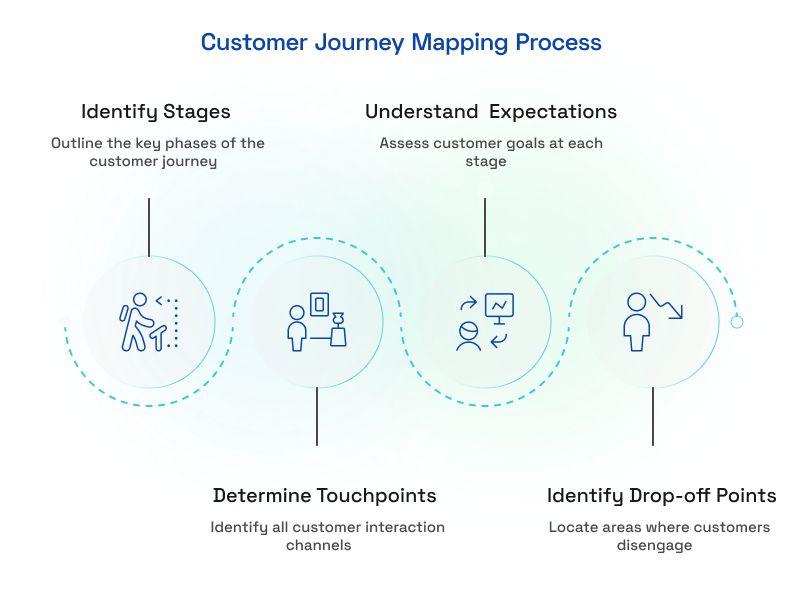
For example, you run an online clothing store. A customer sees your Instagram ad, visits your site, browses a few products, and adds one to their cart. But then they disappear. If your journey map shows many customers dropping off at checkout, it could be a sign of hidden frustrations—unexpected fees, a complicated process, or lack of payment options.
With customer journey analytics, you can track these behaviors and make data-backed optimizations to reduce abandonment and increase conversions.
Step 2: Collect & Connect Customer Data
Customers interact with your brand in more places than ever—your website, social media, email, ads, and customer support. But if your data is scattered across different platforms, you're only seeing pieces of the puzzle instead of the full picture.
Where to gather customer data from:
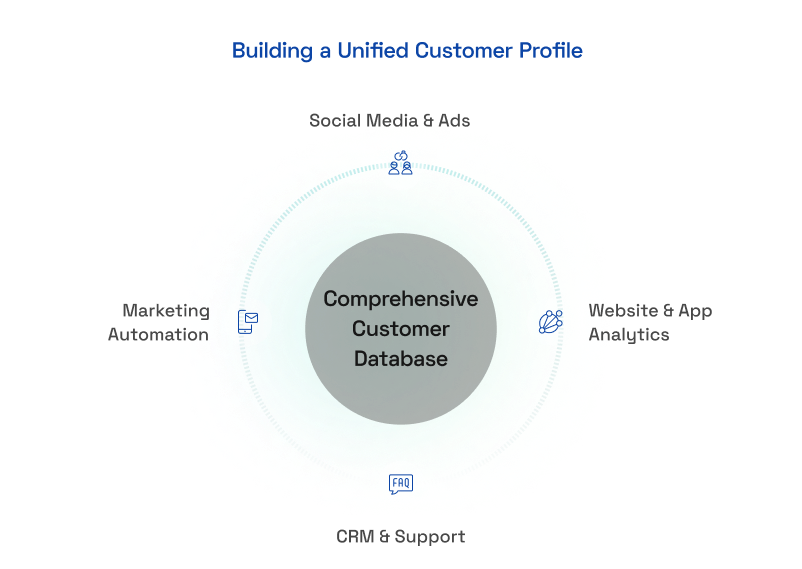
- Website & app analytics – Google Analytics, Adobe Analytics
- CRM & customer support – Salesforce, HubSpot, Zendesk
- Marketing automation tools – Marketo, Mailchimp
- Social media & ad platforms – Facebook Ads, Google Ads, LinkedIn
Why It Matters:
A customer journey analytics platform consolidates all this data, creating a single, unified view of customer behavior. Without this integration, businesses only see isolated interactions rather than the full customer journey.
Let’s say a customer first discovers your brand through a Google search, then clicks a Facebook ad a few days later, and finally makes a purchase after receiving an email offer. Without connected data, these actions look like separate events—but when linked, they reveal a clear buying journey that helps you improve engagement at each stage.
Step 3: Identify Key Metrics to Track
Not all data is useful, so focus on the metrics that actually tell you how well your customer journey is working.
Key metrics to monitor:
- Conversion Rate: Percentage of visitors who complete a desired action (purchase, sign-up, etc.).
- Churn Rate: Percentage of customers who stop engaging or cancel subscriptions.
- Engagement Rate: Measures customer interactions across emails, social media, and website content.
- Time to Purchase: How long does it take for a customer to move from the first interaction to conversion?
- Net Promoter Score (NPS) & Customer Satisfaction (CSAT): Indicators of how satisfied customers are with their experience.
Customer Journey Metrics
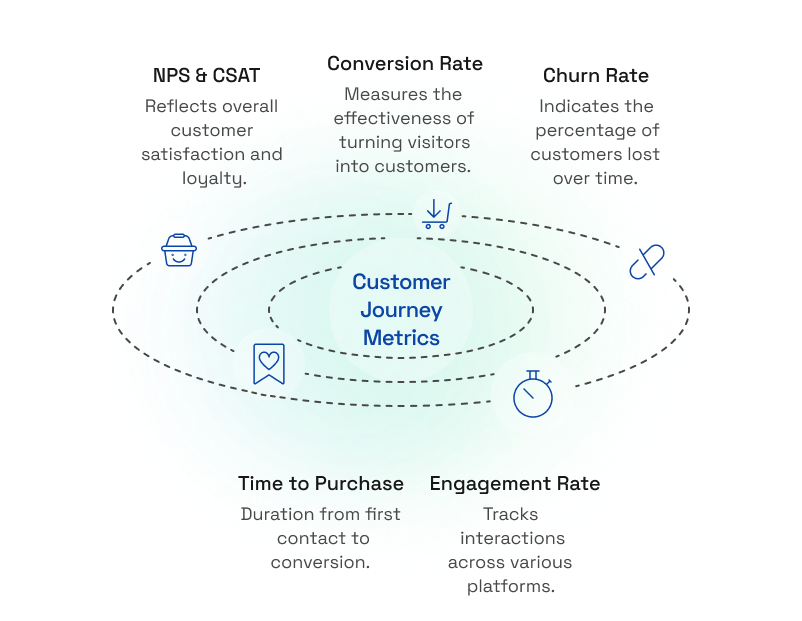
Tracking these KPIs helps businesses analyze customer journeys, identify drop-off points, and make data-driven decisions to improve retention and conversion.
If you notice a high churn rate after a free trial, it could mean customers don’t see enough value to stick around. Maybe your onboarding emails aren’t clear, or maybe they’re confused about how to use your product. Tracking this metric helps you pinpoint where the problem is—and how to fix it.
Step 4: Spot Trends & Predict Behavior
Once you have your data, it’s time to look for patterns and understand what’s influencing customer decisions. By leveraging customer journey analysis, businesses can identify trends that impact engagement, retention, and conversions.
What to analyze:
- Where do customers drop off most often?
- Which marketing channels bring the most engaged customers?
- How do returning customers behave differently from first-time buyers?
- What are the common paths to conversion?
Understanding customer journey analytics examples helps businesses refine marketing, sales, and support strategies. AI-powered customer journey analytics tools can even predict which customers are at risk of churning and suggest proactive interventions.
Let’s say you run an e-commerce store and notice that customers who visit your FAQ page before buying are 20% more likely to complete their purchase. That insight tells you that product concerns might be a common hesitation—so adding key FAQs directly on product pages could help remove that friction.
---outlined-cta---
Download the CX Trends Framework to Guide 2025 Planning and Execution - Access Now
Step 5: Optimize & Improve
Now that you’ve identified pain points and successful patterns, it’s time to take action and refine the customer journey.
Ways to improve the customer journey:
- Remove friction points – If checkout abandonment is high, simplify the process.
- Personalize experiences – Use behavioral data to send relevant emails, recommendations, and offers.
- Refine marketing efforts – Focus on the channels that bring the best customers.
- A/B test and iterate – Try different approaches and measure what works best.
Customer journey analytics isn’t a one-time process—it’s ongoing. The more businesses track customer journeys, the more they can improve experiences, boost retention, and drive higher revenue.
For instance, if you notice that mobile users drop off at checkout, the issue might not be pricing or product-related —it could simply be that your checkout process isn’t optimized for mobile. Making a small change, like streamlining form fields or adding one-click payment options, could significantly boost conversions.
How to Use Customer Journey Analytics: 5 Real Time Examples
From personalizing website experiences to proactively addressing customer issues, CJA enables you to respond to your customers’ needs in real-time, ensuring a seamless and engaging journey across every touchpoint. Let’s take a closer look at how you can use CJA to optimize customer experiences and drive better outcomes in the moment.
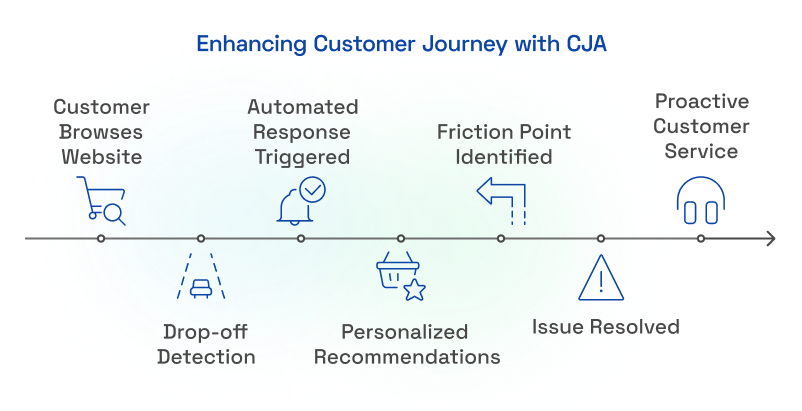
1. Optimize website Experience in Real Time
A customer is browsing your website but exits during the checkout process. Withhelp of CJA now you can do the following to enhance this journey
- Track where they dropped off (e.g., abandoned cart).
- Trigger an automated email or in-app message offering a discount or reminder to return and complete the purchase.
- Adjust the website's layout or content dynamically (such as adding a coupon pop-up or simplifying the checkout process) based on insights from the journey analytics.
2. Personalized Recommendations Based on Behavior
A customer repeatedly looks at a specific category of products but doesn't purchase.
Using real-time insights from CJA, you can send personalized recommendations or offer tailored discounts on the products they are showing interest in. On the next visit, you can dynamically update the website with these specific products on the homepage or send a personalized email featuring those products.
3. Identifying Friction Points and Fixing Them Immediately
You notice a significant drop-off on a specific page of your website.
Use the data from CJA to pinpoint the exact moment customers face friction (e.g., slow load times, confusing navigation). Fix the issue immediately (e.g., optimize page speed, simplify forms) or trigger a support pop-up to assist customers who are stuck. You can also test new design or content adjustments and measure them in real time using CJA to see if they reduce the friction.
4. Proactive Customer Service Based on Interaction Data
A customer interacts with your support chat but seems frustrated, as indicated by their repeated questions or long response times.
Use real-time analytics to detect signs of frustration (e.g., frequent back-and-forth with support). Trigger a proactive action, such as escalating the issue to a more experienced support agent or offering a special promotion to resolve their dissatisfaction.
5. Creating a Seamless Multi-Channel Experience
A customer starts browsing products on their mobile app but later switches to a desktop for the same session.
Track their journey across devices using CJA, and ensure they have the same experience on both. Present consistent product recommendations or offer cross-device discounts to encourage them to continue their purchase on the new device.
With CJA, you can not only identify these moments but also respond in real-time, delivering a tailored and frictionless journey that keeps customers engaged and satisfied.
Best Tools for Customer Journey Analytics
Choosing the right customer journey analytics platform can help businesses track customer journeys, analyze interactions, and optimize experiences at every touchpoint. Here are some of the best tools for CJA:
- Adobe Experience Platform Adobe Experience Platform provides advanced customer journey analytics by integrating data across marketing, sales, and customer service platforms. It leverages AI and machine learning to deliver personalized insights, helping enterprises optimize the customer experience at scale. Its cross-channel data integration helps businesses track, analyze, and act on customer behavior in real time.
- Salesforce Marketing Cloud Salesforce’s Marketing Cloud is a comprehensive tool for customer journey analytics, enabling businesses to create and optimize personalized experiences across email, web, mobile, social, and advertising channels. It integrates with Salesforce's CRM to provide a 360-degree view of the customer journey, offering powerful segmentation, tracking, and reporting features.
- Microsoft Dynamics 365 Customer Insights Microsoft Dynamics 365 Customer Insights is an AI-driven platform that unifies customer data from multiple sources to provide a comprehensive view of the customer journey analysis process and behavioral patterns. It allows enterprises to analyze customer interactions across channels and touchpoints, making it easier to create personalized experiences that enhance customer loyalty and retention.
- Google Analytics 360 Google Analytics 360 is the enterprise version of Google Analytics, providing advanced features and integrations for customer journey analytics. It offers robust reporting, data visualization, and cross-channel tracking capabilities, helping businesses analyze user behavior across web, app, and offline channels in real time.
- SAP Customer Data Cloud SAP’s Customer Data Cloud enables enterprises to unify customer data, offering deep insights into customer behavior and interactions across multiple touchpoints. It provides analytics tools that help businesses optimize personalization, segmentation, and overall customer experience.
- Oracle CX Cloud Suite Oracle’s Customer Experience (CX) Cloud Suite is a comprehensive platform that includes customer journey mapping, analytics, and personalized marketing automation. It integrates data from sales, service, and marketing to provide a unified view of the customer journey, enabling businesses to take targeted actions based on real-time insights.
- Tealium Tealium is an enterprise-grade customer data platform that offers journey analytics across various touchpoints, including websites, mobile apps, and offline channels. It provides advanced tracking, segmentation, and reporting tools, enabling businesses to connect real-time data across their marketing ecosystem and deliver personalized experiences.
---outlined-cta---
Transform Insights into Impactful CX Strategy with this Free Guide - Download Now
Benefits of customer journey analytics
Adopting customer journey analytics tools can significantly enhance your customer experience analytics by helping you track customer journeys and optimize interactions. Here are the key benefits of customer journey analytics:
- Real-Time Issue Resolution: With a customer journey analytics platform, businesses can identify and address issues as they arise. By marking pain points in real time, customer journey analytics software enables swift corrective actions and testing of new approaches to enhance the customer experience.
- Understanding Purchase Decisions: Customer journey analysis reveals the factors influencing purchasing decisions. A customer journey analytics tool provides insights into which platforms and demographics are most effective for lead generation, helping businesses identify the customer journey touchpoints that enhance conversion.
- Mitigating Churn: Understanding why customers disengage is crucial for retention efforts. End-to-end customer journey analytics helps pinpoint the stages where potential customers drop off, allowing for strategic interventions to reduce churn.
- Customer-Centric Insights: By evaluating customer activities, expectations, and sentiments, customer journey analytics platforms offer a comprehensive view of what drives customers along the buying cycle. This enables businesses to tailor their customer experience analytics strategy for better engagement and loyalty.
- ROI Visibility: A data-driven customer journey strategy provides clarity on the ROI of customer experience analytics initiatives. With insights from customer journey analytics tools, businesses can optimize their investments and focus resources on initiatives that yield tangible business outcomes.
Customer Journey Analytics offers much more than just insight. It equips you to turn real-time data into meaningful actions that resonate with customers at every stage of their journey. By integrating customer touchpoints and using behavioral insights, CJA helps identify opportunities for optimization, allowing businesses to adapt quickly and stay ahead of shifting customer expectations.
It’s a continuous feedback loop that keeps you ahead of customer expectations, ensuring your brand is relevant, responsive, and impactful at every moment of their journey.