

How to Predict What Customers Will Do Next


Effective Strategies for Customer Loyalty Data Governance
With customer expectations constantly evolving, businesses must move beyond reactive strategies and begin anticipating their needs. Predicting how customers will interact with products, services, or content not only helps meet their expectations but also empowers companies to take proactive action instead of reacting to changes. But how can you achieve this?
Customers rarely announce what they will do next. They leave signals instead: a drop in logins, repeated product views, a change in purchase frequency, a support complaint, an abandoned cart, or renewed interest in a specific category. Customer behavior prediction turns those signals into probabilities that businesses can act on before the outcome happens.
In 2026, the opportunity goes beyond building a model from historical data. Effective customer prediction increasingly depends on unified first-party data, event-level behavioral signals, identity resolution, real-time scoring, reliable measurement, and the ability to activate predictions inside customer journeys.
This guide explains customer behavior prediction, customer behavior modeling, the machine learning techniques behind it, the data you need, how to validate prediction quality, and how to turn scores into practical marketing and customer-experience decisions.
What is Customer Behavior Prediction?
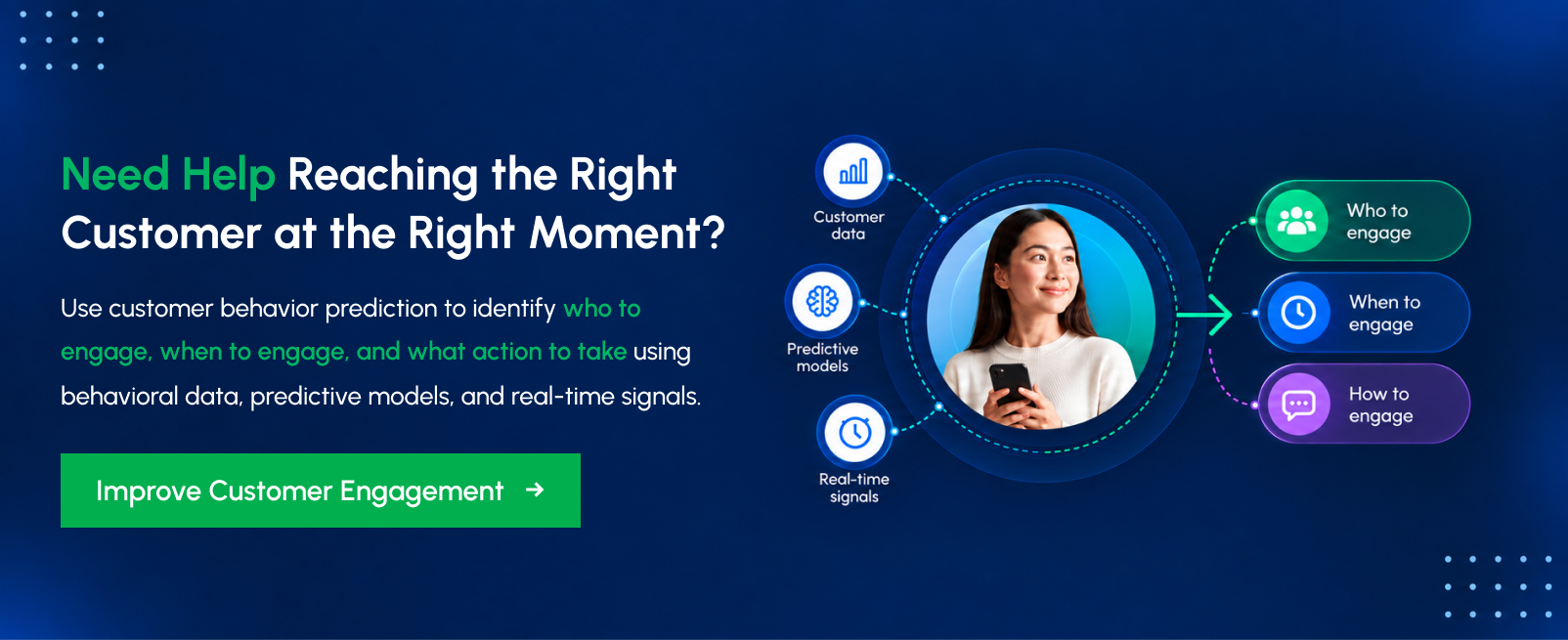
Customer behavior prediction is all about understanding what customers might do based on past data. It involves analyzing and researching customer behaviors from various sources to gain insights into future actions. Businesses can utilize all types of data such as first-party, third-party, and offline data and apply methodologies like predictive analytics to make accurate predictions
Key Points:
- Customer behavior prediction uses historical data to forecast future actions, helping businesses understand what customers will likely do next.
- It can predict outcomes such as purchase likelihood, churn, lifetime value, engagement, next-best action, channel preference, or response timing.
- The goal is not prediction for its own sake. The prediction should lead to a measurable action such as changing a journey, prioritizing an audience, preventing churn, or improving an offer.
Customer Behavior Prediction vs. Customer Behavior Modeling
Customer behavior modeling and customer behavior prediction are closely related, but they are not exactly the same. Customer behavior modeling is the broader process of representing patterns in how customers interact, purchase, engage, and move through a journey. Customer behavior prediction uses those patterns to estimate a future outcome.
| Concept | What it does | Example |
|---|---|---|
| Customer behavior modeling | Finds and represents recurring patterns in customer activity. | Frequent browsing + recent purchase + high email engagement. |
| Customer behavior prediction | Estimates the probability of a future event from those patterns. | 68% likelihood to purchase in the next 14 days. |
A useful way to think about it is: modeling describes the behavioral pattern; prediction converts that pattern into an expected outcome or probability score.
Why Is Predicting Customer Behavior Important?
When you have past data and trends, it provides a clearer picture of future actions, enabling you to make better decisions. By understanding customer behavior, you can achieve the following,
- Enhanced Customer Retention
- Increased Conversion Rates
- Personalized Customer Experiences
- Improved Cross-Selling and Upselling
- Improved Customer Service
- Customer Churn Prevention
- Better Customer Segmentation
The real value appears when predictions change what a business does. A churn score can prioritize retention treatment, a purchase-propensity score can suppress irrelevant offers, and a next-best-action model can determine whether the right intervention is an offer, reminder, service message, or no message at all.
What Customer Behaviors Can You Predict?
To truly connect with customers, it’s important to understand their behavior. By recognizing the different types of customer actions and patterns, businesses can tailor their strategies for better engagement and satisfaction. From predicting what customers might do next to mapping their entire journey, these insights help create more personalized and effective marketing.

- Purchase Behavior: By analyzing purchase patterns, businesses can use customer behavior prediction to understand the frequency, timing, and nature of a customer's buying actions, such as impulse buys or repeat purchases.
- Browsing Behavior: Understanding how customers interact with your website or app allows businesses to predict customer behavior and tailor content based on the pages they visit, the products they view, and the time they spend.
- Engagement Behavior: Behavioral segmentation helps businesses identify and analyze how customers engage with content, ads, and customer service channels, such as social media activity, email responses, and click-through rates.
- Churn Behavior: Using customer churn prediction, businesses can identify indicators that a customer may disengage, such as reduced interaction or purchase frequency, allowing proactive retention strategies.
- Loyalty Behavior: Customer predictive analytics helps predict loyalty behavior by analyzing patterns of repeat purchases and long-term engagement with the brand, assisting in creating personalized loyalty programs.
- Cart Abandonment Behavior: Customer behavior modeling helps predict when a customer may abandon their shopping cart, allowing businesses to implement targeted strategies to encourage them to complete their purchase.
Browsing, engagement, loyalty, purchase frequency, and cart behavior are still important inputs. The optimization is to frame them as signals that support a clearly defined prediction rather than as isolated behavior categories.
How Does Machine Learning Predict Customer Behavior?
Machine learning predicts customer behavior by learning relationships between past customer signals and known outcomes. It then applies those learned relationships to current customers and produces a score or probability for what may happen next.
A typical workflow looks like this:
- Collect behavioral, transactional, CRM, product, campaign, and service data.
- Resolve customer identity so events from different systems can be connected appropriately.
- Create features such as recency, frequency, session depth, product usage, purchase value, complaint count, or engagement change.
- Train the model on historical examples where the outcome is already known.
- Score current customers with a probability, class, expected value, or ranked recommendation.
- Activate the score inside CRM, CDP, campaign, service, product, or decisioning workflows.
- Capture the result and feed it back into model evaluation and retraining.
Common machine learning techniques
| Technique | Typical use |
|---|---|
| Logistic regression | Churn, conversion, renewal or response probability where interpretability matters. |
| Decision trees / random forests | Non-linear relationships across many customer attributes and behaviors. |
| Gradient boosting | High-performing propensity, churn and value prediction on structured customer data. |
| Clustering | Discovering behavioral groups when predefined labels are not available. |
| Recommendation algorithms | Product, content or offer recommendations based on customer and item behavior. |
| Sequence / time-series approaches | Predicting what may happen next, and sometimes when it may happen. |
| Uplift / causal models | Estimating which customers are likely to change behavior because of a specific intervention. |
The most complex algorithm is not automatically the best choice. A simpler, well-calibrated model connected to good data and a clear business action can be more useful than a highly complex model that teams cannot explain, validate, or operationalize.
Customer Behavior Prediction Models and Frameworks
Customer behavior models offer data-backed insights into how customers are likely to act helping businesses proactively respond rather than react. These models provide practical frameworks that businesses across industries use to predict actions like purchase decisions, churn, and engagement levels.
Let's explore the most valuable customer behavior models, how they work, and when to apply them.
1. RFM Model (Recency, Frequency, Monetary Value)
The RFM model is a customer segmentation technique that helps categorize customers based on their past purchasing behavior. It breaks down customers into three dimensions:
- Recency: How recently did the customer make a purchase?
- Frequency: How often does the customer purchase?
- Monetary Value: How much money does the customer spend in total?
RFM is best treated as a behavioral scoring framework and a useful feature source for prediction rather than as a machine learning model by itself. RFM scores can help identify loyal, high-value, inactive, or at-risk customers and can also be used as inputs into churn, propensity, or CLV models.
2. Churn Prediction Model
This model helps identify customers who are likely to stop using products or services. It works by analyzing various behavioral signals such as declining purchase frequency, reduced engagement with emails or app logins, customer complaints, and negative sentiment from surveys or reviews.
Machine learning algorithms like Logistic Regression, Random Forest, or Gradient Boosting assign each customer a probability score indicating how likely they are to churn. The higher the probability, the greater the risk of losing that customer.
Key indicators used to predict churn include:
- Declining purchase frequency
- Reduced app logins
- Lower response rates to emails
- Customer complaints
- Negative sentiment from surveys or reviews
The output is usually a probability or risk score. The business can then decide which customers should receive a retention intervention, which treatment to use, and which customers should not be contacted.
3. Customer Lifetime Value (CLV) Model
The CLV model predicts the total revenue a customer is likely to generate for a business over the entire course of their relationship. It helps businesses understand the long-term financial value of each customer, rather than just focusing on short-term transactions.
The model answers the fundamental question: How much is this customer worth to my business over time?
By estimating future revenue, businesses can make more informed decisions on customer acquisition costs, marketing budgets, and retention strategies.
CLV is typically calculated using Regression Models that analyze:
- Purchase frequency
- Average order value
- Retention rates
CLV is useful for acquisition budgeting, retention prioritization, service differentiation, cross-sell strategy, and deciding how much the business can economically invest in a customer relationship.
4. Propensity Model
The propensity model uses predictive analytics to forecast the likelihood of a customer taking a specific action, such as making a purchase, clicking on an email, or responding to a marketing campaign. It assigns a propensity score a probability value between 0 and 1 to each customer, indicating how likely they are to engage with a particular offer or campaign.
Machine learning algorithms like Logistic Regression, Decision Trees, or Gradient Boosting Machines analyze customer data such as past purchase history, email interactions, website visits, demographics, and campaign responses to predict future actions.
For example, if a customer frequently browses a product category and clicks on promotional emails but hasn't made a purchase, the model might assign them a 70% probability of buying. This insight allows businesses to trigger personalized follow-up emails, discounts, or reminders to encourage the purchase.
5. Look-Alike Modeling
Look-alike modeling identifies prospects who resemble existing high-value or high-intent customers. It is commonly used for prospecting and acquisition, but it should be treated separately from first-party customer prediction because the target population may be unknown prospects rather than existing identified customers.
This model uses clustering algorithms like K-Means or Logistic Regression to group customers based on common behaviors, demographics, or purchase patterns. It plays a critical role in customer acquisition strategies by enabling businesses to target the right audience, rather than casting a wide net with generic marketing campaigns.
Best uses of Look-Alike Modeling include:
- Paid media campaigns
- Prospecting
- Customer acquisition
6. Next Best Action (NBA) Model
The NBA model leverages predictive analytics to determine the most relevant action, offer, or communication to present to each customer at any given time. Instead of following static rules or generic campaigns, this model uses real-time data and machine learning algorithms to recommend personalized actions that are most likely to engage the customer.
The model works by analyzing:
- Past purchase history
- Browsing behavior
- Transaction patterns
- Customer preferences
- Engagement signals (email clicks, app logins)
Machine learning algorithms like Random Forest, Gradient Boosting Machines, or Neural Networks predict which action the customer is most likely to respond to at that moment. This model shifts marketing from a product-centric approach to a customer-centric approach, offering what the customer needs at the right time rather than pushing random promotions.
7. Collaborative Filtering Model
Collaborative filtering is a widely used recommendation system that suggests products, content, or services to users based on the preferences and behaviors of similar customers. It operates on the principle that people with similar tastes are likely to have common preferences.
The model works by analyzing purchase history, ratings, reviews, and browsing patterns across a large pool of users. There are two primary types of collaborative filtering:
- User-Based Collaborative Filtering: Identifies users with similar preferences and recommends products they liked to others with matching tastes.
- Item-Based Collaborative Filtering: Focuses on product relationships—if many customers purchase Product A and Product B together, the system recommends Product B to anyone who buys Product A.
- Collaborative Filtering is widely adopted in e-commerce (Amazon's "Customers who bought this also bought"), streaming services (Netflix's movie recommendations), and content platforms (Spotify's playlist suggestions).
Customer behavior models help you move from reactive strategies to proactive, personalized customer experiences. By applying the right model at the right time, businesses can drive higher engagement, improve customer retention, and optimize revenue outcomes. Whether it's predicting churn, recommending products, or finding look-alike audiences, these models empower businesses to anticipate customer needs and deliver value at every stage of the customer journey.
What Data Do You Need to Predict Customer Behavior?
Predicting customer behavior is a powerful tool for businesses aiming to personalize their strategies and improve customer satisfaction. This guide outlines a step-by-step approach to effectively predict customer behavior, ensuring that businesses can make data-driven decisions that enhance customer engagement, retention, and overall business performance.
| Data type | Examples |
|---|---|
| Behavioral event data | Page views, searches, clicks, sessions, feature use, product views, form starts, journey steps. |
| Transaction data | Purchases, order value, frequency, product mix, returns, renewals. |
| CRM / account data | Lifecycle stage, account status, product holdings, sales interactions. |
| Campaign engagement | Email opens/clicks, message interactions, ad response, campaign exposure. |
| Product usage | Logins, features used, usage intensity, inactivity, adoption milestones. |
| Service data | Tickets, complaints, sentiment, resolution history, contact frequency. |
| Preference and consent data | Channel preference, consent state, contact permissions. |
| Identity signals | Identifiers used to connect known and anonymous activity. |
- Identity: Can relevant interactions be connected to the right customer or account without creating false matches?
- Freshness: Does the score reflect recent behavior, or is it based on data that is already stale?
- Measurement reliability: Are the events, conversions and attributes used for training actually implemented and collected correctly?
A predictive model built on incomplete event tracking, duplicate identities, inconsistent conversions, or broken tagging can produce confident-looking but unreliable scores. Data quality therefore has to be treated as part of model quality.
How to Predict Customer Behavior: Step by Step
1. Establish Clear Objectives & KPIs
The first step in predicting customer behavior is to define what you aim to achieve with these predictions. Your objectives should align with your business goals. For example,
- If your goal is to improve marketing campaigns, you might track metrics such as conversion rates, click-through rates, or customer acquisition costs.
- For customer retention, KPIs like churn rate, customer lifetime value, or Net Promoter Score (NPS) could be valuable indicators
- If your goal is product recommendations, you could track sales growth, cross-sell/up-sell rates, or customer satisfaction scores.
Setting these KPIs will ensure that your predictive models are targeted towards achieving measurable success and allow you to evaluate their effectiveness over time.
2. Focus on Data Quality & Unified Data Collection
To predict customer behavior accurately, high-quality data is crucial. Without reliable data, your predictions will not be effective. Gather clean, accurate, and consistent data from various sources:
- Purchase history: What have customers bought in the past?
- Website visits: Which pages do customers visit? What products do they browse?
- Social media interactions: What are customers saying online about your brand?
- Customer demographics: Understand key factors like age, location, and preferences.
Involving teams from marketing, sales, customer service, and data analytics in setting these objectives ensures that the predictive models align with various business functions.

For example, the sales team can provide insights on customer preferences, while the marketing team can share historical data on campaign performance. Collaborating with these departments ensures that your objectives are comprehensive and well-informed by real-world insights.
Rather than gathering data from fragmented sources (such as separate systems for purchase history, website visits, social media, and customer demographics), integrate your data sources into a single system.
This will create a unified view of each customer, allowing for more accurate predictions. Use a Customer Data Platform (CDP) or other integrated tools to bring all relevant data points together, ensuring consistency across different departments and platforms.
Once you have your data, it’s essential to ensure that it is comprehensive, consistent, and up to date. Implement data governance processes to maintain the integrity of your data and improve its usefulness for predicting customer behavior.
3. Choose the Right Predictive Models
Selecting the appropriate predictive models is crucial for accuracy. There are various techniques available for customer behavior prediction:

- If your goal is to predict customer churn, machine learning models like Random Forest or Logistic Regression can be useful, as they can handle large datasets and uncover hidden patterns related to churn.
- For predicting customer lifetime value (CLV), you may want to consider regression analysis, which can forecast numerical outcomes like total spend over a given period.
- If you aim to personalize marketing efforts, clustering models (e.g., K-Means clustering) can help group customers by similar behaviors or characteristics to target more precisely with tailored messages.
In the real world, it’s often beneficial to start with simpler models that are easier to implement and understand. Begin with regression analysis or decision trees to get a baseline, and then gradually experiment with more complex algorithms like random forests or support vector machines (SVMs).
Before committing to any model, test it using historical data to evaluate its predictive power. Implement a train-test split or cross-validation to assess performance.
For instance, if you’re predicting sales volumes, compare the accuracy of different regression models (e.g., linear regression vs. multiple regression) or evaluate machine learning algorithms like gradient boosting against simpler methods.
After deployment, create feedback loops where customer behavior is continuously tracked, and the model’s predictions are reviewed. This allows for iterative improvement.
For example, after a campaign based on predictive modeling, analyze whether the model accurately predicted customer response or sales outcomes, and use this feedback to fine-tune the model for better accuracy in future predictions.

4. Integrate Predictions into Your Decision-Making
Once you have predictive insights, it’s time to integrate them into your decision-making processes. Involve key stakeholders from marketing, sales, customer service, and product management to ensure predictive insights are aligned with department goals and strategies.
For instance, marketing teams can use customer behavior predictions to craft personalized campaigns, while product teams can adjust their offerings based on predicted demand trends.
Predictions should guide your actions, such as:
- Timing is key: Predict when a customer is most likely to engage with your brand (e.g., after a purchase, when their subscription is about to renew) and send personalized messages or offers at the right moment.
- Optimize customer support: Predict when customers may encounter issues (e.g., product delivery delays, account issues) and proactively reach out to resolve potential problems before they escalate.
- Dynamic pricing strategies: Predict customer price sensitivity and adjust prices in real-time to maximize sales while maintaining customer satisfaction.

To make predictions seamlessly part of your daily operations, integrate them into your Customer Relationship Management (CRM) and Marketing Automation platforms (such as Salesforce, HubSpot, or Adobe Marketo).
Gather feedback on how well predictions are translating into action. For instance, if a predicted customer segment isn’t responding as expected, revisit the segmenting criteria and adjust the model accordingly.
5. Monitor and Continuously Improve
Predicting customer behavior is an ongoing process that requires regular monitoring and improvement. Customer behavior evolves over time, so your predictive models should adapt accordingly. To ensure accuracy:
- Implement real-time monitoring tools that track the performance of your predictive models as customer behavior changes. This helps you quickly identify when a model starts to show signs of inaccuracy, allowing you to act before performance dips significantly.For example: Use dashboards or analytics platforms (like Power BI or Tableau) to track key performance metrics (e.g., prediction accuracy, conversion rates, engagement levels) continuously.
- Creating feedback loops across your organization ensures that insights are consistently validated. Regular communication with teams like marketing, customer service, and sales can provide real-world input on how predictive models are performing
- Make adjustments to your models as new data becomes available.
- Invest in training your team to stay updated on the latest predictive analytics techniques and best practices.
Regularly update your predictive models with new data to keep them accurate and aligned with evolving customer behavior.
How Do You Know if a Customer Behavior Prediction Is Accurate?
A customer prediction model should be evaluated at three levels: model discrimination, probability quality, and business impact.
| Validation layer | What to check |
|---|---|
| Model performance | Use metrics such as precision, recall, F1, ROC-AUC or PR-AUC depending on the problem and class balance. |
| Calibration | Check whether probability scores behave like probabilities. Customers scored around 70% should, over time, convert or churn at roughly the expected rate for that cohort. |
| Business impact | Compare outcomes against a control or holdout group. Measure incremental conversion, retention lift, revenue impact, cost reduction or another business KPI. |
This distinction matters. A model can perform well statistically but still fail to create value if the business cannot act on the score, if the intervention is ineffective, or if the score simply identifies customers who would have acted anyway.
How to Turn Customer Predictions Into Marketing and CX Actions
Prediction becomes useful when it changes the next decision in the customer journey. Common activation patterns include:
- Churn prevention: prioritize at-risk customers and select an appropriate retention treatment.
- Purchase propensity: focus offers or sales outreach on customers with high expected intent.
- Next-best action: choose between education, service, cross-sell, renewal, reminder, or no action.
- Journey recovery: intervene when a customer is likely to abandon a high-value step.
- Customer service: proactively address a likely issue before it becomes a complaint.
- Channel and timing optimization: contact customers when and where they are more likely to respond.
- Audience suppression: avoid spending budget or sending messages when the predicted value of intervention is low.
The activation rule should also respect consent, eligibility, frequency controls, product availability, policy restrictions, and human-review requirements where relevant.
What Tools Are Used to Predict Customer Behavior?
There is no single category of software that owns customer behavior prediction. The right stack depends on whether you need to unify data, build custom models, score audiences, or activate decisions.
| Tool category | Role in customer prediction |
|---|---|
| Customer Data Platforms (CDPs) | Unify customer data, build profiles or audiences, and pass prediction outputs into activation systems. |
| CRM and marketing automation | Use propensity or risk scores inside sales, lifecycle, nurture and service workflows. |
| Customer engagement / decisioning platforms | Use predictions for next-best action, channel selection, personalization and journey orchestration. |
| Product and behavioral analytics | Capture and analyze event-level digital behavior that can become model inputs. |
| Cloud data / ML platforms | Build, train, deploy and monitor custom models at scale. |
| BI and analytics tools | Monitor score distribution, prediction performance, drift and business outcomes. |
For enterprise teams, tool selection should be based on data access, identity, integration, governance, model transparency, activation latency, monitoring, security, and the ability to prove business lift—not simply the number of AI features in the interface.
How Predictive AI, GenAI and AI Agents Work Together
Predictive AI, generative AI, and AI agents solve different parts of the customer decision problem. Treating them as interchangeable can weaken both measurement and execution.
| Layer | Role |
|---|---|
| Predictive AI | Estimates what is likely to happen: churn risk, purchase probability, CLV, next action or timing. |
| Decisioning layer | Applies eligibility, policy, business rules, economics and context to decide what should happen. |
| Generative AI | Generates or adapts content, explanations, messages or recommendations using the approved context. |
| AI agent / workflow | Coordinates actions across systems within defined permissions and control boundaries. |
For example, a predictive model may identify a customer with high churn risk. A decisioning layer can determine whether the customer is eligible for an intervention. Generative AI can adapt the message to the customer's context, while an agent or workflow can coordinate the approved action across the engagement stack.
This makes the quality of customer data and measurement even more important: AI can only make reliable decisions when the context, identity, events and outcomes it receives are trustworthy.
5 Key Factors Influencing Customer Behaviour to make Decision
Customer decisions are not made in isolation, they are influenced by a range of factors that shape how they think, feel, and act. Understanding these factors helps to identify their behavior and act accordingly. Some of the key factors influencing customer behavior are:

- Psychological Factors – These are internal factors that drive how customers think, feel, and make decisions. Key aspects include motivation (what drives them to take action), perception (how they interpret information), learning (how past experiences shape future choices), and attitudes (how they feel about certain products or brands).
- Social Factors – These factors relate to the influence of other people or groups, such as family, friends, peers, or social networks. They include reference groups (those whose opinions customers value) and social roles (e.g., the role a person plays in society).
- Cultural Factors – These refer to the shared values, customs, and norms of a customer’s cultural or social group. These can include broader cultural influences (such as traditions or societal values) or more specific subcultures within a larger culture.
- Personal Factors – These are individual characteristics of customers, including age, occupation, income, lifestyle, personality, and life stage. Personal factors affect the way people make purchasing decisions and what they prioritize in a product or service.
- Situational Factors – Situational factors involve external conditions that may influence a customer’s decision-making process. This includes time pressures (urgency to make a decision), physical environment (store or online experience), and broader economic or market conditions.
Key Challenges in Predicting Customer Behavior
While predictive behavior modeling offers numerous advantages, businesses often face significant challenges that can impact the accuracy and effectiveness of customer behavior prediction models. Addressing these challenges is essential to anticipate customer behavior accurately and derive meaningful insights.
1. Data Quality Issues
One of the most critical challenges in predicting customer behavior is ensuring data accuracy, completeness, and consistency. Predictive models rely on large datasets, and if the data is outdated, incorrect, or incomplete, the insights generated may be misleading.
- Inconsistent customer records (e.g., duplicate entries, conflicting data points).
- Lack of real-time data updates, causing outdated behavioral predictions.
- Missing key behavioral attributes, leading to gaps in forecasting.
Solution: Implement strong data governance policies, use automated data validation techniques, and integrate a unified data collection system to ensure high-quality inputs.
2. Overfitting of Models
A common issue with customer behavior prediction models is overfitting, where the model is too finely tuned to past data, capturing unnecessary details instead of generalizable patterns. This means the model may perform well on historical data but fail when applied to new customer behavior trends.
- Excessively complex models that pick up noise instead of genuine patterns.
- Lack of generalization, leading to poor predictive performance on new data.
- Over-reliance on short-term trends, making predictions unreliable.
Solution: Use simpler, more interpretable models where possible, employ cross-validation techniques, and test models with new, unseen data before full implementation.
3. Changing Consumer Behavior
Customers’ needs, preferences, and behaviors are constantly evolving, influenced by market trends, technological advancements, economic shifts, and societal changes. A model trained on past data may become irrelevant if consumer behavior forecasting does not account for recent changes.
- Seasonal variations and market fluctuations impacting purchase behavior.
- Shifting digital engagement trends (e.g., from desktop to mobile-first interactions).
- Unexpected disruptions like global events, economic downturns, or industry shifts.
Solution: Continuously update customer behavior modeling by retraining models with fresh data, integrating real-time analytics, and regularly refining assumptions to reflect new customer trends.
4. Privacy and Data Compliance
With stricter data protection regulations such as GDPR (General Data Protection Regulation) and CCPA (California Consumer Privacy Act), businesses must be cautious about how they collect, store, and use customer data for predictive modeling for customer behavior.
- Legal risks of misusing personal data in predictive analytics.
- Limited data availability due to privacy laws restricting third-party data access.
- Customer trust concerns, as excessive data tracking may feel invasive.
Solution: Implement privacy-first data collection strategies, ensure compliance with local and global regulations, and use anonymized or aggregated data for analysis. Transparency in data usage policies also builds customer trust.
5. Integration with Business Strategies
Even with accurate customer behavior prediction models, businesses may struggle to integrate predictive insights into marketing, sales, and customer service strategies. Without proper execution, the benefits of anticipating customer behavior may not translate into real business impact.
- Lack of collaboration between departments (e.g., marketing not aligned with sales).
- Siloed data systems preventing seamless integration of predictive insights.
- Difficulty in translating data insights into actionable business decisions.
Solution: Ensure that predictive insights are aligned with business goals, integrate predictions into CRM and marketing automation platforms, and train teams on how to use data-driven recommendations effectively.
Conclusion
To wrap it up, predicting customer behavior is like having a crystal ball for your business—except, it’s powered by data and insights! By understanding the mix of psychological, social, cultural, personal, and situational factors, you can forecast what your customers will do next and craft experiences that make them feel understood and valued.
The best part? With the right data, you can predict what they want before they even know it!
Ram Prabhakar
Head of Solutions and Content
Xtelligence Inbox.
Your weekly dose of marketing smarts!