---blog Title---
Infosec in the DevOps Era: Crafting Secure and Efficient CI/CD Pipelines for Enterprises
---desktop---

---mobile---

Introduction
Gone are the days when development and operations existed as two separate worlds in the whole application release process. With that having caused several challenges for development and operation teams, the integration of development and operations (DevOps) has emerged as a game-changer to streamline software delivery, enhance collaboration, and accelerate innovation. Statistics show that the DevOps market is projected to hit USD 25.5 billion by 2028, with a compound annual growth rate (CAGR) of 19.7%. As enterprises strive to meet the demands of rapidly evolving markets, the adoption of DevOps methodologies has become pivotal to staying competitive and agile in the face of constant change.
Central to DevOps practices is the concept of continuous integration and continuous delivery and deployment (CI/CD). CI/CD pipelines are the backbone of modern software delivery, allowing enterprise organizations to iterate rapidly, respond to customer feedback, and deliver value to end-users with agility. However, the inherent speed of CI/CD pipelines also introduces new security challenges. With the increasing frequency of cyber threats and data breaches, enterprises cannot afford to treat security as an afterthought. It makes it important for you to embrace a collaborative approach that integrates security considerations throughout the entire software development lifecycle to ensure that applications are resilient against vulnerabilities and threats from inception to deployment.
This article aims to emphasize the critical role of information security (Infosec) within DevOps, address common vulnerabilities in CI/CD pipelines, and offer practical solutions while shedding light on crafting secure and efficient CI/CD pipelines for mid-market and enterprise companies.
Evolution of DevOps and InfoSec Integration
In the evolution of software development practices, the integration of DevOps and Information Security (Infosec) marks a significant departure from traditional silos and heralds a new era of collaborative and secure software delivery.
Emergence of DevOps as a Culture and Set of Practices
The emergence of DevOps Services represents a paradigm shift in software development culture. It emphasizes the breaking down of barriers between development and operations, fostering collaboration, communication, and shared responsibility throughout the software development lifecycle (SDLC). DevOps encourages cross-functional teams to work together seamlessly, promoting a culture of continuous integration, delivery, and improvement.
Integration of Infosec into DevOps Methodologies
As enterprises embrace DevOps practices, the integration of Information Security (Infosec) becomes imperative. Historically, security was often viewed as a separate concern from software development, leading to a "bolt-on" approach where security measures were implemented late in the development lifecycle, leading to vulnerabilities and breaches.
---outlined-cta--- Puppet's 2023 State of DevOps Report indicated that mature DevOps teams observed benefits including increased deployment frequency (deployed on-demand), minimal time for repair (MTTR under one hour), shortened lead time for changes (within one hour), and a reduced change failure rate (less than 5%).
However, in the DevOps era, Infosec is recognized as a fundamental aspect of software delivery, requiring proactive integration into development workflows and processes. This integration ensures that security is embedded at every stage of the DevOps pipeline, from code development to deployment and beyond.
Importance of Aligning Security Objectives with DevOps Principles
To achieve effective DevOps-Infosec integration, your organizations must align security objectives with DevOps principles. This involves fostering a culture of security consciousness across development and operations teams, promoting collaboration, and establishing shared goals. Security considerations should be integrated into DevOps practices such as infrastructure as code (IaC), automated testing, and continuous monitoring. By aligning security objectives with DevOps principles, you can mitigate risks, and enhance the overall security posture of their software delivery pipelines.
In essence, the evolution of DevOps alongside the integration of Infosec signifies a significant transformation in software development methodologies. Through the dissolution of conventional barriers, fostering collaboration, and harmonizing security goals with DevOps principles, enterprises can establish resilient and streamlined software delivery mechanisms, fostering innovation and ensuring business prosperity.
Common Security Vulnerabilities in CI/CD Pipelines and their consequences
Although CI/CD pipelines can typically function at rapid rates, without adequate precautions, they become susceptible to various security threats. Here, we explore typical security vulnerabilities found in CI/CD pipelines and the potential risks they entail.
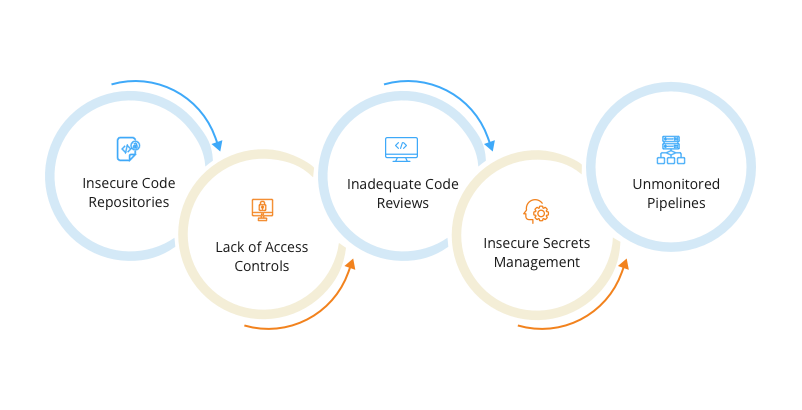
1. Insecure Code Repositories:
Insecure code repositories occur when code repositories, such as Git or SVN, lack adequate security measures. This can manifest in several ways such as weak authentication methods, publicly accessible repositories, or insufficient encryption protocols.
Potential Consequences:
- Unauthorized access to sensitive source code or intellectual property.
- Code tampering or manipulation, leading to the introduction of malicious code or backdoors.
- Compromise of proprietary algorithms or business logic, resulting in competitive disadvantage or loss of intellectual property.
2. Lack of Access Controls:
Lack of access controls refers to the absence or misconfiguration of user permissions within CI/CD pipelines. It allows unauthorized users to access, modify, or execute critical pipeline components, such as build scripts or deployment configurations.
Potential Consequences:
- Unauthorized modification or execution of pipeline tasks, leading to disruption of software delivery processes.
- Data breaches or leakage of sensitive information stored within the pipeline.
- Increased risk of insider threats, where privileged users exploit their access to compromise pipeline integrity or steal sensitive data.
3. Inadequate Code Reviews:
Inadequate code reviews occur when CI/CD pipelines lack robust mechanisms for reviewing and validating code changes before deployment. This may involve automated code analysis tools or manual review processes being bypassed or improperly implemented.
Potential Consequences:
- Introduction of software bugs, vulnerabilities, or insecure coding practices into production environments.
- Inadvertent inclusion of third-party dependencies with known security vulnerabilities, posing risks to the overall system integrity.
- Reduced code quality and maintainability, leading to increased technical debt and operational challenges over time.
4. Insecure Secrets Management:
Insecure secrets management is a major security concern in CI/CD pipelines. It happens when sensitive information, like passwords, API keys, or encryption keys, are not handled, stored, or transmitted properly. This can involve storing secrets in plain text, embedding them within code repositories, or transmitting them over unencrypted channels.
Potential Consequences:
- Unauthorized access to sensitive credentials by individuals with malicious intent, leading to data breaches or unauthorized system access.
- Exposure of sensitive information in version control systems, making it susceptible to unauthorized disclosure or exploitation.
- Compromise of privileged accounts or systems, resulting in unauthorized data access, service disruptions, or financial losses.
5. Unmonitored Pipelines:
Unmonitored CI/CD pipelines lack comprehensive monitoring and logging capabilities. This includes failure to track pipeline execution, monitor resource usage, or detect anomalous activities during the software delivery process.
Potential Consequences:
- Failure to detect and respond to security incidents, such as unauthorized access attempts or suspicious pipeline activities.
- Inability to identify performance bottlenecks, resource constraints, or scalability issues within CI/CD workflows.
- Limited visibility into pipeline health and operational status, hindering timely troubleshooting, and resolution of issues during software delivery.
By addressing these common security vulnerabilities and implementing robust security controls and best practices within CI/CD pipelines, you can mitigate risks, enhance resilience, and safeguard the integrity of their software delivery processes.
Designing Secure and Efficient CI/CD Pipelines with InfoSec Best Practices
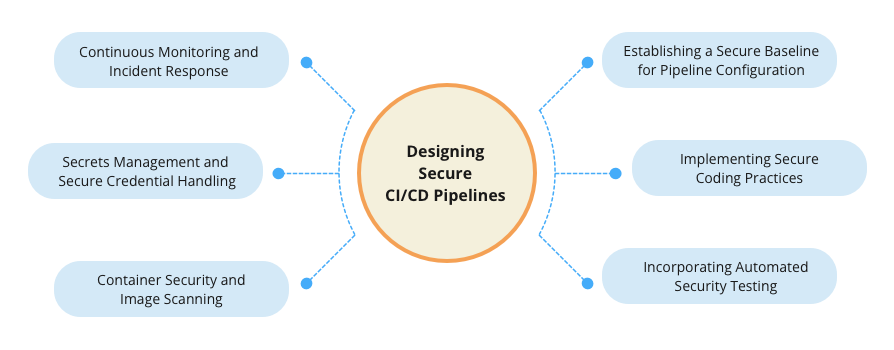
A. Establishing a Secure Baseline for Pipeline Configuration:
Establishing a secure baseline for pipeline configuration entails establishing uniform settings and security measures throughout all stages of the process. This involves implementing least privilege access controls, robust authentication methods such as multi-factor authentication, and secure communication channels.
Additionally, encrypting data both at rest and in transit, adhering to secure coding practices, and leveraging version control systems are essential for protecting sensitive data and maintaining configuration integrity. These measures collectively fortify the security posture of the CI/CD pipeline, reducing the likelihood of unauthorized access, data breaches, and other potential security risks.
B. Implementing Secure Coding Practices and Static Code Analysis:
To build secure software, it's crucial to take a proactive approach that begins with empowering developers. Implementing secure coding practices through comprehensive training equips them with the knowledge and skills to write code resilient to common threats like SQL injection and cross-site scripting (XSS). Also, establishing standardized secure coding practices across your organization ensures consistent application of these principles.
Moreover, integrating static code analysis (SCA) tools into the CI/CD pipeline automates vulnerability detection. Combining secure coding practices with SCA tools creates a robust defense against vulnerabilities, reducing the risk of security breaches and protecting your software ecosystem.
---outlined-cta--- “Enterprises that adopted static code analysis tools noted a 30% decline in vulnerabilities following the integration of these tools.” State of Software Security Report 2023
C. Incorporating Automated Security Testing (SAST, DAST, IAST):
Incorporating automated security testing, including Static Application Security Testing (SAST), Dynamic Application Security Testing (DAST), and Interactive Application Security Testing (IAST), is essential for identifying and addressing security vulnerabilities throughout the CI/CD pipeline.
SAST tools analyze source code for potential security vulnerabilities, while DAST tools simulate real-world attack scenarios to identify vulnerabilities in running applications. IAST tools combine aspects of SAST and DAST, offering real-time feedback during application runtime. By integrating these automated security testing tools into the CI/CD pipeline, you can proactively detect and remediate security issues before they reach production environments.
D. Container Security and Image Scanning:
Container security and image scanning are critical components of secure CI/CD pipelines, especially in containerized environments. Container security tools scan container images for known vulnerabilities, misconfigurations, and compliance violations before deployment. Implementing container security best practices, such as using trusted base images, minimizing attack surfaces, and regularly updating dependencies, helps mitigate the risk of container-based security breaches and ensures the integrity of containerized applications throughout the CI/CD pipeline.
E. Secrets Management and Secure Credential Handling:
Don't let weak credential handling expose the core of your CI/CD pipeline. Secure secrets management is crucial for safeguarding sensitive data like API keys and passwords. It makes it pivotal for enterprises to embrace robust solutions like encrypted vaults or key management services. These tools provide secure storage and access control, ensuring your secrets remain protected.
Furthermore, grant users only the minimum access required to perform their tasks, and restrict access based on their roles. By prioritizing secure storage and controlled access, you significantly reduce the risk of credential theft, misuse, and unauthorized access, ultimately fortifying the security of your CI/CD pipelines. Remember, robust secrets management is essential in today's security-conscious world.
F. Continuous Monitoring and Incident Response:
Continuous monitoring and incident response capabilities stand as crucial pillars in safeguarding the integrity of your CI/CD pipeline. These comprehensive monitoring solutions allow you to meticulously track pipeline activity, scrutinize for any anomalous behavior, and swiftly detect security incidents in real-time.
Automated alerting mechanisms play a pivotal role in this endeavor. They promptly notify your dedicated security teams of potential security threats or breaches, facilitating timely investigation and response. Establishing an incident response plan outlines predefined procedures and protocols for addressing security incidents, minimizing the impact on production environments and ensuring swift resolution.
By embracing continuous monitoring and robust incident response strategies, your organization can effectively fortify its CI/CD pipeline against emerging security threats and uphold the integrity of its software delivery processes.
---insight-section---
Summing Up
Building secure and efficient CI/CD pipelines is no longer optional in the DevOps era. In 2023, the average expense of a data breach was $4.35 million, showcasing the substantial financial ramifications of security breaches. With technology evolving and cyber threats on the rise, it becomes imperative for organizations to prioritize continuous improvement and adaptation in security practices.
The landscape of Infosec is dynamic, requiring enterprises to stay vigilant, update their defenses, and embrace emerging technologies. By fostering a culture of security awareness and promoting ongoing education and training, enterprises can better prepare themselves to address evolving threats and challenges in the DevOps era.
While prioritizing security is paramount, you must also strive to achieve a delicate equilibrium between security, agility, and innovation. Remember, proactive security is not a roadblock to speed, but rather an investment in saving time and resources in the long run. By following the recommendations we highlighted in this article and continuously seeking improvement, you can streamline software delivery processes while maintaining robust security measures.
---Interests---
You may also be interested in

Thought Leadership
Are Predictive Models Still Relevant in the Age of Campaigns, Journeys, and Nudges?

POV
Tracking Metrics in Adobe Analytics: A Strategic Guide

Thought Leadership
Digital Analytics Audit: Steps to Perform a Digital Analytics Audit for Business Growth