Interactions Correctly?


Amplitude vs Adobe Analytics in 2026


Effective Analytics Techniques to Make Marketing Data-Driven
Choose Amplitude when your main requirement is analyzing feature adoption, onboarding and retention through behavioral events. Evaluate Adobe Analytics when you need flexible enterprise digital reporting, segmentation and attribution within an established Adobe measurement setup. Both platforms can analyze website and app interactions, so compare your reporting tasks and data requirements rather than choose only by the “product” or “web” label.
Amplitude also supports web and marketing analysis, including sessions, channel classifiers and attribution. Adobe Analytics supports custom success events as well as visit and page metrics. Their capabilities overlap; the important differences are the reporting workflow, implementation model, connected data and features included in your subscription.
This comparison explains the capabilities to evaluate, the implementation work each option requires, and where Adobe Customer Journey Analytics should be considered separately. Use the same measurement task and dataset when comparing demos.
Use the table below to shortlist a platform, then review the detailed use cases and selection checks before committing.
Amplitude vs Adobe Analytics at a Glance
| Decision area | Amplitude | Adobe Analytics |
|---|---|---|
| Typical starting point | Feature adoption, funnels and retention | Flexible enterprise digital reporting and audience segmentation |
| Events and sessions | Event properties plus sessions and channel classifiers | Custom success events, conversion variables and visit metrics |
| Web and campaign analysis | Web acquisition, page engagement and conversions | Configured digital attribution and reporting |
| Connected journeys | Collect or import required events with consistent identifiers | Evaluate CJA separately for AEP-based connected datasets |
| Commercial model | Free and paid plans with feature and volume limits | Obtain package-specific commercial terms; scope CJA separately |
| Evaluation task | Build an adoption cohort and retention report | Build audience segments and a digital conversion report |
What Are Product Analytics and Web Analytics?
Product analytics and web analytics describe different measurement questions, but modern platforms can support both. Product analysis often investigates adoption and retention; web analysis often investigates acquisition and conversion. The same event data can contribute to either task.
Defining Product Analytics
Product analytics zeroes in on how users interact with digital products like mobile apps, software platforms, or online services. The goal is to uncover patterns in user behaviour, helping businesses enhance their products and retain users.
The global product analytics market was valued at approximately USD 14.81 billion in 2023 and is projected to grow at a CAGR of 19.8%, reaching about USD 58.78 billion by 2030.
Key Features of Product Analytics:
- Tracks specific user actions, such as button clicks, feature usage, and app navigation.
- Maps the customer journey within the product.
- Groups users into behavioural cohorts for targeted analysis.
Common Use Cases:
- Improving user retention by identifying drop-off points in the customer journey.
- Evaluating how effectively users adopt new features.
- Optimizing engagement by understanding what keeps users coming back.
For instance, a subscription-based app could use Amplitude to analyze which features drive engagement, helping the team prioritize improvements that matter most to users.
Defining Web Analytics
Web analytics focuses on tracking and improving the performance of websites. The emphasis is on understanding how visitors find, navigate, and interact with your site, making it invaluable for marketing and content strategies.
Key Features of Web Analytics:
- Monitors page views, bounce rates, and time spent on the site.
- Provides insights into traffic sources, such as search engines, social media, or ads.
- Analyzes conversion funnels to identify and resolve drop-off points.
Common Use Cases:
- Evaluating the success of marketing campaigns by analyzing traffic and conversions.
- Optimizing landing pages to improve user experience and lead generation.
- Tracking how users move through an e-commerce site to boost sales.
For example, an online retailer might use Adobe Analytics to see where customers abandon their shopping carts, enabling the team to refine the checkout process and increase sales.
Use these categories to define your measurement question. A team investigating checkout abandonment may need event funnels and acquisition analysis in the same workflow, so the category label alone does not determine which platform to buy.

Key Features Comparison of Amplitude and Adobe Analytics
Compare the platforms against the same task: recording a feature action, defining an audience, investigating a funnel or attributing a conversion. Confirm the data required and the relevant feature access before comparing the outputs.
Data Collection and Granularity
- Amplitude:Amplitude centers analysis on events and their properties, such as a purchase, a feature action or a page view. It also groups events into sessions and supports marketing analysis. Define consistent event names and user identifiers so product and acquisition reporting can be compared.
- Adobe Analytics:Adobe Analytics collects digital interactions and supports custom success events, conversion variables and visit-based metrics. It can measure product actions as well as page activity. Customer Journey Analytics uses data from Adobe Experience Platform and should be evaluated separately for connected online and offline analysis.
Why This Matters:
If your goal is to fine-tune product features, Amplitude’s event-based tracking is invaluable. For optimizing your website or analyzing the success of marketing campaigns, Adobe Analytics provides the breadth you need.
Usability and Learning Curve
- Amplitude:Amplitude’s charts give product and growth teams ways to explore behavior, but useful analysis still requires suitable events, an identity model and agreed definitions. Ask the intended users to build a representative funnel or retention report before assessing ease of use.
- Adobe Analytics:Adobe Analytics is feature-rich but comes with a steep learning curve. Its complexity is balanced by its integration capabilities, such as those with other Adobe solutions like Experience Manager or Campaign, making it a powerful option for enterprises.
Why This Matters:
Test usability with the people who will operate the platform. Compare the time needed to build a report, explain a discrepancy and maintain definitions, rather than name a universal winner without a benchmark.
Reporting and Insights
- Amplitude:Amplitude shines in behavioral analytics. Features like cohort analysis, retention tracking, and user flow visualization allow teams to understand user journeys and improve product experiences. These are essential when prioritizing feature adoption and engagement metrics.
- Adobe Analytics:Adobe Analytics offers detailed segmentation and advanced attribution modelling. These features are particularly valuable for businesses running multi-channel campaigns and needing to attribute conversions to specific channels or touchpoints.
Why This Matters:
For product questions, evaluate cohort and retention workflows. For campaign questions, compare segmentation, channel rules and attribution settings in both platforms. Report usefulness depends on the configured data and the decision your team needs to make.
Integration and Ecosystem
- Amplitude:Amplitude can receive data through SDKs, APIs and supported sources such as Segment. Check each required source and destination separately, including sync direction, identifiers and data freshness. A familiar vendor name does not make the integration complete or effortless
- Adobe Analytics:Adobe Analytics is part of Adobe’s larger ecosystem. By pairing Adobe Analytics with tools like Adobe Journey Optimizer, businesses can refine how they deliver personalized customer experiences across multiple touchpoints.
Why This Matters:
Amplitude is perfect for teams relying on modern, agile tools. Adobe Analytics is better suited for enterprises already using Adobe’s ecosystem for their marketing and analytics efforts.
By breaking down these key differences, you can see how these tools are designed to address distinct business challenges. The right choice depends on your focus - whether it’s product innovation or optimizing web and marketing strategies.
How to Measure Feature Adoption in Amplitude
Define a meaningful event for successful feature use, then specify the users eligible to use it. Adoption rate is the number of eligible users who trigger that event divided by the number of eligible users in the same period. Track first use separately from repeat use, and compare retention for adopters and non-adopters with the same entry window. Amplitude supports event, funnel and retention analysis for this work. Check cohort access for the selected plan. [3][4][12]
For example, measure “report successfully exported” rather than only a click on the Export button. Exclude users without access to the feature from the denominator. A relationship between adoption and retention is a starting point for investigation, not proof of causal lift.
How to Compare Segments in Adobe Analytics
Create two audiences with comparable definitions, such as customers who complete checkout and customers who abandon it. Use the Segment comparison panel to investigate differences and overlap in the captured data. Keep dates and relevant conditions consistent and confirm panel access for your account. Follow up with funnel or behavior analysis before treating a difference as the cause of abandonment.
What Has Changed for the 2026 Comparison
Two changes matter when refreshing this guide: Amplitude’s scope extends into web and marketing workflows, and current AI capabilities must be attributed to the correct product. Confirm subscription access before treating a documented feature as available in your account.
Amplitude Updates in 2026
- Amplitude’s February 2026 AI platform launch introduced a Global Agent, specialized agents and MCP capabilities for interacting with behavioral data. Evaluate the supported tasks, permissions and feature access for your setup. The release does not establish that an unlaunched feature will improve retention.
- Amplitude’s current documentation also covers web acquisition, page engagement and conversion analysis. These are existing capabilities to include in the comparison, rather than describe them as a new 2026 launch without release evidence
Adobe Analytics and Customer Journey Analytics in 2026
- Adobe Analytics, part of Adobe’s powerful web-analytics suite, now leverages Adobe Sensei GenAI for anomaly detection and auto-segment discovery.
- Separately, Adobe’s September 2026 Customer Journey Analytics release notes list MCP plugins for ChatGPT and Claude and consent-policy reporting and filtering. These are CJA capabilities, not evidence that the same features are included in every Adobe Analytics account. Review the product-specific release notes and setup requirements.
AI assistance can help teams explore configured data. Validate generated findings and access permissions, and keep metric definitions consistent before using an answer to change product or campaign decisions.
When to Choose Amplitude: The Product Analytics Perspective
If your business revolves around understanding and improving how users interact with your product, Amplitude could be your ideal analytics partner. Its features are purpose-built for driving product success through actionable insights.
Ideal Scenarios for Amplitude
Amplitude is the right choice if your business needs to:
- Track In-App User Journeys: Understand how users navigate through your app or platform, identifying points of friction or drop-off.
- Measure Feature Adoption: Gain clarity on which features are driving engagement. Amplitude allows teams to define events, build funnels, and visualize how to measure feature adoption in Amplitude using cohort and retention tools.
- Optimize Retention: Uncover patterns in user behaviour that contribute to retention, helping you design strategies to keep users engaged over the long term.
Use implemented events to investigate adoption and retention after a release. Observed behavior can identify an association worth testing; it does not by itself prove that a feature caused better retention.
Amplitude Strengths in Real-World Use Cases
Let’s consider a few examples:
- SaaS Products: A subscription software company can use Amplitude to analyze how users engage with their platform post-onboarding. Are they using premium features? What’s driving churn? These insights guide feature development and customer success strategies.
- Gaming Industry: Gaming companies rely on Amplitude to track player behaviour. Are players progressing through levels as expected? Are there points of frustration causing them to abandon the game? Amplitude helps answer these questions.
- Tech Start-ups: Start-ups often operate with limited resources, making it crucial to prioritize product improvements that have the most significant impact. Amplitude helps teams focus their efforts on features that drive engagement and growth.
Why Choose Amplitude?
If your business is product-centric and thrives on innovation, Amplitude provides the clarity and focus you need to enhance user experiences and boost retention.
When to Choose Adobe Analytics: The Web Analytics Perspective
For businesses focused on understanding their website’s performance and optimizing multi-channel marketing strategies, Adobe Analytics stands out as a robust solution. Its capabilities are designed to track, analyze, and improve digital experiences at scale.
For journeys that combine digital activity with CRM, contact-center or offline records, evaluate Customer Journey Analytics separately. It analyzes datasets brought into Adobe Experience Platform, with connections, data views and identifiers that must be configured for the use case.
Ideal Scenarios for Adobe Analytics
Adobe Analytics is a great fit if your business needs to:
- Track Multi-Channel Marketing Performance: Measure the effectiveness of campaigns across platforms such as email, social media, and paid ads.
- Analyze Website Traffic and Conversion Paths: Dive deep into how visitors interact with your site and identify opportunities to improve the customer journey.
- Measure Digital Campaigns across Platforms: Attribute conversions to specific channels and understand the ROI of your marketing spend.
Measure Digital Campaigns: Compare attributed conversions and configured revenue outcomes. Add cost and margin definitions separately when evaluating profit-based ROI.
Adobe Analytics Strengths in Real-World Use Cases
Here are a few examples that highlight Adobe Analytics’ strengths:
- E-Commerce Sites: Online retailers use Adobe Analytics to optimize their sales funnels. By analyzing data on cart abandonment, product page engagement, and checkout flows, they can make adjustments that directly impact revenue.
- Media & Content Platforms: Publishers rely on Adobe to understand which content drives clicks, time-on-site, and ad performance—perfect for complex segment comparison in Adobe Analytics.
- Enterprises with Connected Customer Data: Evaluate CJA for analysis across configured digital and business datasets. Scope identity matching and data availability rather than assume every customer touchpoint will be visible.
Why Choose Adobe Analytics?
If your business thrives on high-traffic websites and data-driven marketing strategies, Adobe Analytics provides the tools and insights to optimize every aspect of your digital presence. Its ability to handle vast amounts of data and integrate with Adobe’s ecosystem makes it ideal for enterprise-level needs.
Can Amplitude Replace Adobe Analytics
A replacement needs validation against the reports your business relies on. Map Adobe hits, eVars, props and success events to Amplitude events and properties, then test how identity, sessions, conversion counting and segment logic behave. Amplitude’s migration guide describes collection changes and report rebuilding, so migration should be scoped beyond changing an SDK. [14]
Run the two implementations over a representative period. Reconcile selected outcomes such as orders, signup completions and active users, and document expected differences in counting rules. Rebuild business-critical segments and confirm supported integrations, permissions, retention and historical-data requirements before retiring an existing system.
Where GA4 Mixpanel and Customer Journey Analytics Fit
| Platform | Question to evaluate | Selection consideration |
|---|---|---|
| GA4 | How do acquired users move through configured web or app conversion steps | Validate the implemented events and funnel definition. |
| Amplitude | Which product behaviors are associated with adoption and return usage | Agree on eligible users, identity and the retention interval. |
| Mixpanel | How do users progress through event funnels and retain over time | Compare event taxonomy, identity, access and feature limits. |
| Adobe Analytics | How do digital audiences and conversion patterns differ | Validate variables, events, segment scope and report definitions. |
| Adobe CJA | What happens across connected customer datasets in AEP | Scope ingestion, identity matching, connections and data views. |
These options are adjacent candidates, not a ranking. Keep the main decision on this page centered on Amplitude and Adobe Analytics.
Making the Decision: Amplitude vs Adobe Analytics – Key Factors to Consider
Choosing between Amplitude and Adobe Analytics for enterprise requires a thoughtful evaluation of your business goals, resources, and operational priorities. While both tools are powerful in their domains, their utility depends on how well they align with your specific needs.
The Scale and Scope of Your Business Needs
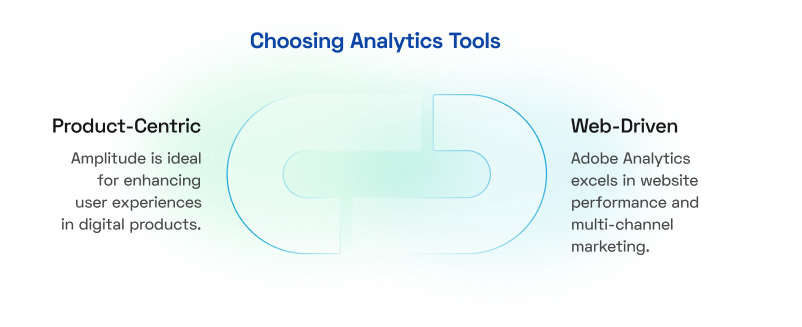
- For Product-Centric Businesses: If your primary focus is on enhancing user experiences within a digital product -such as an app or SaaS platform-Amplitude is the better fit. It offers granular insights into how users interact with features, making it ideal for start-ups, tech companies, and product-led organizations.
- For Web-Driven Businesses: Adobe Analytics shines when your focus is on website performance and multi-channel marketing. Large enterprises, e-commerce platforms, and organizations with complex marketing ecosystems will benefit most from its capabilities.
Budget and Resource Allocation
- Amplitude: Compare the current Free, Plus, Growth and Enterprise offerings against your volume and required features. Behavioral cohorts, predictions, replay and other capabilities have plan-specific limits or access, so a free entry point is not equivalent to the complete platform.
- Adobe Analytics: Request commercial terms for the required package and include implementation, analyst training and ongoing support. Evaluate Customer Journey Analytics licensing and AEP data work separately where that product is part of the shortlist.
- Cost comparison: Use the same expected volume, reporting requirements and operating period for each quote. Include collection, data preparation, integrations and maintenance alongside the software price.
Team Expertise and Tool Familiarity
- Amplitude: Ask the intended users to create an adoption cohort, build an onboarding funnel and investigate a retention change using your sample data. Record where they need analyst or engineering support.
- Adobe Analytics: The platform’s complexity requires a team with advanced analytics skills or investment in training. While powerful, it may feel overwhelming for teams without prior experience.
Key Consideration: Evaluate the same reporting tasks in both products. Include the people who maintain tracking and definitions as well as the people who read the dashboards.
Use Case Matrix for the 2026 Evaluation
Use these scenarios to define a shortlist. The recommendation depends on data, implementation and the existing team, rather than a single winner for each category.
| Use case | Shortlist | What to validate |
|---|---|---|
| Feature adoption and retention | Amplitude | Eligible users, meaningful events and repeat use. |
| Website acquisition and conversion | Either platform | Campaign rules, event capture and reporting workflow. |
| Complex digital audience comparison | Adobe Analytics | Segment definitions, variable scope and comparison access. |
| Mobile app behavior | Either platform | SDK implementation, identity and required product reports. |
| Connected online and offline data | Evaluate CJA separately | AEP datasets, matching identifiers and implementation effort. |
| Lean team with a narrow initial task | Evaluate Amplitude’s relevant plan | Feature access, sample implementation and ongoing ownership. |
Our Verdict: Amplitude vs Adobe Analytics
Understanding the difference between product analytics and web analytics is crucial for selecting the right tool to support your business. Amplitude and Adobe Analytics are both leaders in their respective domains, but their strengths cater to different needs.
- Choose Amplitude if your priority is understanding in-depth user behaviour within a product. It’s perfect for teams focused on enhancing product features, driving engagement, and retaining users.
- Opt for Adobe Analytics if your goal is to optimize website performance, track multi-channel campaigns, and analyze complex customer journeys. The comprehensive integration capabilities of Adobe solutions further amplify its value for enterprise-scale operations.
Take advantage of free trials or demos to experience these tools first-hand. Testing their capabilities in your specific context will give you confidence in your choice.
The right analytics platform isn’t just a tool - it’s a strategic partner that helps you make smarter decisions, improve user experiences, and drive business growth. Choose wisely, and let your data lead the way.
Frequently Asked Questions
1. Is Amplitude better than Google Analytics?
Amplitude and GA4 overlap in website and app measurement, so compare the reporting task and implementation rather than assume their purposes are entirely separate.
- Amplitude excels at product analytics, helping teams understand user behavior, feature adoption, and retention within apps or platforms.
- GA4 also supports configured funnel exploration. Its usefulness for a product or marketing question depends on implemented events and the analysis required.
If you're tracking how users interact with features inside a digital product (like a SaaS app or mobile app), Amplitude is the better choice. For top-of-funnel web performance tracking, Google Analytics remains useful.
2. Who competes with Amplitude?
Top competitors to Amplitude include:
- Mixpanel – Also focused on product analytics and cohort analysis
- Heap, alongside other platforms, may be relevant when evaluating automatic interaction capture. Validate current capabilities and operating requirements during evaluation.
- Pendo – Strong in product feedback and onboarding flows
- Google Analytics (GA4) – Used for web and app tracking
- Adobe Analytics – Enterprise-level competitor with powerful segmentation
Each platform has strengths, but Amplitude stands out for deep behavioral insights, funnel tracking, and real-time data exploration.
3. Which is better: Google Analytics or Adobe Analytics?
- Google Analytics (GA4) is free, user-friendly, and widely adopted, ideal for startups or marketing teams tracking basic web metrics.
- Adobe Analytics is a premium, enterprise-grade tool offering advanced segmentation, custom variables, and deep cross-channel attribution.
If your business requires scalable, customizable insights across platforms, Adobe Analytics is typically the better fit — especially for large websites, e-commerce, or omni-channel campaigns.
Ram Prabhakar
Head of Solutions and Content
Xtelligence Inbox.
Your weekly dose of marketing smarts!
Related Posts


Digital Analytics
Real-Time Personalization Is Losing You Conversions. Here Is How to Take Them Back.


















Digital Analytics
Customer Segmentation: Using Predictive & Adaptive Models for Targeted Marketing