Interactions Correctly?


Why You Might Be Overlooking AEM Content Fragments in These 7 Use Cases


Apply Data-Driven Segmentation at Scale with Adobe AEP
Adobe Experience Manager (AEM) is celebrated for its versatility, offering tools that help businesses create, manage, and deliver content seamlessly across channels. And, yet, one of its most underutilized features, Content Fragments, often flies under the radar despite its potential to revolutionize content workflows.
Content Fragments in AEM allow you to create reusable, structured content that can be used across websites, apps, and even third-party platforms. They eliminate duplication, streamline updates, and ensure consistency in messaging. However, many businesses fail to recognize how powerful this feature can be in specific scenarios.
If your team rewrites the same product information for every channel or updates several copies whenever a detail changes, Content Fragments can reduce that repeated work. Their value depends on how you model the content and connect it to the experiences that use it.
In this article, we'll explain how Content Fragments work, how they differ from Experience Fragments, and where they fit into localization, omnichannel marketing, personalization and headless delivery.
Let’s uncover the potential of AEM Content Fragments and how they can transform your content strategy.
What is a Content Fragment in Adobe Experience Manager?
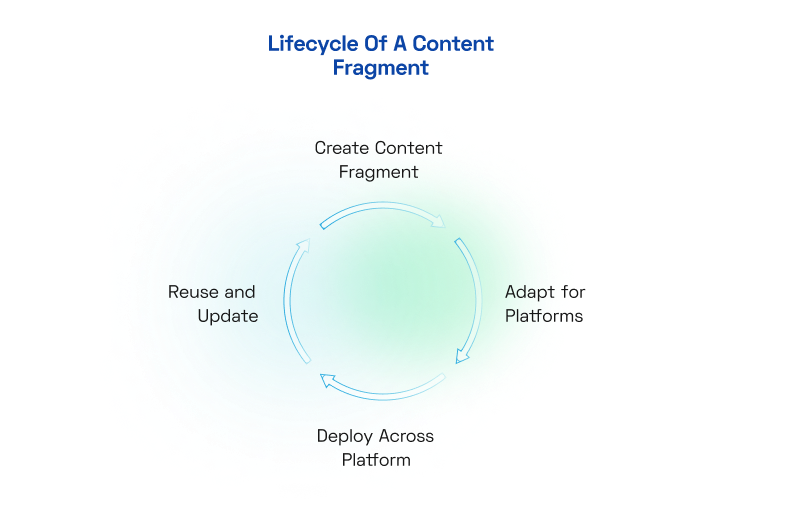
A content fragment is a reusable piece of content that is free from design or layout constraints. It allows businesses to create content once and use it across various digital platforms.
Think of it as a building block that can be shaped to fit different needs without rewriting or recreating it from scratch. This reflects the very essence of AEM structured content, where form and function are decoupled to maximize reusability. This separation allows marketers and developers to scale content operations without reworking designs, which is the fundamental promise of AEM structured content.
Reusable fragments centralize content maintenance, helping teams reduce duplicate authoring and coordinate updates across connected experiences.
Organizations utilizing AEM report significant improvements in content management efficiency due to the ability to create reusable fragments that can be updated centrally and reflected across all channels. This reduces the time spent on content creation and maintenance by approximately 30%.
For example, if you manage product descriptions for an e-commerce platform, a content fragment can hold all the details, such as product name, features, and specifications. This aligns well with use cases where you create content fragments in AEM to streamline multichannel product publishing. This fragment can then be reused across your website, mobile app, or even printed catalogs without having to manually recreate it each time.
This separation of content from its presentation is what makes content fragments a game-changer for efficient content management.
Is your team still authoring the same content once per channel?
Xerago's AEM specialists help you design Content Fragment Models around how your content is actually reused, so updates happen in one place.
Key Components of AEM Content Fragments
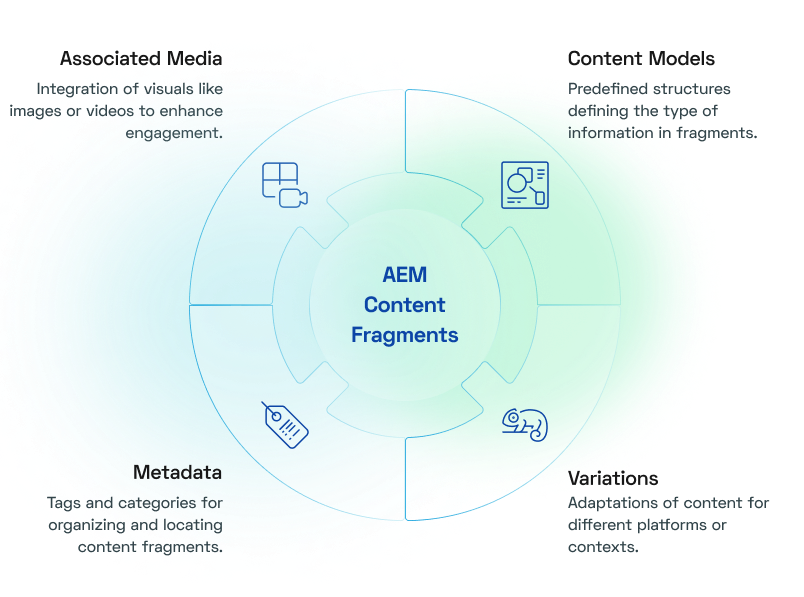
- A Content Fragment Model defines the fields authors populate. A product model might include text for the name and description, numbers for specifications, dates, Boolean values and references to assets or other fragments. These fields structure reusable content; targeting decisions belong to the consuming application or personalization system.
- Variations: Not all content is one-size-fits-all. Variations allow you to adapt the same content for different platforms or contexts, such as a short version for social media or a detailed one for a webpage.
- Metadata: These are details like tags, categories, or keywords that help you organize and locate your content fragments quickly.
- Associated Media: Content Fragments can reference images, videos and other assets. The consuming page component or application controls how these assets are displayed.
These AEM content models act as templates that ensure consistency and enforce data standards across all content fragments—and many recent AEM new features continue to enhance how models and fragments are structured, automated, and delivered.
How AEM Content Fragments Enable Structured Content
Structured content means storing information as defined fields rather than as a formatted page. In AEM, Content Fragments are how that structure is put into practice.
- Content Fragment Models define the structure. A model sets which fields a fragment has and what type of value each field accepts. Every fragment created from that model follows the same structure.
- Each field stores one specific piece of information. Fields can hold text, numbers, dates, tags, or references to assets and other fragments, so a product name, a price, and an offer end date each live in their own field.
- Structured content can be reused across channels. Because content is not tied to a layout, websites, apps, and other channels can each use the fields they need and present them in their own way.
- The same structure supports headless delivery. Applications can request fragments as JSON through AEM’s GraphQL or delivery APIs, without depending on AEM page templates.
The quality of the model decides how reusable the content is. A model built around one page tends to need rework once a second channel starts using it, so it helps to plan fields around how the content will be reused.
Will your Content Fragment Models still work when the next channel needs them?
Xerago reviews your existing models, field types, and references, and restructures them for reuse across web, app, and headless delivery.
What Structured Data Can AEM Content Fragments Store?
Content Fragment Models support several field types. The table below shows common examples and how each is typically used.
| Data Type | Example | Use Case |
|---|---|---|
| Text | Product name | Messaging |
| Number | Price | Product content |
| Boolean | Premium user | Conditional experiences |
| Date | Offer expiry | Campaign timing |
| Enumeration | Customer segment | Audience targeting |
| Tags | Interest/category | Classification |
| Content Reference | Image/asset | Content assembly |
| Fragment Reference | Product/category | Nested content |
Storing content in typed fields makes it easier to reuse, filter, personalize, and deliver across channels. A field such as a customer segment or an offer expiry date gives other systems something specific to act on. The fields themselves do not apply targeting: the consuming application or a personalization service, such as Adobe Target, reads these values and applies the audience rules.
AEM Content Fragments vs Experience Fragments: What’s the Difference?
Many teams new to Adobe Experience Manager assume content fragments and experience fragments are interchangeable—but they’re not.
- AEM content fragments are content-only and layout-independent. They’re ideal for reusability across web, email, mobile, and headless CMS environments.
- Experience fragments combine content and layout (design), useful for building consistent page-level experiences with pre-styled components.
The table below compares the two based on what your project needs.
| Requirement | Content Fragment | Experience Fragment |
|---|---|---|
| Structured content | Best suited | Limited |
| Layout included | No | Yes |
| Headless/API delivery | Yes | Limited |
| Reuse across channels | Strong | More presentation-focused |
| Visual component reuse | Limited | Strong |
Use Content Fragments when: you need structured, reusable, channel-independent content.
Use Experience Fragments when: you need reusable content together with layout and presentation.
A page can use both. For example, a product page might pull specifications from a Content Fragment and display a promotional banner built as an Experience Fragment.
If your goal is to enable multi channel reuse or feed structured content to APIs, AEM content fragments are the right fit. But if you need pre-built visual blocks for website templates, experience fragments may be better.
Use a Content Fragment when the same information needs different layouts across channels. Use an Experience Fragment when you want to reuse a composed block of content and layout, such as a promotional banner. A page can use both.
Also Read: AEM Has AI and Agents. Is Your Content Metadata Ready for Them?
Benefits of Using AEM Content Fragments in Content Management
AEM Content Fragments provide numerous advantages that go beyond simply saving time. They offer structure, consistency, and scalability, which are critical for any growing business or enterprise.
- Consistency Across Channels: One of the key benefits of using content fragments in AEM is maintaining consistency across platforms. Whether your content is being displayed on a mobile app, a desktop site, or other digital touchpoints, fragments ensure uniformity. This level of control is foundational to the Adobe CMS, helping brands deliver a seamless experience across all channels. Consistency isn’t just a branding benefit—it’s a signal of operational maturity.
- Efficient Workflows: Content fragments allow your team to create reusable pieces of content that can be utilized across various channels. This not only streamlines workflows but also eliminates the need for repetitive content creation. Your team can focus on crafting high-quality, engaging content instead of duplicating efforts. This efficiency leads to faster turnaround times and a more productive team, which is especially important in fast-paced industries.
- Scalability for Growing Needs: As your business grows, so does your content. Managing large volumes of content can quickly become overwhelming, but content fragments make it easier to scale. These reusable components allow your team to handle an increasing amount of content without sacrificing quality or control. Whether you're expanding your product offerings or entering new markets, fragments provide a flexible, scalable solution. At scale, AEM content modeling becomes a critical discipline for organizing content structure, supporting dynamic variations, and reducing maintenance load.
- Integration Ready: AEM Content Fragments are designed to integrate seamlessly with other marketing analytics tools and systems, enabling smooth content delivery across platforms. This flexibility ensures that your content management ecosystem remains connected and efficient, facilitating a more cohesive approach to content distribution. Integration-ready fragments support dynamic, Omnichannel strategies and ensure your business can deliver personalized, targeted content wherever your customers engage.
By leveraging AEM Content Fragments, businesses can not only improve content management efficiency but also enhance user experiences and future-proof their digital strategies.
Common Misconceptions about AEM Content Fragments
Why Are AEM Content Fragments Often Overlooked?
One of the reasons content fragments are underutilized is a lack of awareness. Many organizations see them as an advanced feature rather than a practical tool for daily content management. Teams tend to focus on designing pages or using templates, unintentionally ignoring the value that content fragments in AEM bring to structured, reusable content workflows. This oversight often results in inefficient workflows where content is recreated from scratch for each channel.
Misunderstanding Their Versatility beyond Traditional Text
It’s easy to think of content fragments AEM provides as just blocks of text, but their functionality goes far beyond that. They are designed to handle a mix of content types, from structured data like product specifications to multimedia elements like videos and infographics. This flexibility means they aren’t limited to blogs or articles - they can also support product catalogs, FAQ sections, or even interactive guides.
When organizations don’t fully understand this versatility, they miss out on opportunities to make their content work harder and smarter.
How to Identify Missed Opportunities with AEM Content Fragments
To spot where you might be falling short, consider these questions:
- Are you creating the same content multiple times for different platforms?
- Is your content inconsistent across channels?
- Do small changes require a significant amount of manual effort?
If you’re nodding yes to any of these, it’s likely time to revisit how your team is handling content. Adopting content fragments could address these inefficiencies and set you up for smoother operations.
By understanding and overcoming these misconceptions, businesses can unlock the true potential of AEM content fragments and make their content processes far more effective.
The 7 Use Cases for AEM Content Fragments that you may be overlooking
AEM Content Fragments are often seen as a tool for basic content reuse. But their potential goes far beyond that. They can solve some of the most persistent challenges in content management, especially for businesses that operate across multiple channels and regions.
Let’s start with one of their most impactful uses: localization.
1. Streamlining Localization Efforts
Managing content across different languages and regions can feel overwhelming. Each market has its own nuances, and keeping everything consistent is a constant battle. This is where AEM Content Fragments come in.
Localization often gets sidelined because businesses view it as a manual, resource-heavy process — especially when AEM content modeling and localization integrations aren’t fully leveraged. Many rely on translating content reactively rather than proactively using AEM structured content for multilingual use. Content Fragments are overlooked because teams don’t realize their power in simplifying updates and managing global content from a single source.
With AEM create content fragment capabilities, you can build a single source of truth. The master fragment holds your core message in its original language. From there, AEM’s translation integration localizes it into multiple languages while retaining structure and consistency.
But it’s not just about translating words. The structure of the fragment stays intact, so the localized versions align perfectly with the original. Whether it’s a product description, blog post, or policy update, content fragments in AEM ensure alignment across regions.
Translation workflows slowing down your regional launches?
Pick one content bottleneck, such as language copies, retranslation, or regional review, and Xerago will fix it end to end in a 5-day Bootcamp.
Why This Matters
- Reduces errors. Source updates can be managed through translation workflows, followed by review and publication of the updated language copies.
- Increases speed. New campaigns can roll out to global markets faster.
- For example, a multinational retailer could create a master fragment for product descriptions and use AEM translation workflows to maintain language copies for different markets.
- When the source changes, the team can send the affected content for retranslation, review and publication rather than recreate each description from scratch.
A multinational retail brand struggled to keep up with product launches in different regions. Using AEM Content Fragments, they streamlined their workflow. They created one master fragment for product descriptions and localized it into 20 languages.
The result? A 40% reduction in the time it took to launch campaigns worldwide. And because updates to the master fragment were reflected across all markets, consistency improved dramatically.
Localization doesn’t have to be messy. With Content Fragments, you’re in control, no matter how many regions you serve.
2. Powering Omnichannel Marketing
Delivering consistent content across multiple channels is one of the biggest challenges for marketers today. Your audience doesn’t just interact with your brand on a website—they’re on apps, social media, email, and even IoT devices.
AEM Content Fragments make omnichannel marketing not just possible but seamless. This level of flexibility is why content fragments in AEM are ideal for delivering channel-specific variations without duplicated effort.
Omnichannel strategies can be intimidating. Many businesses end up managing separate workflows for each channel, assuming there’s no alternative. Content Fragments are underutilized because teams often don’t know they can decouple content from design and distribute it seamlessly across platforms.
Same message, different version on every channel?
Xerago connects your content, campaign, and messaging platforms so a single approved update reaches web, app, and email together.
Explore Campaign ManagementHow It Works
At its core, AEM Content Fragments separate content from presentation. You create content once in a flexible format that isn’t tied to a specific design. This content can then be styled and formatted differently for each channel while maintaining the core message.
With AEM’s API capabilities—such as GraphQL or the Content Delivery API—you can deliver these fragments to websites, apps, social media, or even voice assistants like Alexa. This eliminates the need for creating and managing channel-specific content manually.
For example, a single Content Fragment for a product description can be:
- Displayed as a detailed webpage with specifications and high-quality images.
- Used as a concise product summary on a mobile app.
- Integrated into an email campaign promoting new arrivals.
The same fragment adapts to each channel’s needs without duplicating work.
Why This Matters
- Efficiency at ScaleManaging multiple channels can overwhelm marketing teams. With Content Fragments, you create content once and push it everywhere, saving hours of manual effort.
- Brand ConsistencyInconsistent messaging across channels can erode trust. Content Fragments ensure that the same information, tone, and language are delivered, no matter the platform.
- Faster Time-to-MarketLaunching new campaigns or updating existing ones across channels becomes much faster. Published changes can reach connected experiences, subject to their integrations and cache refresh behavior.
- Future-Proof StrategyAs new channels emerge—think AR/VR or IoT—Content Fragments make it easier to scale your strategy without reinventing the wheel.
When you are dealing with a plethora of channels and devices with the need to personalize each message for each customer and each channel, content fragments can come to your rescue.
Content Fragments can hold approved content variations for different audiences. For example, a travel agency can maintain itinerary options, while a retail brand can maintain product messaging. A connected personalization service or application selects the appropriate content using customer data and targeting rules.
What’s more, the personalization possibilities are endless. Each fragment can include dynamic content fields that adjust based on customer data. For example, a travel agency can use fragments to offer tailored itineraries. A retail brand might show product recommendations unique to each customer. All of this happens while maintaining consistency in messaging and tone across channels.
3. Bringing Creators and Developers Together
One common challenge businesses face is the disconnect between content creators and developers. Content fragments bridge this gap by offering a unified approach to content creation and delivery
Creating content that works across multiple channels often creates a tug-of-war between marketing and development teams.
Collaboration challenges between marketing and development are often seen as an inevitable bottleneck. Many organizations default to traditional workflows, where marketers rely on developers for implementation. AEM Content Fragments remain underused because businesses fail to recognize their potential to empower both teams to work in parallel.
Marketers focus on the messaging and audience needs, while developers are tasked with ensuring the content fits seamlessly into digital platforms. Miscommunication or delays between the two can derail timelines and dilute the end product.
AEM Content Fragments act as the bridge that connects these teams, simplifying workflows and fostering collaboration.
For instance:
- Marketers can create fragments for a campaign launch, including headlines, product descriptions, and call-to-action messages. These fragments are often based on predefined AEM content models that ensure every asset follows a consistent structure.
- Developers can use AEM’s APIs to deploy this content into apps, websites, or other platforms without touching the core messaging.
This clear division of roles saves time and reduces back-and-forth revisions.
Why This Matters
- Speeds Up Time-to-MarketMarketing and development teams can work simultaneously, ensuring faster rollouts for campaigns or product updates.
- Reduces ErrorsStructured content ensures that developers don’t accidentally alter messaging during the implementation process.
- Empowers Non-Technical TeamsMarketers no longer rely heavily on developers to publish or edit content, making workflows more autonomous.
- Improves Content QualityTeams can focus on their strengths—marketers on crafting impactful messages and developers on delivering polished digital experiences.
Collaboration is essential for delivering cohesive customer experiences. AEM Content Fragments empower teams to work smarter, not harder. By bridging the gap between marketing and development, businesses can save time, reduce errors, and maintain the agility.
4. Simplifying Personalization at Scale
Personalization is no longer optional—customers expect tailored experiences that speak directly to their needs and preferences. However, delivering personalized content at scale, across multiple channels and touchpoints, is no easy feat. AEM Content Fragments make it manageable by allowing you to create structured, reusable content that adapts dynamically for different audiences.
Personalization is widely acknowledged as important, but scaling it across diverse audiences and platforms can feel unattainable. Teams may avoid it due to fears of high costs or complexity. Content Fragments are overlooked because their role in enabling dynamic, data-driven personalization isn’t always clear.
How It Works
At the heart of personalization is dynamic content delivery. AEM Content Fragments work seamlessly with customer data platforms (CDPs) and personalization engines to serve tailored content to individual users.
Here’s an example:
- You create a master fragment for a product launch that includes details like specifications, benefits, and a call to action.
- Using customer data, the fragment dynamically adjusts. Returning customers see exclusive discounts, while first-time visitors get an introductory offer.
The structured nature of Content Fragments ensures that no matter how they’re personalized, the core message remains consistent and accurate.
Why This Matters
- Reduces Manual EffortInstead of creating multiple versions of the same content for different audiences, you can use one fragment that adapts dynamically.
- Maintains ConsistencyPersonalized experiences still align with your brand voice and messaging, avoiding the risks of fragmented or conflicting content.
- Scales SeamlesslyWhether you’re targeting a hundred customers or a million, the workflow remains efficient and manageable.
5. Improving SEO with Structured Content
AEM structured content can help teams maintain product details, article information and other fields used by web pages. Its SEO value depends on how the website turns those fields into crawlable content and page metadata.
- Model useful information: store article titles, descriptions, author references or product details where reuse is appropriate.
- Map fields to the page: developers must connect the content to visible HTML, title elements, meta descriptions and any applicable structured data.
- Validate the output: check that important content is available in the rendered page and that structured data matches the content users see. [6]
For example, a product page can read its specifications from a fragment while keeping its own page title and description. Reusing product data does not mean every page should receive identical metadata.
Implementation consideration: distinguish structured content in AEM from search engine structured data markup. A Content Fragment Model does not automatically generate schema.org markup or improve rankings. Rendering, indexing and page relevance still need attention. [6]
6. Enabling Headless Content Delivery at Scale
In a headless implementation, AEM manages the content while an external application controls presentation. Content Fragments provide the structured records that the application requests through a delivery API.
A mobile app, kiosk or web application can consume the same content model, with its own interface and release cycle. The useful separation is between the content lifecycle and the application lifecycle: an approved copy update need not require rebuilding the interface.
Implementation consideration: plan publication of referenced content and assets, API access, preview, caching and error handling. A model that works for one page may need refinement before it supports several applications.
7. Differentiating Between Content Fragments and Experience Fragments
One of the most misunderstood distinctions in Adobe Experience Manager is between content fragments and experience fragments. While both are reusable assets, they serve entirely different purposes.
- AEM Content Fragments: These are pure content units—text, media, and metadata—structured through models and variations. They're built to be omnichannel, serving content to apps, emails, web pages, and more.
- Experience Fragments: These are layout-based containers that include content and design components. They’re intended for templated web experiences, often used in page authoring.
Understanding this distinction helps teams apply the right asset to the right problem. For example:
- You’d use content fragments in AEM to manage blog content, FAQs, or API-driven experiences.
- You’d use experience fragments when you need consistent branding and design across a website homepage, landing pages, or promotional banners.
Why this matters:
- Smarter Asset Reuse: You can reuse structured content independently from layout, or as part of styled components—depending on the channel.
- Cleaner Architecture: Avoid bloated templates by distinguishing layout needs from reusable content.
- Personalization Opportunities: Use content fragments for personalization via CDPs, and experience fragments for tailored on-page layouts.
By understanding AEM content fragments vs experience fragments, teams can streamline workflows, avoid duplication, and build content strategies that scale with business needs.
Conclusion: Making AEM Content Fragments Work for Your Business
Content fragments in Adobe Experience Manager are more than a convenience - they are a strategic tool for efficient, consistent, and scalable content management. They save time, reduce errors, and help businesses maintain a cohesive voice across channels. Whether you're personalizing experiences, scaling for global audiences, or simply looking to streamline your processes, content fragments provide a reliable foundation for success.
The key is understanding their potential and incorporating them thoughtfully into your workflows. Start small, identify areas where repetitive content creation is holding you back, and experiment with fragments to simplify your operations. With the right approach, you’ll not only save time but also create a more agile content management system that grows with your business. If you need help designing or scaling that system, consider working with Adobe Experience Manager consulting experts who can guide your team through best practices and sustainable implementations.
By harnessing the power of content fragments, organizations can move from reactive content management to a proactive, streamlined, and future-ready strategy. It’s not just about managing content - it’s about managing it smarter.
Frequently Asked Questions
Can I deliver Content Fragments to a Next.js app
Yes. A Next.js application can consume JSON content through a supported AEM delivery API. Your implementation maps the response to components and sets how content is fetched, cached and refreshed. Choose the rendering approach around SEO, performance and content freshness requirements. This is an application architecture choice, rather than a feature that fragments configure automatically.
What structured data can a Content Fragment contain
Models can define text, numbers, dates, Boolean values, asset references and references to other fragments. These fields organize content for reuse. If you use attributes to support targeting, the application or personalization service still needs to interpret them and apply the audience rules. [1]
Can I use visual assets with Content Fragments
Yes. Fragments can reference visual assets, and supported rich text configurations can include inline assets. The consuming experience determines their presentation. Confirm that assets are published and accessible alongside the fragment. [1]
What can I create variations for
Variations let authors maintain alternative content within a fragment, such as a shorter summary for an app or a different message for a campaign. The consuming experience must request or select the appropriate variation. Keep language copies within your translation workflow. [7]
How do launches work with Content Fragments
In AEM as a Cloud Service, a Content Fragment launch lets teams prepare content for a future release separately from the current source. Authors can edit launch content and promote approved changes back to the source. The Publish Ready setting can publish fragments automatically on promotion. Check this setting and any scheduled promotion before using a launch for a release.
Vignesh Gunaseelan
Technical Content Writer
Xtelligence Inbox.
Your weekly dose of marketing smarts!
Related Posts


Digital Analytics
Real-Time Personalization Is Losing You Conversions. Here Is How to Take Them Back.

















Digital Analytics
Customer Segmentation: Using Predictive & Adaptive Models for Targeted Marketing