AEM 6.5 LTS vs AEM as a Cloud Service: Which Is the Better Investment for Your Enterprise?

AEM Content Migration & Go-Live Checklist
Enterprises still running classic AEM 6.5 need a support and modernization roadmap. Adobe's core support ends on February 28, 2027. In our previous article, we compared classic AEM 6.5 and AEM 6.5 LTS, including the differences, support timelines, and what an upgrade involves.
AEM 6.5 LTS and AEM as a Cloud Service are both supported paths. They are not the same kind of investment. LTS continues an established hosting and operating model. Cloud Service changes how infrastructure, scalability, updates, and deployment are managed.
The decision is whether the organization needs to modernize its entire AEM operating model, or whether upgrading the current implementation to LTS meets its business objectives. Cost, technical fit, and operating responsibility should determine that choice. Cloud Service is not mandatory, and LTS is not only a way to postpone change.
Choosing between LTS and Cloud Service?
As an Adobe Solution Partner with more than 10 years of experience,
Xerago brings together AEM consulting, implementation, integrations and ongoing operations. This connects the platform decision to publishing reliability, campaign delivery and the cost of maintaining connected experiences.
Choosing the right AEM path requires a clear view of what your enterprise needs to retain, what must change and what each option will cost to implement and operate. These factors determine whether LTS can meet your business needs or whether Cloud Service offers enough value to justify a broader transition.
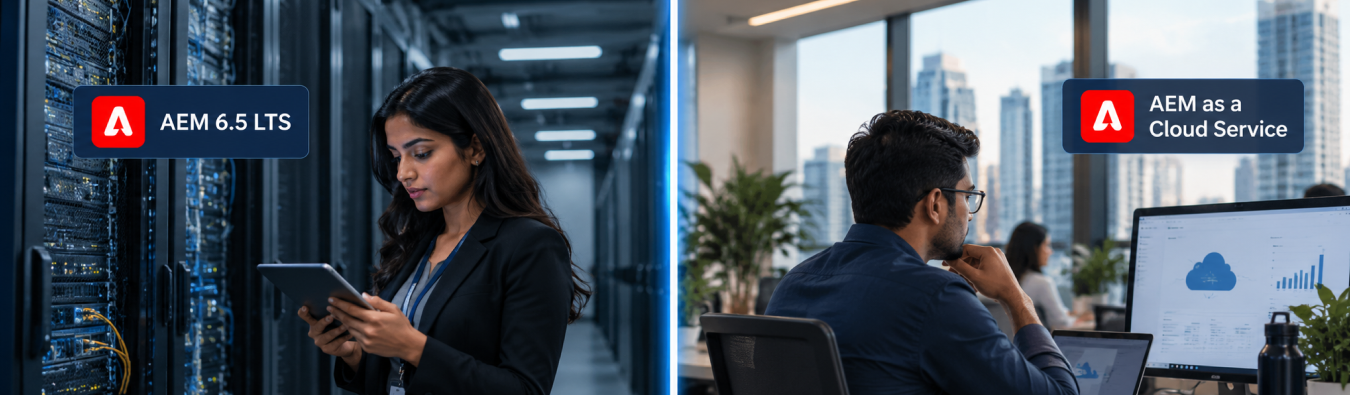
AEM 6.5 LTS vs AEM as a Cloud Service: Key Differences
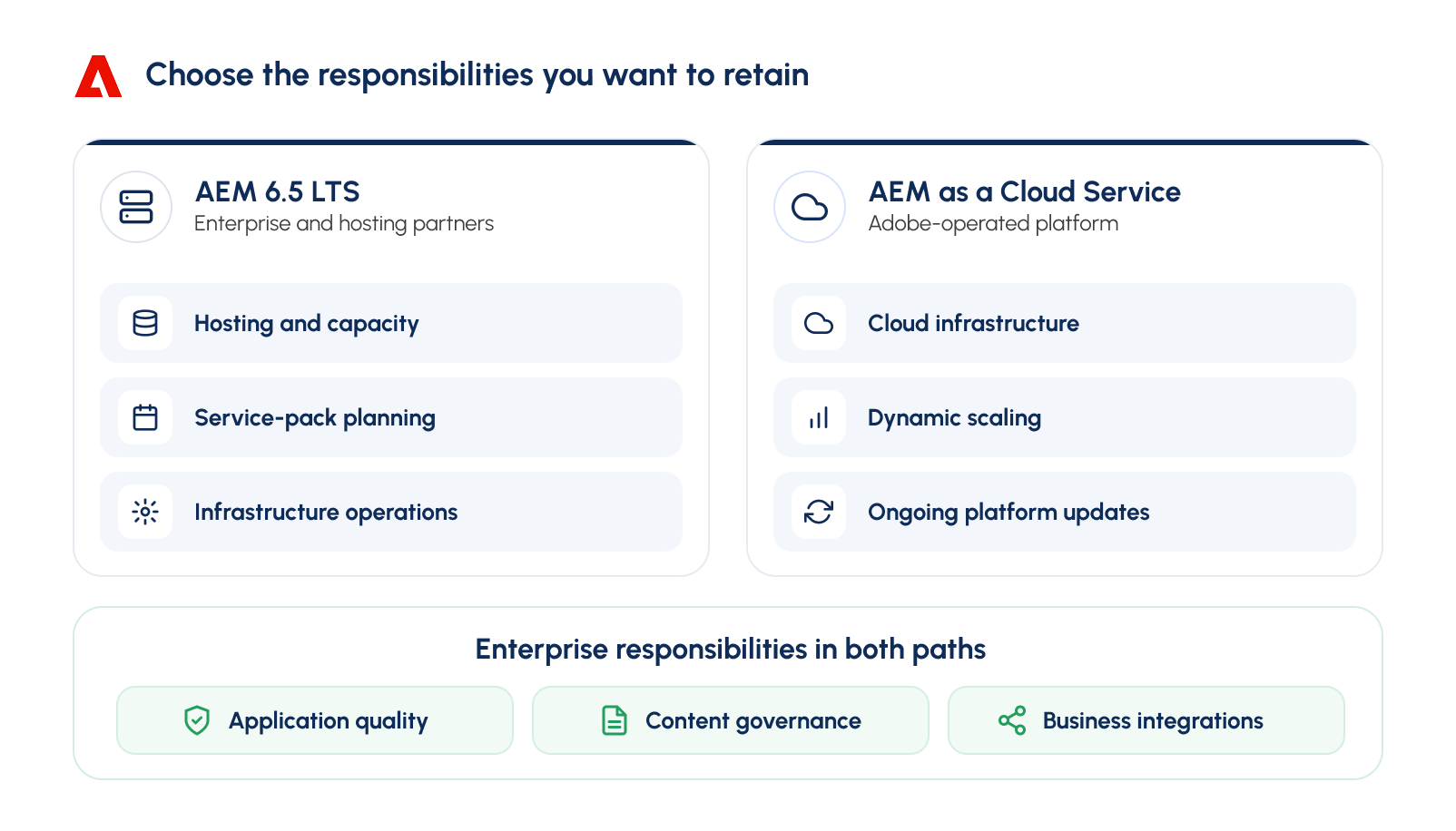
Both options support enterprise digital experience requirements, but they place different responsibilities on technology teams and require different levels of organizational change.
| Comparison area | AEM 6.5 LTS | AEM as a Cloud Service |
|---|---|---|
| Deployment | On-premise or supported managed hosting | Adobe-managed cloud environment |
| Infrastructure | Enterprise or hosting provider manages infrastructure | Adobe manages the underlying service infrastructure |
| Maintenance | Enterprise plans and validates service-pack upgrades | Adobe delivers ongoing platform updates |
| Scalability | Depends on provisioned infrastructure and capacity planning | Cloud-native architecture with automatic scaling |
| Development | Retains more established development practices | Cloud-compatible code and automated deployment pipelines |
| Customizations | Existing code may be retained after compatibility assessment | Legacy code may require substantial refactoring |
| Operations | Enterprise retains greater infrastructure control and responsibility | Infrastructure operations shift toward Adobe; application governance remains with the enterprise |
| Investment | Upgrade costs plus ongoing infrastructure and maintenance | Migration and subscription costs plus cloud operating-model changes |
The key distinction is how each platform changes the work required to operate AEM.
For an enterprise with stable infrastructure and efficient release processes, retaining its existing model through LTS may be commercially reasonable.
For another enterprise facing frequent maintenance delays, scaling limitations, and slow deployments, Cloud Service could offer greater long-term value. Neither conclusion should be reached without examining the current environment.
When Is AEM 6.5 LTS the Better Investment for an Enterprise?
AEM 6.5 LTS may be the more practical investment when an organization's existing architecture, infrastructure and operating processes continue to support its business requirements.
Consider an enterprise with a stable AEM environment, several business-critical integrations and infrastructure that has already been optimized for its workload.
Moving to Cloud Service could require considerable changes to custom code, networking, deployment processes and internal team responsibilities.
If those changes do not address an immediate business need, a full migration may introduce more cost and disruption than value.
LTS may be particularly suitable when:
- Existing infrastructure investments remain commercially valuable.
- The organization has specific hosting, integration or architectural requirements.
- Current platform operations are stable and efficiently managed.
- Cloud migration requires substantial remediation without proportionate near-term benefits.
- Additional preparation is needed before adopting a cloud-native operating model.
However, LTS should not be treated as a routine service-pack upgrade.
An established AEM implementation may depend on older libraries, OSGi bundles, custom configurations or components that require compatibility changes.
Adobe's AEM Analyzer helps identify potential upgrade issues, but technical testing remains necessary.
This is where enterprises can underestimate the investment. Custom code may function correctly in the existing environment while depending on libraries or APIs that behave differently in LTS.
The required effort can therefore extend beyond the platform upgrade itself to include code remediation, integration validation, regression testing and deployment rehearsals.
LTS offers value when retaining the existing operating model is an intentional business decision rather than simply a way to postpone modernization.
When Does AEM as a Cloud Service Deliver Greater Business Value?
AEM as a Cloud Service can offer stronger long-term value when an enterprise wants to reduce infrastructure responsibilities, improve release efficiency and modernize its digital experience operations.
For organizations managing multiple websites, brands or regional platforms, the existing AEM environment may require significant effort to maintain.
Infrastructure upgrades, release coordination, capacity planning and manual deployment activities can consume resources that could otherwise support digital experience improvements.
Cloud Service addresses some of these challenges through Adobe-managed infrastructure, automated updates, cloud-native scaling and deployment pipelines.
It may be particularly relevant when:
- Infrastructure management consumes considerable internal effort.
- Existing deployment processes limit release frequency.
- The organization is pursuing a cloud-first technology strategy.
- Scalability and operational flexibility are important business requirements.
- A broader digital experience modernization programme is already planned.
Yet cloud migration alone does not guarantee these outcomes.
An enterprise may successfully migrate thousands of pages while retaining duplicated content, unnecessary approval stages and complex authoring processes.
The infrastructure becomes more modern, but the operational problems remain.
A cloud migration moves the platform. It does not automatically change the habits and processes built around it.
This is why Cloud Service should be evaluated as an operating-model investment rather than simply a hosting change.
For example, replacing redundant custom components with standard AEM Core Components can reduce ongoing development and testing complexity.
Similarly, simplifying content approval workflows can improve publishing efficiency without compromising appropriate governance.
The financial and operational benefits become more compelling when the organization uses migration to address these underlying problems.
Without those changes, the enterprise risks investing in a modern platform while continuing to operate with legacy inefficiencies.
Thought Leader Perspective: Let the Enterprise's Constraints Decide the Path

Two enterprises running the same AEM version may need different paths because their constraints and readiness differ.
Stable operations and substantial cloud remediation may favor LTS, while recurring infrastructure demands can strengthen the cloud case.
Base the recommendation on what each enterprise needs to improve and can realistically operate.

What Technical and Operational Factors Should Influence the Decision?
Assess both paths against the same business-critical functionality. The assessment should establish what must change, how much effort it requires and whether your team can sustain the chosen operating model.
- Application compatibility: For LTS, review the release notes and run the AEM Analyzer to identify affected customizations and removed capabilities. For Cloud Service, use Adobe's Best Practices Analyzer, then investigate runtime dependencies such as local file storage, background jobs and custom replication.
- Content and integrations: Review templates, metadata, permissions, approval workflows and asset processing. Validate identity, CRM and analytics connections through complete author and customer tasks.
- Security requirements: Document mandatory requirements for residency, access, connectivity and contractual obligations. Assess the proposed configuration and service terms against those requirements.
- Operational readiness: Cloud Service requires teams to manage pipeline-based deployments, automated testing and application compatibility with ongoing updates. LTS retains responsibility for infrastructure maintenance and service-pack testing. Include the skills, staffing and partner support each option requires.
Test these assumptions through a representative pilot before committing to the full scope. Include common templates, heavily customized pages, forms and real authoring tasks. Use the findings to refine remediation effort, testing requirements and the delivery plan.
How Do AEM 6.5 LTS and Cloud Service Compare on Total Cost of Ownership?
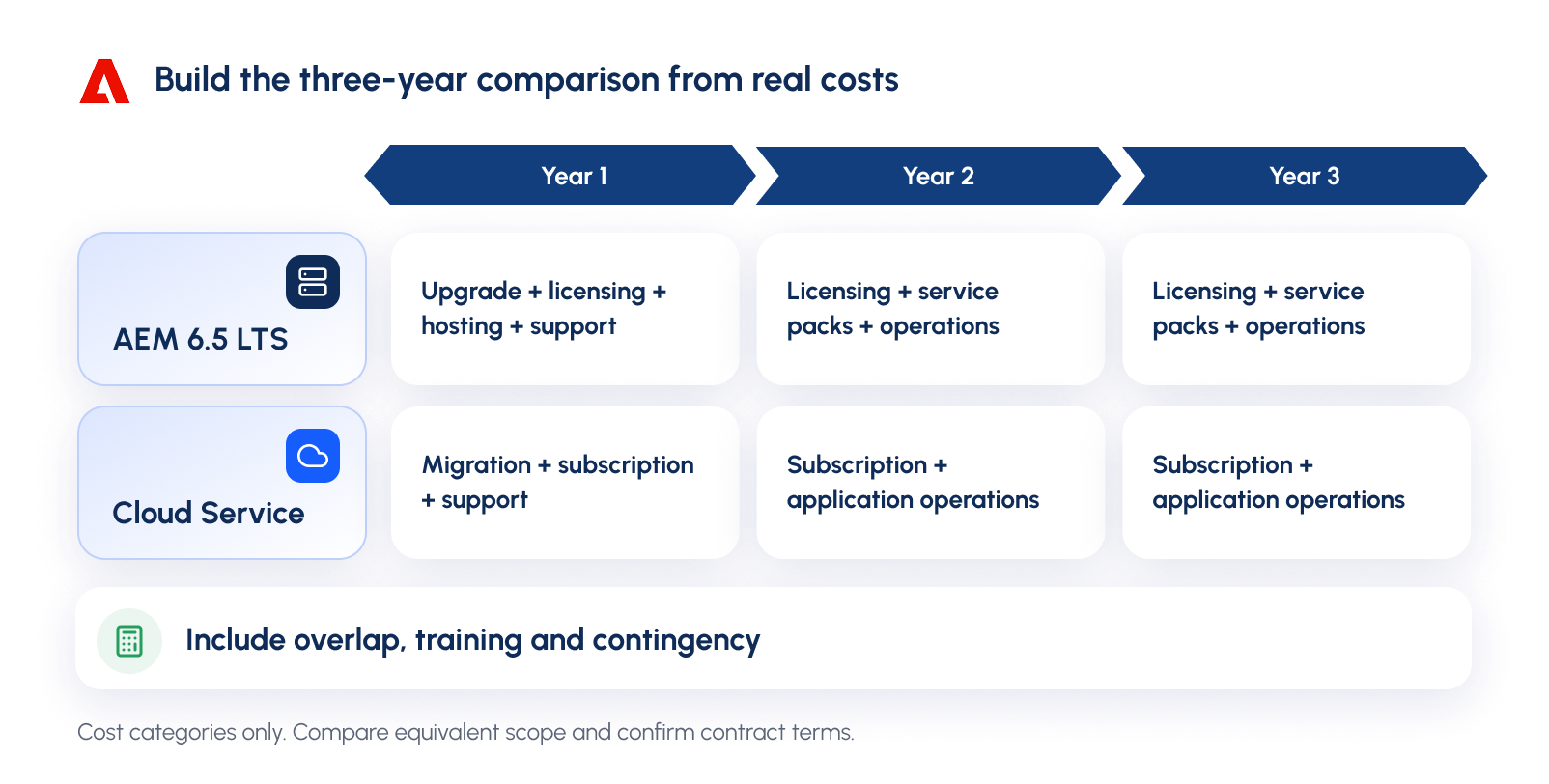
Use a common planning period to compare the expected cost of each path. Three years can provide a practical starting point, provided finance agrees with the assumptions and treatment of benefits.
Establish the current baseline. Record licensing, hosting, infrastructure administration, application support, upgrade effort and relevant supplier costs. Separate committed spending from costs that can actually be avoided.
| Cost component | AEM 6.5 LTS | AEM as a Cloud Service |
|---|---|---|
| Licensing | Contract-specific licence and support terms | Contract-specific cloud subscription |
| Infrastructure | Hosting, servers, storage, OS and Java runtime, backups | Included in the Adobe-managed service; confirm limits and add-ons with Adobe |
| Implementation | Upgrade, Analyzer-led remediation, regression testing | Migration, code adaptation, content transfer, pipeline setup |
| Integrations | Compatibility testing and continued operation | Re-architecture where integrations rely on local state or custom replication |
| Internal resources | Platform administration plus application support | Application support, cloud development skills, release governance |
| Future maintenance | Quarterly service-pack testing and installation | Keeping custom code compatible with continuous updates |
| Transition overlap | Usually short, if done in place | Parallel environments and dual running during migration |
| Business benefits | Stability and value from retained investments | Reduced infrastructure work, elastic capacity, faster access to new features |
Fill each cell with your own contract and delivery figures. Published list prices rarely reflect enterprise agreements, so do not compare the two paths on headline licence cost alone.
- Estimate the transition investment. For LTS, include compatibility work, infrastructure changes, regression testing and production preparation. For Cloud Service, include application adaptation, content transfer, pipeline preparation, integration testing and team enablement.
- Calculate ongoing commitments. LTS requires its applicable licensing and support arrangements, hosting, operations and service-pack maintenance. Cloud Service requires its contracted subscription plus application support, integration maintenance and release governance. Confirm included services and commercial limits directly with Adobe.
- Account for transition overlap. Include parallel environments, existing supplier commitments, training and contingency. Assign an end date and owner to temporary spending so overlap does not become an unplanned operating cost.
- Test the assumptions. Compare expected costs with a scenario involving greater remediation or slower delivery. Identify which unresolved dependencies could change the preferred option.
Keep benefits separate from the cost calculation until their basis is clear. A reduction in upgrade administration may be measurable, while additional campaign revenue needs evidence connecting the proposed changes to customer outcomes. Compare equivalent functionality before adding redesign or broader modernization.
Should Enterprises Upgrade to AEM 6.5 LTS First or Migrate Directly to Cloud Service?
Enterprises have several possible transition paths, and the appropriate sequence depends on business urgency, technical readiness and implementation risk.
Option 1: Upgrade to LTS and retain the existing operating model
This can suit enterprises whose architecture, hosting requirements and operational processes remain appropriate for their business.
The organization should still maintain a documented upgrade, support and modernization roadmap.
Option 2: Upgrade to LTS first and migrate to Cloud Service later
This approach may be appropriate when an enterprise needs a supported platform but requires additional time to prepare for cloud migration.
For example, complex integrations may need redesign, or automated testing may need to be established before the cloud transition.
However, an intermediate upgrade can create duplicated effort.
Leadership should understand the cost of both transitions and why the staged approach is necessary.
Option 3: Migrate directly to Cloud Service
Direct migration may provide stronger value when cloud modernization is already a strategic priority and the organization has the technical and operational readiness to execute it.
It can also avoid completing an intermediate upgrade that provides limited long-term benefit.
Consider two hypothetical organizations.
Enterprise A operates a stable AEM environment with substantial infrastructure investments, tightly coupled internal integrations and no immediate requirement for cloud-specific capabilities.
Its assessment may show that LTS provides the necessary platform continuity with a more manageable implementation scope.
Enterprise B operates multiple regional websites and experiences slow deployments, duplicated components and considerable infrastructure-maintenance effort.
Its assessment may demonstrate that Cloud Service offers greater long-term value, particularly if migration is combined with component consolidation and workflow modernization.
The difference is not the AEM version.
It is the business requirements, existing dependencies and operational changes each enterprise needs to make.
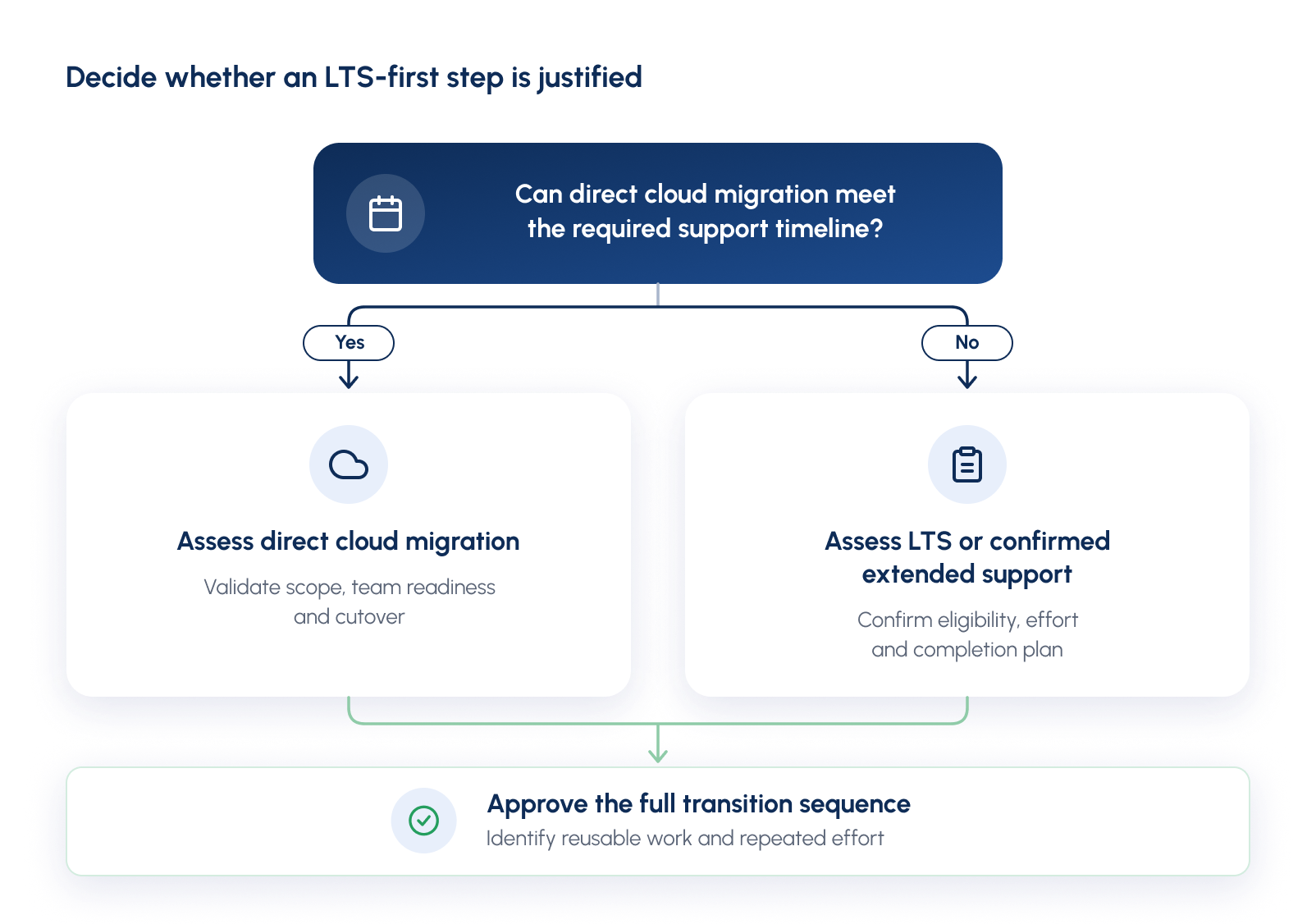
If both transitions are proposed, request a work-reuse assessment. Identify which dependency cleanup, automated tests and integration improvements can carry forward, and which hosting or deployment work will be replaced.
Remaining on LTS can also be a deliberate long-term decision when it meets business requirements and maintenance has an accountable owner. Adobe supports LTS through quarterly service packs, each supported for up to 18 months from its release, so staying supported means planning to adopt new service packs on a regular cycle.
| Option | What to evaluate before choosing it |
|---|---|
| LTS first, Cloud Service later | Cost of the extra upgrade, how long a stable interim platform is needed, which remediation carries forward, and what will be repeated |
| Direct Cloud Service migration | Migration scope, whether delivery can finish before the support position lapses, team readiness, and implementation risk |
| Remain on LTS long term | Ongoing hosting and staffing cost, the service-pack upgrade cycle, and fit with the long-term technology strategy |
Extended support should be considered only with Adobe-confirmed eligibility, scope and terms, supported by a funded transition plan.
A Decision Framework for Choosing Between AEM 6.5 LTS and Cloud Service
Use a decision record that distinguishes mandatory conditions from preferences. Start by excluding configurations that cannot meet essential hosting, security or business requirements. Then compare the remaining options using priorities agreed by technology, marketing, finance and operations.
For each option, record:
- Expected outcome: The operational or business improvement, its baseline and the team accountable for measuring it.
- Feasibility evidence: Assessment findings, representative test results and unresolved dependencies.
- Investment: Transition costs, ongoing commitments and the assumptions behind the three-year estimate.
- Operating readiness: Required skills, supplier responsibilities and support ownership.
- Future flexibility: Planned changes and the cost of any additional transition.
Weight these factors according to enterprise priorities. A high aggregate score should not override a failed mandatory requirement. Where evidence is missing, identify the test or commercial clarification needed before approval.
Compare Both AEM Paths Before Committing Your Budget
Discuss your current environment, operating requirements and modernization objectives with Xerago's AEM experts. Define an assessment scope that supports a defensible choice between LTS and Cloud Service.
Define What Digital Experience Teams Must Be Able to Do After the Transition
Marketing teams should state their acceptance requirements before the platform decision becomes an implementation contract. Include campaign publication, content reuse, approvals and the integrations required to capture and measure customer actions.
For example, a campaign landing page should publish correctly, preserve consent choices, deliver a valid lead to the CRM and record the expected conversion. Assign owners to investigate differences from the existing behavior.
Track baseline publishing lead time, failed releases, lead-delivery errors and campaign measurement gaps where relevant. Agree which measures the project is expected to improve and which must remain within accepted limits.
This connects platform investment to operational outcomes without promising that an upgrade or migration will independently increase conversions.
Ask Xerago for an Assessment with Defined Outputs
Xerago's published AEM services cover advisory, migration, implementation, integrations, testing and managed services. These capabilities support the technical and operational work required to evaluate an enterprise's next AEM step.
Agree the assessment deliverables before implementation begins: a recommendation and alternative, dependency register, remediation priorities, commercial assumptions and proposed transition sequence. Specify which decisions require further testing or confirmation from Adobe.
Bring the current deployment details, priority journeys, contract milestones and available delivery resources to the discussion. This enables a focused assessment of the options the enterprise can realistically fund and operate.
Frequently Asked Questions
Is Cloud Service mandatory after classic AEM 6.5 core support ends?
Cloud Service is one supported path. Enterprises should also evaluate LTS and any confirmed extended-support arrangement against their requirements.
Is an LTS upgrade always cheaper?
Cost depends on remediation, hosting, licensing and ongoing operations. Compare both options using equivalent scope and current commercial terms.
Can we upgrade to LTS and move to Cloud later?
Yes, but assess the complete sequence and distinguish reusable work from effort that will be repeated.
Does LTS remove the need for platform maintenance?
LTS requires continuing maintenance and supported service-pack planning, with responsibility assigned to internal teams or providers.
What should determine the final choice?
Use mandatory requirements, technical evidence, operating readiness and a comparable business case to support the recommendation.
Kaviarasu S
Associate Content Writer