Interactions Correctly?


Are You Buyable By AI? The Data Readiness Checklist For Agentic Commerce


Is Your Brand Ready for Agentic Commerce? Download Checklist
For more than twenty years, the shopping journey ran through a browser: search, compare tabs, check reviews, check out. But starting in 2026, that's changing fast, as a rapidly growing number of AI agents do the searching, comparing, and buying on the customer's behalf by reading product data, checking prices, applying preferences, and completing the transaction without the customer ever seeing the page.
This is agentic commerce: AI systems that discover, compare, recommend, and sometimes transact for consumers, instead of just pointing them to a website. That shift raises a question most brands haven't asked yet: if an AI agent is doing the shopping, is your brand even buyable by it?
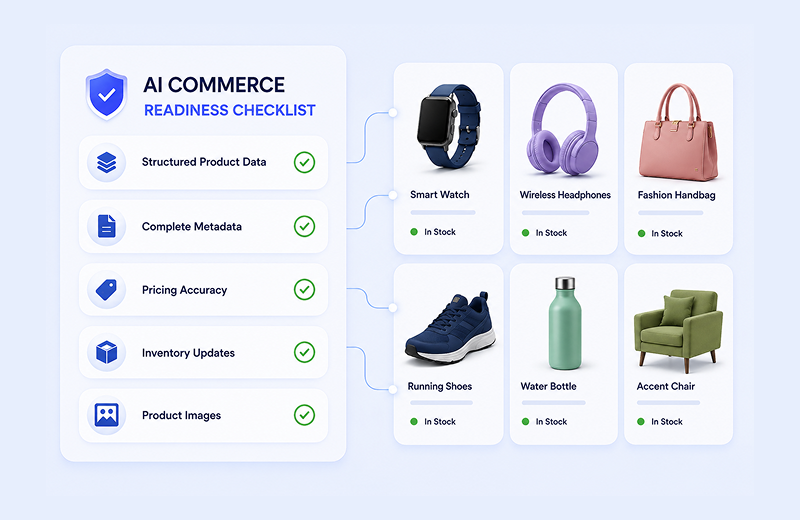
Want the full AI commerce readiness checklist?
Get the checklist to assess whether your product data is complete, consistent, structured, and ready for agentic commerce.
Key Takeaways
- Shopping is shifting from browsers to Agentic AI that search, compare, and transact on customers' behalf.
- "Buyable by AI" means machine-readable, current, governed data and not chatbots or AI features.
- Agentic commerce is a data problem first: one weak layer causes bad outcomes or gets brands skipped.
- Readiness rests on four data layers, product, customer, consent, and activation.
- An eight-question checklist across these layers is the fastest way to self-assess where the gaps are.
- Brands that wait for the channel to mature risk having data that was never ready to represent them.
What "Buyable By AI" Actually Means
Being buyable by AI isn't about having a chatbot on your site or a flashy AI feature bolted onto checkout. It means your products, prices, inventory, policies, and brand signals are structured well enough that an AI system can interpret them accurately, and safely enough that it can act on them without guessing.
An AI shopping agent doesn't browse the way a person does. It doesn't imply that "one size fits most" probably means true to size, or that a five-star review from 2019 might not reflect the current product. It reads what's structured, and it acts on what it can parse. If your product data is incomplete, inconsistent, or locked inside formats built only for human eyes, the agent either gets it wrong or skips you for a competitor whose data it can trust.
This is the practical definition worth holding onto: buyable by AI means machine-readable, current, and governed, not just present.
Why Agentic Commerce Is a Data Problem First
Most coverage of agentic commerce focuses on the interface with the chat window, the voice assistant, the autonomous checkout flow. That's the visible layer. Underneath it sits the real determinant of whether any of this works for a brand: data.
An AI agent making a purchase decision pulls from several sources at once. If any one is missing, stale, or contradictory, the agent either produces a bad outcome or routes around the brand entirely.
| What the agent needs | If it's missing or unreliable |
|---|---|
| Structured product attributes | Wrong or skipped recommendations |
| Live pricing and inventory | Bad transactions, fulfillment problems |
| Customer identity and preferences | Generic, unpersonalized results |
| Consent status | Compliance exposure |
| API access to execute the transaction | Agent can't complete the purchase at all |
MarTech.org has flagged the business risk directly: agentic commerce could weaken a brand's pricing power and customer relationship if the brand doesn't own the data shaping how it's discovered and represented.
When an AI agent compares your product to five others using scraped or third-party data instead of your own governed feed, you've effectively lost control of your storefront even though the storefront still exists.

Product visibility in AI-led commerce will work differently. Customers may no longer need to visit websites, search for products, and compare options themselves.
AI can do this for them and recommend specific products based on their needs.
This pushes marketing to think beyond traffic. It means making the product easy for AI to understand through structured data, content, metadata, and clear product information, while building trust through reviews, testimonials, case studies, social conversations, and third-party mentions.
Marketers now need to manage the entire product information ecosystem so the product, information, and evidence all tell the same story.

Where Agentic Commerce Can Go Wrong
Once AI agents begin making purchase decisions on a brand's behalf, poor data readiness tends to surface in specific and largely avoidable ways.
- Wrong recommendations: An agent may surface an incorrect variant, size, or compatible product when the underlying attributes are incomplete or mismatched. This generally happens when product data hasn't been structured for machine reading, rather than any fault in the agent itself.
- Outdated inventory or pricing: An agent transacting against a feed that hasn't synced can create a fulfillment problem after the fact. This risk tends to be higher for brands running multiple sales channels off separate, unsynchronized feeds.
- Inconsistent product descriptions: Different copy across channels can give an agent conflicting signals about what a product actually is, which may affect the accuracy of what gets recommended or purchased.
- Discounting or margin pressure: Agents optimizing purely on price comparison can push brands toward a race to the bottom, particularly when pricing data isn't paired with brand and value signals the agent can also weigh.
- Loss of the direct customer relationship: If the agent becomes the primary interface, the brand risks losing the first-party relationship and data it would otherwise capture directly. This is generally considered one of the harder risks to reverse once it sets in.
- Poor consent handling: An agent acting on stale or missing consent data can create exposure that a brand may not discover until it's already a problem. This is subject to how well consent records are maintained and synced across systems.
- Weak measurement: When an AI agent sits between discovery and purchase, standard analytics setups often cannot reliably tell a brand whether it won or lost that moment, let alone why.
Each of these traces back to the same root cause: data that wasn't ready for a machine to act on.
For enterprises looking to work through a specific gap like this, Xerago offers a focused 5-day Bootcamp built around solving one critical problem at a time.
The Four-Layer Data Audit to fix Agentic Commerce
Getting ready for agentic commerce comes down to four layers of data, each with its own risks if left unaddressed.
- Product data. This sees the attributes, pricing, availability, descriptions, reviews, compatibility, and policies. Inconsistent attributes across the catalog are generally the fastest way for a product to get recommended incorrectly, or not recommended at all.
- Customer data. This identifies, preferences, purchase history, segments, and lifecycle signals. When identity cannot be resolved consistently across channels, an agent is generally unable to personalize and tends to default to generic recommendations instead.
- Consent data. This works on the permissions, privacy choices, and regional rules. If consent status doesn't travel with the customer record across systems, an agent acting without it can create a compliance risk that may not surface until later.
- Activation data. It's potential as feeds, APIs, campaign rules, personalization logic, and measurement events. It's the layer where product and customer governance meet the systems that expose data externally, and it's often where otherwise well-organized brands still fall short, since internal hygiene doesn't automatically translate into external readiness.
For enterprises looking to fix a specific layer like this, Xerago offers a 5-day Bootcamp built around solving one critical problem at a time.
A Quick Audit to Check If You're Ready For Agentic Commerce
Before layering AI-specific tools onto commerce operations, it's worth running through a straightforward audit. It generally helps to work through the questions in order, since each one tends to expose whether the layer before it is actually ready.
Start with whether product attributes are complete, consistent, and machine-readable across the catalog, and whether pricing and inventory feeds are current and synced in near real time.
From there, check whether customer identity can be resolved consistently across channels and touchpoints, and whether consent data is connected to activation systems rather than stored separately from them.
It's also worth confirming that product claims and policies stay consistent across every platform where the brand appears, and that APIs can expose the right data safely without over-exposing sensitive or regulated fields.
Finally, the team should be able to measure discovery, recommendation, and conversion when an AI agent sits in the middle of the journey, and there should be clear governance over what data agents can access or act on, and what they cannot.
A brand that can answer yes to most of these has a real head start. A brand that hasn't lost the opportunity yet but it also can't assume it's ready simply because its website looks polished.
Preparing for Agentic Commerce Shopping, One Layer at a Time
The instinct with any emerging channel is to move fast on the visible layer as pilot, a shopping assistant, integrate with a new protocol, and chase the headline feature. Commerce data readiness works better as groundwork than as a reaction.
A few practical steps tend to matter more than any single tool. It generally helps to start by auditing product and customer data quality before adding new AI-facing integrations on top of data that isn't yet trustworthy.
Standardizing taxonomy and product attributes so the catalog reads the same way to a machine as it does to a merchandiser tends to reduce a large share of downstream errors.
Consent data should be connected to activation workflows so permissions travel with the customer record, rather than living in a separate system nobody checks.
Feed and API reliability is also worth improving on its own, since agentic commerce depends on data that's not just accurate but consistently available. It also helps to create explicit rules for what data agents can see and act on, and what stays gated.
Measurement for AI-assisted journeys is generally better defined now than reconstructed later, once agents are already routing meaningful volume
And piloting in one category or use case before scaling across the full catalog tends to let data gaps surface in a contained setting rather than at full exposure.
Agentic commerce is still early. AI agents aren't the primary way most consumers shop yet, and no single protocol has become the standard interface between brands and agents. That's exactly why the data work matters now rather than later, the brands that wait for the channel to mature before addressing product data governance and customer data governance may find, once it does mature, that their data was never ready to represent them in the first place.
Being ready for agentic commerce isn't about handing the buyer journey to AI. It's about making sure that when AI enters the journey, it sees the right data, follows the right rules, and represents the brand accurately.
For enterprises ready to adapt to agentic commerce now, Xerago offers a Bootcamp that solves one critical commerce problem in 5 days.
Frequently Asked Questions
1.What is agentic commerce?
AI agents discovering, comparing, and completing purchases on a customer's behalf. The AI reads product data and applies preferences directly. The customer may never see the page. It shifts shopping from browser-driven to agent-driven.
2.What does it mean to be "buyable by AI"?
Product and pricing data structured clearly enough for an agent to interpret without guessing. It must be current and governed, not just present. An agent that can't trust the data gets it wrong or skips the brand. Buyable is a data property, not a feature.
3.What data does an AI agent need?
Structured attributes, live pricing and inventory, resolvable identity, valid consent, and API access. If any one is missing or stale, the agent errs. It may recommend the wrong variant or use outdated pricing. One weak layer is enough to lose the sale.
4.How can a brand check if it's AI-ready?
Run the eight-question checklist earlier in this article. It covers attributes, pricing, identity, consent, and measurement. Answering yes to most means a real head start. Answering no means doesn't assume readiness from a polished website.
5.Is agentic commerce a big share of shopping yet?
Not yet, it isn't the primary way most consumers shop today. No protocol has become the standard between brands and agents. That's exactly why the data work matters now. Waiting risks data that was never ready to represent the brand.
Kaviarasu S
Associate Content Writer
Xtelligence Inbox.
Your weekly dose of marketing smarts!
Related Posts

Digital Commerce