
Stop Identifying Churn After It Already Happened
Models flag churn risk after customers already left. Prevention never had a chance.

Why do customers churn before your team knows the risk?
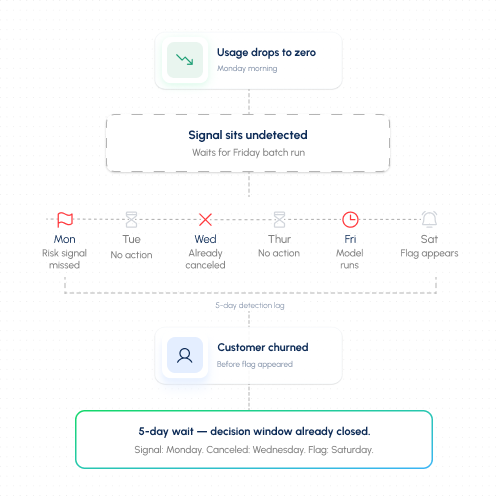
Churn models run on batch schedules. Customers showed risk signals Monday. Model runs Friday. Customer success reviews next week. Customers have already canceled Wednesday. Signals existed. Nothing acted on them in time to prevent the churn.
Why At-Risk Customers Churn Before Teams Can Act
Models Run on Batch Schedules

What Happens: Churn models process data weekly or daily, not real time. Risk signals appear immediately but detection waits for the next run.
Real Scenario: Customer usage drops to zero Monday morning. Churn model runs Friday night. A flag appears on the dashboard on Saturday. Customer success sees it Monday. The customer already canceled their subscription on Wednesday afternoon.
Signals Don't Trigger Action
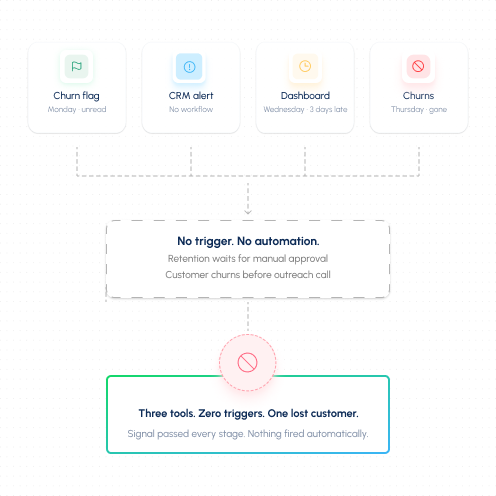
What Happens: At-risk customer flags appear in dashboards and CRM. Nothing automatically triggers. Retention workflows wait for manual review and approval.
Real Scenario: Model flags customer as high churn risk. Alert sits in CRM waiting. Customer success checks the dashboard three days later. Schedules outreach for next week. Customer churns before the outreach call.
Retention Arrives Too Late
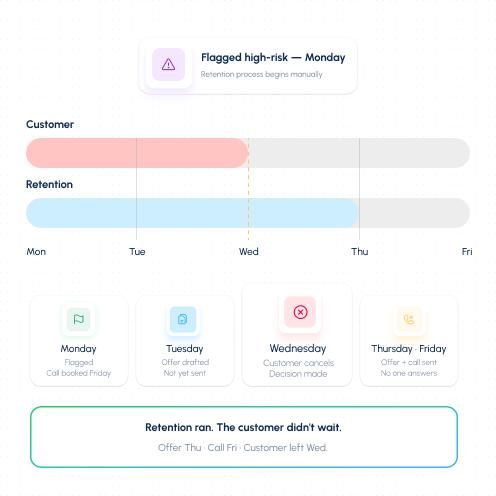
What Happens: Even when at-risk customers are identified, retention offers and outreach execute days later. Customers already decided to leave by then.
Real Scenario: Customers flagged as high churn risk on Monday. Customer success schedules retention calls for Friday. Personalized offer drafted Thursday. Customer cancels Wednesday. Retention actions arrive two days after the decision.
How We Fix It
AI detects churn in real time and triggers retention workflows instantly.
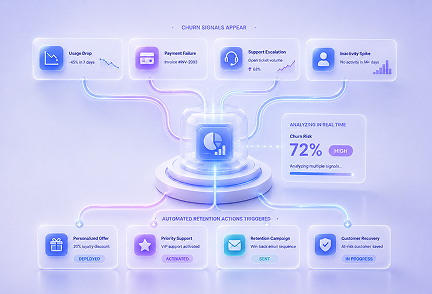
Churn Signals to Real-Time Detection
What We Build
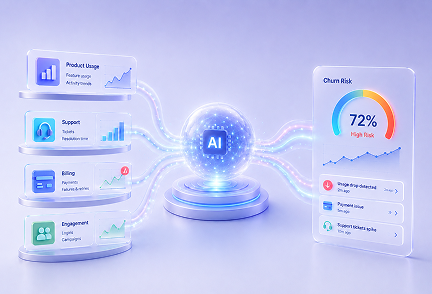
A unified data layer connecting product usage, support, billing, and engagement signals for continuous churn detection using AI.
How We Build It
- Map churn signals across product usage, support tickets, billing, and engagement patterns
- Connect all signal sources into one unified stream so AI evaluates churn risk continuously
- Build real-time data flows so usage drops, payment issues, and support spikes update live
Instant Retention Response
What We Build
AI-driven workflows that detect at-risk customers and trigger retention actions automatically within minutes of churn signals appearing.
How We Build It
- Detect at-risk customers in real time as churn signals appear, not waiting for batch runs
- Trigger retention workflows automatically when churn risk crosses threshold without review
- Deploy personalized offers, priority support, and campaigns within minutes of detection
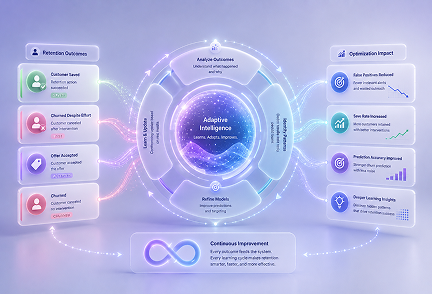
Churn Prevention Performance
What We Build
A continuous learning system using AI to track which retention interventions work and improve prevention effectiveness over time.
How We Build It
- Track which retention actions prevent churn and which customers cancel despite efforts
- Surface which churn signals predict actual churn versus which create false positives
- Build feedback loops improving retention effectiveness based on save rates and patterns


What You Get
Churn detected in real time. Retention triggered instantly. Customers save before they cancel.
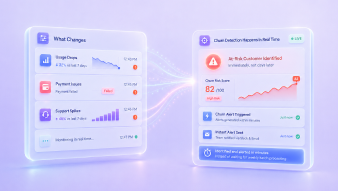
Churn Detection Happens in Real Time
At-risk customers identified immediately, not days later.
Usage drops, payment issues, and support spikes trigger churn alerts within minutes instead of waiting for weekly batch processing.
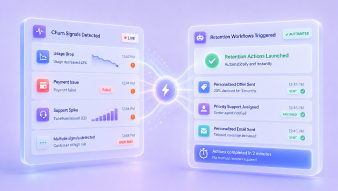
Retention Workflows Trigger Automatically
Churn signals launch retention actions without manual review.
High-risk customers receive personalized offers and priority support automatically instead of alerts sitting in dashboards for days.
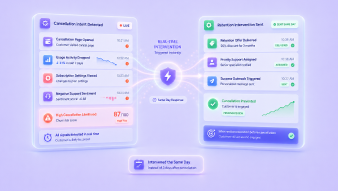
Intervention Happens Before Cancellation
Retention actions execute while customers are deciding, not after.
Customers receive retention offers the same day churn signals appear instead of three days after they already canceled.
Enterprise AI Products for Secure, Governed Adoption
Enterprise-ready AI products that standardize access, enforce compliance, and keep AI usage aligned across the organization.
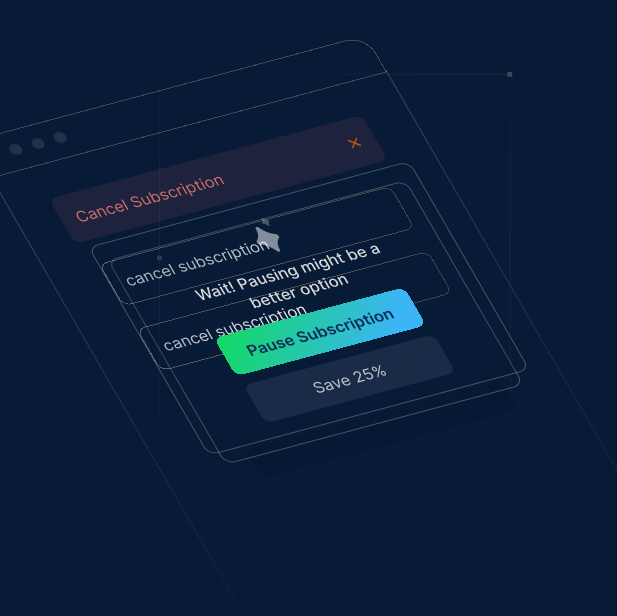
Secure, governed AI adoption across enterprise.
Secure every AI request with encrypted routing and policy guardrails to prevent sensitive data exposure. Role-based access, model routing, and audit trails ensure AI use remains secure and compliant.
Book a Demo →Deploy One AI Use Case. Replicate the Pattern.
Identify the problem worth solving. Build real-time infrastructure. Deploy with controls. Scale the pattern everywhere.
Start with a Bootcamp

Bootcamp
 (5 Days)
Prove one high-value AI use case
A 5-day engagement focused on one AI opportunity: personalization automation, demand forecasting, churn prevention, or another high-ROI problem.
Data readiness assessed. Use case validated against business impact. Feasibility confirmed using your actual data and systems. Pilot demonstrates a working AI solution.

Launchpad
(60 Days)Production with MLOps and governance
The AI model moves live with monitoring infrastructure. Performance tracking catches degradation. Retraining triggers automatically when accuracy drops.
AI governance layer activates. LLM usage routes through controls. Data leakage prevention enforces. Your teams operate the model daily.

Rollout
Extend pattern to additional use cases
The same MLOps and governance infrastructure supports new AI models. Each deployment takes less time because monitoring, governance, and data foundation already exist.
Personalization extends to new channels. Forecasting adds product categories. Churn prevention covers additional customer segments. Pattern replicates systematically.
Digital OS
All AI operations centralized
All AI models operate from single control layer. Performance monitors continuously. Governance enforces automatically. Retraining happens without manual intervention.
New models deploy in days using existing infrastructure. AI operations become self-service. Vendor dependencies eliminated.
Real-World AI Problems.Real Execution.
Practical behavioural intelligence execution across journeys, systems, and campaigns without replatforming.
View Case Study
Campaigns respond to live intent, not static segments.
Real-time digital behavior fed into the campaign engine enabled journeys to react to actions, recover drop-offs, update segments, and adjust offers via interactions.
Turn AI Pilots into Production Systems
Monitoring for every model. Governance for every request. Automation for every workflow. Your systems running it.
Built with Enterprise-Grade Partners
20 years building on Adobe, Salesforce, IBM, HCL, SAS, and Microsoft. We know how to make them work as one system.








Customer Endorsements
"The Xerago team demonstrated exceptional execution across analytics, AI-driven decisioning, and experience platforms. Their ability to orchestrate complex use cases across AEP, CJA, and Target on a single experience layer showed real maturity in applying AI and data to solve business problems."
— Head of Digital Experience & Intelligence, Enterprise Telecom Client
Perspectives on AI at Scale
Insights from deploying, monitoring, and governing AI across industries and use cases.

Why AI Sentiment Models Fail Without Context
How raw sentiment scores fall apart without behavioral, journey, and decision-layer integration.
Read article
Why Analytics Foundations Decide AI Success
AI initiatives break when data quality, consistency, and observability aren’t production-ready.
Read article
GA4 vs Adobe Analytics for AI-Ready Measurement
Which analytics model better supports AI-driven decisions, predictions, and orchestration.
Read article