

Using Adobe RTCDP to drive customer engagement in insurance industry in a third party cookieless world!
Authored by Ram Prabhakar
Published: May 23, 2024 | Updated: July 14, 2025
Introduction
While Google has recently announced its third-time delay in third-party cookie deprecation on its browser, citing regulatory challenges and insufficient industry readiness, the big shakeup in the world of digital marketing has already been happening.
As the browser companies strive to come up with a solution that balances both ad efficiency and user privacy, businesses cannot remain passive and go with the flow but must explore alternative tracking options. Why? While this change fosters a more privacy-focused online environment, it presents a significant challenge for insurers, who have traditionally relied on cookie data for personalized communication and customer experience.
According to PwC's Annual Global CEO Survey 2023, insurance CEOs are already concerned about financial exposure to inflation (51%), economic volatility (37%), and cyber risks (30%) in the upcoming year. Thus, indeed, this quiet earthquake of third-party cookies deprecation has pushed insurance companies to focus vigorously on collecting first-party data. Not just that, marketers are bending over backwards to successfully survive this big void from server-side tracking to contextual tracking. However, the status quo is no cookies, less or siloed data, and fewer insights.
This is where Xerago views Adobe RTCDP as a trustworthy solution that can empower insurance companies to build more data-rich audiences and data-backed communication that foster stronger customer experiences and relationships.
"Customers are dynamic. Sometimes connected. Sometimes dormant. Sometimes active. You can't blindly target everyone with same message"
Ram Prabhakar, Head of Solutions and Content, Xerago
The cookie conundrum: A World without Third-Party Cookies for Insurers
Traditionally, insurers relied on third-party cookies to gain valuable insights into customer behavior. These cookies tracked users across different websites, enabling insurers to:
Segment policyholders: Segment policyholders based on demographics, browsing habits, app usage, and online behavior. It, in turn, allowed for targeted marketing campaigns, such as offering health insurance to fitness enthusiasts who received gym memberships online or had shown notable engagement with fitness-related content.
Tailored Targeting: Provide personalized content and ads. For instance, an insurance company can offer home insurance estimated coverage to users who have recently visited real estate websites, targeting those who are likely in the process of purchasing homes.
Campaign Measurement: Evaluate the success of marketing efforts built with cookies by measuring click-through rates and conversion rates.
However, with third-party cookies fading away, this approach becomes significantly limited.
*According to a* survey *conducted by Acxiom and Arizent that polled senior Insurance executives about their reliance on third-party cookies and what made them scary of cookie deprecation,*
*18% mention Data management issues*
*9% say Poor customer experience*
*4% state Tracking and measurement*
*9% say Retargeting and acquisition*
*14% mention Loss of business*
Insurers can collect first-party data directly via website visits and insurance applications though. Still, this data often lacks the richness and depth needed for effective segmentation and communication.
Here are the reasons why Xerago thinks relying solely on first-party data falls short:
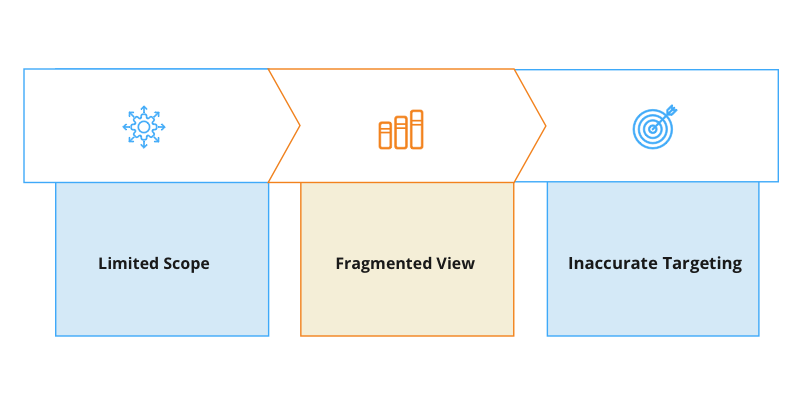
- Limited Scope: While first-party data provide a glimpse of a customer's interaction with specific touchpoints, it fails to provide broader picture as offered by third-party cookies.
- Fragmented View: As it is mentioned in the above survey results, management of customer data is the predominant issue insurance industry worry about. With data often residing in siloed systems like CRMs, websites, and mobile apps, gaining a holistic understanding of individual customers becomes unimaginably hard without unification.
- Inaccurate Targeting: When comprehensive view is not in place, targeting becomes less precise, which is likely lead to result in irrelevant communication and a bad customer experience.
In essence, the cookieless future demands insurance brands have a more strategic approach. That is, you need to move beyond fragmented data sets and build a unified customer profile for personalized data-backed communication even in the absence of third-party cookies.
How Adobe RTCDP Can Help Insurers Build Data-backed Communication in a Cookieless World
The main objective or hurdle for marketers without cookies is to identify anonymous visitors and transform them into known customers.
Considering the market is currently oversaturated with IDs, the need of the hour is not bombarding the market with new ID solutions but a system that stitches various identities into a single customer profile.
For an insurance company like yours, to drive customer intelligence and make impactful communication, leveraging the best of the available first-party data is critical. But having the ability to collaborate with partners to access their first-party data (your second-party data) in a privacy-focused way can enrich the understanding of your current high-value customers and future prospects.
Recognizing the importance of this situation, Adobe has built a solution with privacy at the forefront.
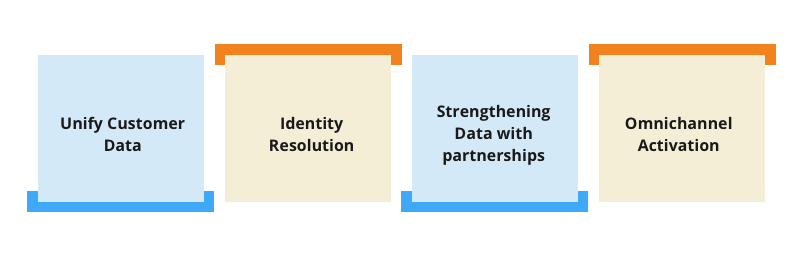
Unifying Customer Data: Building a 360-Degree View
Centralized Data Hub:
Although brands swim in the first-party data, unification is the key to make the real sense of it. In that regard, Adobe Real-time CDP can serve as a centralized repository for insurance companies to collect and unify first-party data in real-time from various sources such as websites, mobile apps, CRM system (policyholder information, claims history), Offline interactions (call center conversations, agent notes).
Data Transformation and Standardization:
Adobe RTCDP takes a multi-step approach to ensure all incoming customer data, regardless of source is clean, consistent, and ready for analysis. As part of this process, it removes duplicates and errors, then standardize its format for seamless integration. Finally, RTCDP categorize attributes, implement business rules, and potentially adjust data elements. This crucial step empowers insurers to build a comprehensive understanding of their policyholders and gain meaningful insights without traditional cookie identifiers.
Identity Resolution: Connecting the Dots without Cookies
Here are a few ways Adobe RTCDP resolves identity challenges and unifies customer data, thereby equipping insurers with a powerful foundation for developing data-driven communication strategies in the cookieless world.
Recognizing Faces:
By utilizing identifiable information like login credentials, email addresses, and phone numbers of users that have been collected with their consent, RTCDP, using deterministic identifiers, instantly links anonymous user data to existing customer profiles. It ensures accurate connections and enables insurers to recognize faces and build personalized experiences based on known customer preferences and histories.
Predicting customer signals:
RTCDP uses smart programs to decode the user's identity. By analyzing data through advanced algorithms, it can identify patterns and relationships between unknown users and known customers. This way, it makes valuable guesses about the anonymous user's identity, their demographics, and their potential insurance needs with high accuracy. It, in turn, allows insurance companies to connect with these potential customers confidently.
Building strong customer bridges:
To tackle the incompleteness of anonymous profiles, RTCDP facilitates the art of progressive profiling. With this, insurance companies can encourage users to voluntarily share more information through website forms, app interactions, or email preferences, which are typically non-sensitive details, and offer value in return. As users show interest in engaging further, you can ask for more specific details, take a progressive approach to building a profile, and slowly build a richer customer profile over time. It will significantly help insurers deliver targeted messages about relevant insurance options and enhance customer experiences.
Strengthening Data: Partnering for success and Enhanced Insights
Collaborative Data Expansion:
Adobe Real time CDP facilitates partnering with entities like financial institutions and health providers. This allows insurers to access partner-sourced prospect profiles and supercharge first-party data while maintaining highest levels of privacy and security for data. Such partnerships is significant for building trusted ecosystem without cookies, aiding in targeted marketing efforts.
Enhanced Customer Insights:
The enrichment of customer profiles enables insurers to improve risk assessment capabilities and facilitates tailored product recommendations. By making use of overlapped segment metadata from partners, insurers can gain a deeper understanding of customer needs and preferences even without third-party cookies, leading to more accurate risk evaluations, data-backed communication and deliver an customer experience to the last mile.
Targeted Acquisition:
As partner data fuels data-driven prospecting initiatives, insurers can reach net new potential customers who share characteristics as existing policyholders. RTCDP's analytical tools further enable insurers to segment prospects effectively. Built on a foundation of trust, it paves the way to predict the next step of the users, build the privacy-centric acquisition strategies that are aligned with specific customer segments, ensure transparent communication and increase the overall effectiveness of acquisition efforts.
Omnichannel Activation with Destinations: Delivering the Right Message at the Right Time
RTCDP plays a pivotal role in enabling insurers to deliver the right message to the right audience at the right time across multiple channels through its "Destinations" feature:
Targeted Advertising:
Insurers can utilize RTCDP's pre-built integrations with advertising platforms, such as social media, Connected TV, and audio channels, to reach high-value audiences precisely without relying on stale and outdated third-party cookies. This capability ensures that your message resonates with the intended audience, ensuring compliance with privacy regulations and enhancing campaign effectiveness.
Person and Account-Based communication:
Adobe real-time CDP paves way for Insurance companies to deliver tailored communications and campaigns for specific individuals or entire household. For example, let's suppose a logged-in customer has booked multiple international trips with family online in recent months. In this case, RTCDP can analyze this browsing data and recommend travel insurance options for the specific persons or entire family. This approach not only meets the customer's specific insurance needs but also boosts engagement and relevance, leading to better response rates in a cookieless environment.
Wrap Up
Although Google pushes third-party cookie deprecation in its browser to early 2025, it is only a temporary reprieve for insurance companies. Undeniably, it is good news for the digital world, as it gives companies more time to experiment and prepare for the world without cookies.
It is apparent that the regulatory landscape surrounding data privacy is constantly evolving. Regulations like GDPR and CCPA get more stringent and keep setting new standards for user consent and data protection, emphasizing the importance for insurers to embrace a customer-centric targeting approach that values data privacy and builds trust with customers. Indeed, long-worked strategies will eventually lose their effectiveness.
Xerago concurs that the shift from third-party cookie dependence to first-party data is challenging. But remember, the worst still is the struggle to make the best of available first-party and second-party data. And to this end, Adobe RTCDP stands out as a future-proof solution for the insurance industry. It is time to adjust to this new reality, recalibrate your strategies, invest in Adobe RTCDP, glean meaningful insights from your pool of data, and build data-backed communication in the world without cookies.



Global Office Locations



#901, 9th Floor , Ellora Fiesta.
Plot No - 8 , Sector - 11 , Sanpada.
Opp. Juinagar Rly Station.
Navi Mumbai – 400 705

Xerago Towers, Plot 80 & 93,
Industrial Estate, Perungudi,
Chennai, Tamil Nadu - 600096
Office No. 26, 10/F, Beverley Commercial Centre,
87-105 Chatham Road South, Tsim Sha Tsui, Kowloon,
Hong Kong